The Exact Roadmap I’d Use to Launch an MVP in 30 Days (Without Wasting a Single Week)
Let’s be honest.
Most founders don’t fail because they move too slowly.
They fail because they move blindly.
They build too much, too early, in the wrong order — then wonder why motivation dies, users don’t care, and momentum disappears.
A 30-day MVP is not about speed for ego.
It’s about sequence.
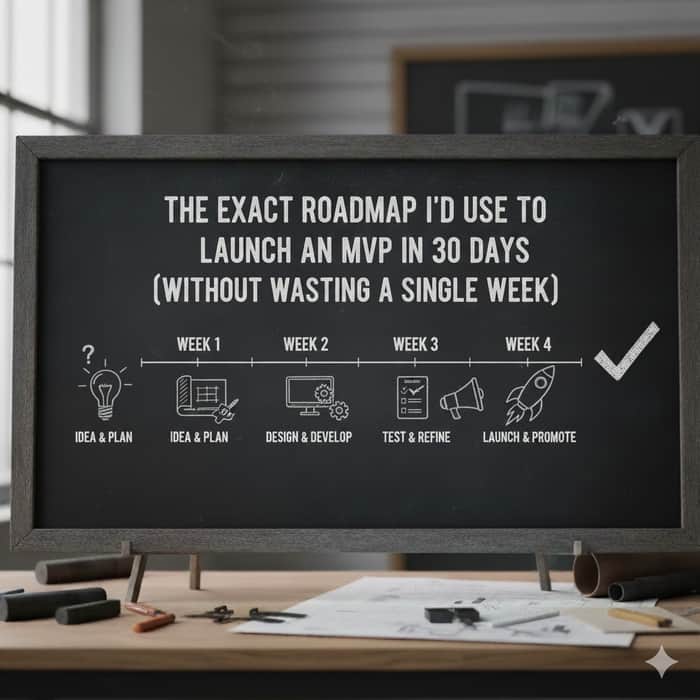
Below is the exact roadmap I’d use — again and again — to turn an idea into a real, testable product in 30 days without burning time, money, or energy.
If you follow this properly, you don’t just ship.
You learn faster than everyone else.
First: What an MVP Is NOT
Let’s clear the poison first.
An MVP is not:
A smaller version of your dream product
A half-baked app
A feature dump with bugs
Something you’re embarrassed to show
A real MVP is:
The fastest possible version of your product that can prove whether people actually care.
If your MVP doesn’t answer real questions, it’s not an MVP — it’s busy work.
The Only 3 Questions Your MVP Must Answer
Before touching design or code, your MVP must answer at least one of these:
-
Do people have this problem strongly enough to act?
-
Will they change behavior to solve it?
-
Will they pay (with money, time, or attention)?
Anything not directly answering one of these gets cut.
Ruthlessly.
The 30-Day MVP Roadmap
WEEK 1: Idea Compression (This Is Where Most Fail)
Goal:
Turn a vague idea into a sharp problem statement.
What Founders Usually Do (Wrong):
Brainstorm features
Look at competitors endlessly
Overthink positioning
What Actually Works:
You define ONE painful moment.
Not a market.
Not a persona.
A moment.
Example: ❌ “A productivity tool for freelancers”
✅ “Freelancers forgetting client follow-ups and losing money”
That moment becomes your entire product focus.
The Problem Compression Exercise
Answer this in one sentence:
“People feel ___ when ___, and they want ___ without ___.”
If you can’t finish this sentence cleanly, you’re not ready to build.
Clarity here saves months later.
WEEK 2: MVP Definition (Cutting Is the Skill)
Goal:
Decide what NOT to build.
This week is uncomfortable because it forces tradeoffs.
You define:
One core action the user takes
One outcome they get
One reason they return
Everything else is noise.
The MVP Feature Filter
For every feature, ask:
-
Does this prove the problem exists?
-
Does this help the user act immediately?
-
Would removing this break the product?
If the answer isn’t yes to at least two — it’s gone.
This is where founders overbuild because they’re emotionally attached.
Execution requires emotional distance.
WEEK 3: Build the Smallest Working Truth
Goal:
Get something real in users’ hands.
This is where most founders freeze — especially non-technical ones — because uncertainty peaks.
But here’s the truth: You don’t need perfect architecture. You need feedback velocity.
The MVP should feel:
Clear, not complete
Focused, not flashy
Useful, not impressive
Ugly products with clarity beat beautiful products with confusion.
Every time.
What Matters During Build
Not:
Tech stack debates
Scalability fantasies
Edge cases
What matters:
Can users complete the core action?
Do they understand it without explanation?
Do they want to do it again?
That’s it.
WEEK 4: Launch for Learning (Not Validation)
This is where mindset decides outcomes.
Your first launch is not to:
Go viral
Make money
Impress Twitter
It’s to observe behavior.
What users do matters far more than what they say.
What to Measure (Early On)
Forget dashboards.
Watch for:
Do they come back?
Where do they get stuck?
What confuses them?
What do they try to do instinctively?
Confusion is data. Silence is data. Drop-off is data.
If you’re listening, the product tells you what to fix next.
Why Most Founders Can’t Do This Alone
This roadmap sounds simple.
It’s not.
Because founders:
Overthink decisions
Struggle to cut features
Build emotionally
Delay hard choices
Speed requires detachment.
That’s why founders who ship consistently usually have:
External execution help
A clear product process
Someone saying “cut this”
Not cheerleaders.
Operators.
The Real Advantage of a 30-Day MVP
It’s not the product.
It’s the position.
Once something is live:
You stop guessing
You stop arguing with yourself
You stop building in the dark
You move with intent.
That’s how real products are born.
If You’re Serious About Shipping
If you:
Have an idea you believe in
Are tired of planning loops
Want clarity instead of theory
Then your next move shouldn’t be another article.
It should be a focused conversation.
I help founders turn ideas into lean, testable MVPs — fast — without overbuilding or wasting months.
📩 Email me at: quratulaincreatives@gmail.com
Tell me:
What you’re building
Where you feel stuck
I’ll tell you honestly:
What to build
What to cut
And whether this can move in weeks instead of months
No pressure.
No fluff.
Just execution clarity.

Solid breakdown. One thing I’ve noticed with 30-day MVP roadmaps is that the order matters less than whether there’s a moment of real-world exposure early.
Curious — in your roadmap, what’s the earliest step where a real user can react to something concrete (even if it’s rough)?
I’ve found that one interaction often collapses weeks of uncertainty faster than perfect sequencing.