The First Wave of AI Agent Companies Sold Automation. The Second Wave Will Sell Management.
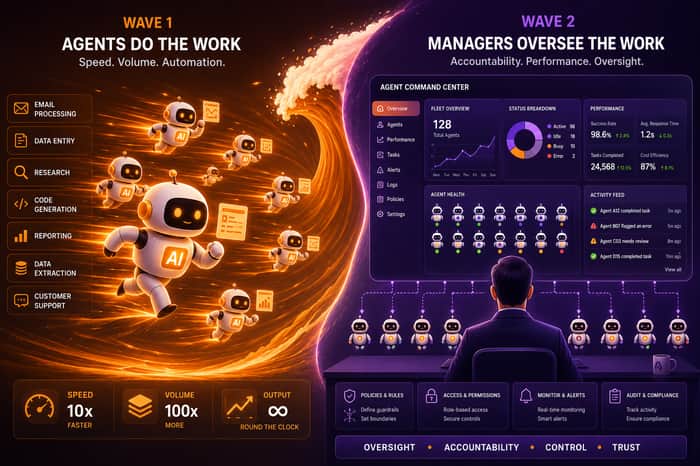
Everyone building AI agents right now is racing to answer 'look what it can do.' The buyers asking the next question — how do I supervise 500 of them — don't have a product yet.
The pitch that sells AI agents today is capability. Speed. Volume. Automation. 'Your sales agent will qualify leads at 3 a.m.' 'Your support agent will close 70% of tickets without a human.' The demo is impressive, the ROI math is easy, and the buying decision feels obvious.
That pitch works right now because most enterprise buyers are still on agent number one or agent number two. The question dominating their thinking is whether the agent does the job well enough to replace the process they had before.
But there's a second question coming. And nobody has really built for it yet.
buyer_journey.log
$Year 1 // 2–5 agents in production
→ 'Can the agent do the job?'
→ 'Is the output accurate enough?'
→ 'What's the ROI vs. the old process?'
$Year 2–3 // 50–500 agents in production
→ 'Who owns each agent?'
→ 'How do I know when one goes off-script?'
→ 'What's my offboarding process when a model gets deprecated?'
→ 'How do I review agent performance across departments?'
The second set of questions doesn't have good answers yet. Not because the industry hasn't thought about them — but because the companies asking them in earnest are only now reaching the scale where they become urgent. The market is right behind them.
// the gap between two pitches
Wave 1 — now
'Look what the agent can do.'
Capability demos and benchmark comparisons
ROI calculators vs. headcount
Speed, accuracy, always-on uptime
Per-use-case deployment playbooks
Sold to: engineering, operations, early adopters
Wave 2 — forming
'How do I run 500 of these?'
Agent ownership and accountability mapping
Performance monitoring across a fleet
Behavioral drift detection over time
Deprecation and offboarding workflows
Sold to: HR, ops, finance, legal, C-suite
Notice the buyer shift in that second column. The people buying Wave 1 products are builders — they want capability and control at the code level. The people who will be buying Wave 2 products are operators — they want visibility, accountability structures, and the ability to manage a digital workforce the same way they manage a human one.
That is a completely different product category. It's not an extension of the agent platform. It's a management layer that sits on top of everything.
And here's the part worth sitting with for a minute: the closest analogy isn't AI infrastructure. It's human resources infrastructure.
// the analogy that reframes the market
When organizations started hiring at scale in the early 20th century, a whole industry emerged around managing that workforce. Payroll software. Performance management systems. Org chart tooling. Compliance tracking. Onboarding platforms.
None of those companies were in the business of making workers more capable. They were in the business of making the organization more capable of managing workers.
That's the category that doesn't exist yet for AI agents. The companies that build it won't be competing with OpenAI or Anthropic. They'll be competing with Workday.
Most indie hackers thinking about AI right now are building in Wave 1 — and that's fine, there's a lot of market left there. But the builders who are paying attention to where enterprise anxiety is heading will see something interesting: every company deploying agents at scale is independently inventing the same internal tooling to answer those Year 2 questions. They're building it in Notion docs and spreadsheets and internal dashboards that nobody outside the company ever sees.
That's how you know a real product category is forming. When ten enterprise teams are solving the same problem with duct tape, someone is about to raise a Series A to solve it cleanly.
The question that creates the category is not 'what can this agent do?' It's 'who is accountable when it does something wrong?'
The second question is harder. It doesn't have a good technical answer — it has an organizational answer. And organizational answers require organizational products. That means user roles and permissions structures designed for managers, not engineers. Reporting dashboards built for operations leads, not developers. Audit workflows designed for legal and compliance teams who have never written a line of code and never will.
That's the unlock. Not a better agent. A better way to run a team of agents — where 'run' means the same thing it means when you're talking about running a team of people.
Wave 1 companies are selling automation. They're right to. The market is there and the timing is good. But the companies building now that will look obvious in four years are the ones building the infrastructure for what comes after the automation lands — the management layer, the accountability layer, the workforce visibility layer for a world where the digital workers outnumber the human ones inside the org chart.
Not workforce replacement. Workforce management. That's the next market. And it's wide open.

This framework maps to what I am seeing on the ground. The teams that deployed 2-3 agents last year are now hitting the supervision wall. They are building Notion docs to track which agent does what, manual review loops to catch drift, and spreadsheets for token attribution per department. Every one of them is reinventing the same management layer independently. The workforce analogy is exactly right. The companies that build agent management tooling with HRIS-level structure will be the ones that win the next cycle.