The Google SRE Interview Has Evolved. Here's the 2026+ Playbook.
Hey Indie Hackers,
For the last few months, I've gone deep into a single question: Why do so many talented engineers fail the Google SRE interview?
After reviewing hundreds of interview experiences and talking to people in the industry, the answer is clear: the free resources out there are a chaotic mess. They're either outdated, too generic, or just plain wrong about what Google actually tests in 2026+.
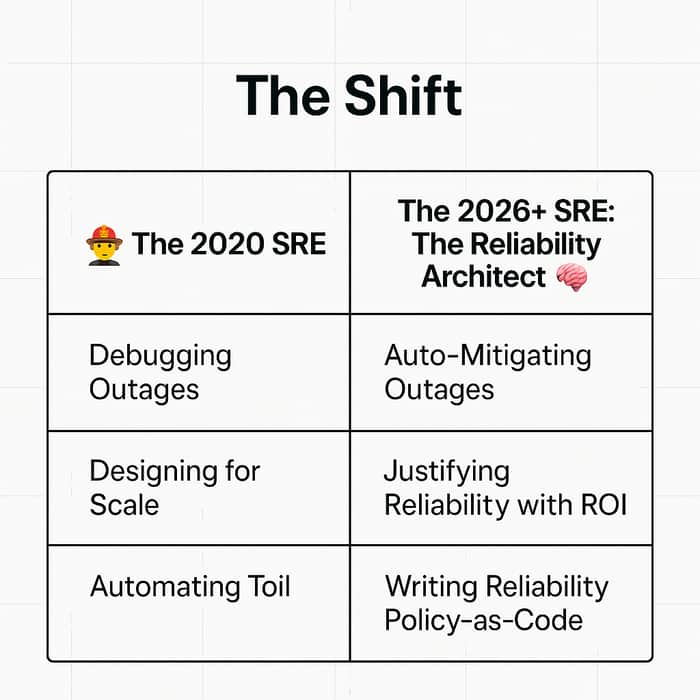
The modern Google SRE loop has evolved. It's no longer just about LeetCode and drawing boxes. It's a test of judgment under pressure, focusing on things like:
- eBPF-powered observability
- Production-grade debugging (not just theory)
- Cost-aware SLOs and FinOps thinking
- AI-augmented operational tooling
I realized there wasn't a single, cohesive system to prepare for this. So, I decided to build it. This post is a summary of my findings—the "missing manual" for the modern Google SRE interview.
SECTION 1 — What Google Actually Tests (The Hidden Framework)
Forget the vague lists of topics. The interview is designed to test five core dimensions of your mindset:
- Reliability Mindset: Can you make the right tradeoffs when everything is on fire? (Safety vs. speed, SLOs vs. feature pressure).
- Systematic Reasoning: Can you debug an unknown system without guessing? (Hypothesis -> test -> observe loops).
- Production Safety & Automation: Do you build systems that eliminate human error and "heroics"? (Guardrails, defensive engineering).
- Distributed Systems Judgment: Can your design survive Google-scale failure modes? (Backpressure, consistency models, disaster recovery).
- Communication Under Stress: Can you lead an incident calmly and clearly?
Every question, from coding to system design, is a window into one of these five areas.
SECTION 2 — The Modern Google SRE Interview Loop (2026+)
Here's the most accurate, up-to-date breakdown of the full loop:
- Recruiter Screen
- Technical Coding (Practical Python/Go, not abstract algorithms)
- Systems Design (SRE-flavored, failure-mode centric)
- Troubleshooting & Incident Handling (A live "war-room" simulation)
- NALSD (Non-Abstract Large System Design): The infamous "seniority filter" round.
- Behavioral / Leadership / Googliness
- Final Hiring Committee Review
SECTION 3 — The Real Interview Questions & Patterns (Updated for 2026+)
These aren't just question dumps. These are the archetypes Google uses to test the signals mentioned above.
A. The SRE Coding Round (Python/Go)
Google's coding questions are about building tools, not solving puzzles. Expect to:
- Parse a 10GB log file to find the top N failing endpoints (tests streaming).
- Implement a token bucket rate limiter (tests concurrency safety).
- Write a script to monitor a resource (e.g., detect high CPU + high I/O processes).
B. The Troubleshooting / Debugging Round
This is where you're dropped into a live fire. The prompts are intentionally ambiguous:
- "The site is slow. CPU is normal. What now?" (Tests layered debugging: network, disk, queues).
- "p99 latency doubled after a deploy. Walk me through it." (Tests canary analysis, rollback logic).
- "A service can't reach its database. Root cause?" (Tests your knowledge of the full stack: DNS, TLS, firewalls, connection pools).
C. The System Design Round (SRE-Flavored)
It’s all about designing for failure.
- Design a global metrics pipeline: Must discuss cardinality explosions, backpressure, and HA ingestion.
- Design a feature flag system: Must discuss blast-radius control, auditability, and rollback safety.
D. The NALSD Round
This is where they separate the architects from the engineers. The questions are broad and strategic.
- "You're the new SRE lead for a flaky payments system — what's your 90-day plan?"
- "Google Search has inconsistent latency across regions — diagnose and fix."
E. The Behavioral / Googliness Round
It boils down to blameless culture, calm leadership, and data-driven decision-making.
- "Tell me about the most severe outage you handled."
- "Describe a time you disagreed with a SWE on a technical decision."
SECTION 4 — The Differentiator: Linux Internals
This is the biggest gap I found in existing prep materials. The modern SRE interview goes deep into the kernel. You need to be able to talk intelligently about:
- Cgroups & Namespaces
- CFS Throttling (Why does your service stutter with 50% CPU free?)
- Memory Reclaim & The OOM Killer
- eBPF, perf, and ftrace
If you can use eBPF to trace slow syscalls in a hypothetical scenario, you instantly signal that you're operating at a Google level.
SECTION 5 — The Product I Built From This Research
After realizing how massive this gap was, I spent the last few months building the system I wish I had: The Complete SRE Career Launchpad.
It's a bundle of 20+ playbooks and workbooks that covers every single topic in this post with the depth it deserves. It’s not just a guide; it’s a full-stack career system.
It includes dedicated, deep-dive playbooks on:
- Linux Internals & eBPF
- The NALS Round
- Production-Grade Coding (Python & Go Workbooks)
- Behavioral Interviews (with the SRE-STAR(M) method)
- And even a Negotiation Playbook with word-for-word scripts.
I poured everything I learned into making it the most comprehensive SRE prep material on the planet.
If you're serious about this role, you can check it out here:
https://aceinterviews.gumroad.com/l/Google_SRE_Interviews_Your_Secret_Bundle_to_Conquer
(Full transparency: this is my product, and this post is the culmination of the work that went into building it. But I've tried to make this post a complete, valuable guide in its own right.)
SECTION 6 — Final Advice: It's About Mindset, Not Memorization
The truth is, you don't get hired at Google for knowing everything. You get hired for your ability to think in a structured way under pressure.
Focus on mastering:
- Clarity and calm communication
- Reasoning about tradeoffs
- The reliability-first mindset
- Systematic, layered debugging
That's what interviewers are really looking for.
I'd love to hear your thoughts. If there are any sections here you'd like me to expand on, or if you have questions about the SRE loop, just drop a comment. I'm happy to build this out further with the community.

The evolution of SRE interviews reflects how modern systems engineering has shifted toward production reliability, scalability, observability, and operational decision-making rather than only algorithmic problem solving. That mindset is becoming increasingly important across distributed systems and Web3 infrastructure as well.