The Great Traffic Heist: Why AI is Swallowing Organic Search (And How to Fight Back)
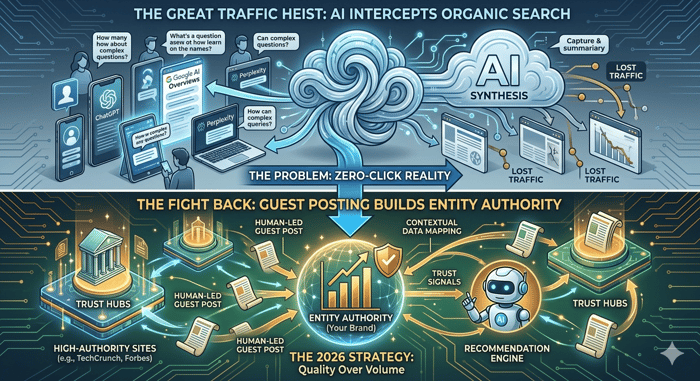
The digital landscape isn't just shifting; it’s being terraformed. The traditional "click-and-browse" era—where a user types a query, scans ten blue links, and visits a website—is dying. We are entering the age of the Zero-Click Reality.
Today, users aren't searching; they are consulting. Whether it’s OpenAI’s ChatGPT, Google’s AI Overviews, Perplexity, or Claude, the behavior is identical: ask a complex question and receive a synthesized, polished answer without ever leaving the platform. For brands, this means the organic traffic that once flowed freely is now being intercepted by AI "concierges."
The "Black Box" of AI Trust
AI models don't invent facts; they synthesize them from a massive web of existing data. However, they are inherently skeptical. To avoid "hallucinations," AI engines prioritize Entity Authority. They look for consensus across the web to verify that your brand is a legitimate, expert source.
If your expertise only exists on your own website, you are essentially invisible to an LLM (Large Language Model). You are an unverified claim. To be recommended, you need to be part of the "knowledge graph" that the AI consults before it generates a response.
Enter GEO: Generative Engine Optimization
In 2026, the focus has shifted from SEO to GEO. While traditional SEO satisfies an algorithm, GEO influences the AI’s recommendation engine. The most effective way to influence this engine is through high-quality, manual link-building and strategic guest posting.
Guest posting has evolved from a simple link-building tactic into a vital credibility signal. Here is how it forces AI to notice you:
Establishing "Neighborhood" Authority: When your brand is featured on high-authority sites like TechCrunch, Entrepreneur, or niche-specific leaders, AI notes the association. This "neighborhood effect" tells the AI that if a trusted source recognizes you, it should too.
Contextual Data Mapping: AI thrives on relationships. A guest post allows you to surround your brand name with relevant industry terminology and primary research. This creates a permanent link in the AI's "brain" between your brand and your specific expertise.
Combatting "AI Slop": In an era where the web is being flooded with generic, AI-generated filler, human-led expertise stands out. AI models are increasingly trained to detect and prioritize content that reflects real-world experience and technical depth.
The 2026 Strategy: Quality Over Volume
The old method of bulk, automated link-building is now a liability. AI systems are sophisticated enough to identify "link farms" and disregard them. One high-authority placement on a site with genuine niche relevance is worth more than a thousand low-quality links.
Effective guest posts now require:
Original Research: Sharing data that doesn't exist elsewhere.
Opinionated Insights: Taking a stand on industry trends that an AI cannot replicate.
Human Narrative: Content that reflects 2+ years of on-the-ground experience in fields like guest post outreach.
The Bottom Line
The future of search isn't about being #1 on a list of links; it’s about being the name the AI whispers in the user’s ear. By building a digital paper trail of authority across the web, you ensure that when an AI looks for an answer, it finds your brand—vouched for by the most trusted voices in the industry.
Are you ready to stop being a destination and start being the source?

I’ve been seeing the same shift, and the part that hits hardest for me is how picky these AI models are about what they trust. I’ve had way better results getting picked up once I focused on fewer but stronger mentions on sites that already have clout. Cheap links feel like shouting into the void, but real context and real expertise seem to stick in the models’ memory a lot longer.
I’ve been seeing the same shift, and the part that hits hardest for me is how picky these AI models are about what they trust. I’ve had way better results getting picked up once I focused on fewer but stronger mentions on sites that already have clout. Cheap links feel like shouting into the void, but real context and real expertise seem to stick in the models’ memory a lot longer.
Exactly, that’s the key shift now.
AI systems don’t just count links anymore—they evaluate context, authority, and consistency. Fewer strong mentions on trusted sites outperform dozens of low-quality backlinks that add no real credibility.
It’s less about volume now, more about signals that actually “earn trust” over time.
I’ve been seeing the same shift, and the part that hits hardest for me is how picky these AI models are about what they trust. I’ve had way better results getting picked up once I focused on fewer but stronger mentions on sites that already have clout. Cheap links feel like shouting into the void, but real context and real expertise seem to stick in the models’ memory a lot longer.
I’ve been seeing the same shift, and the part that hits hardest for me is how picky these AI models are about what they trust. I’ve had way better results getting picked up once I focused on fewer but stronger mentions on sites that already have clout. Cheap links feel like shouting into the void, but real context and real expertise seem to stick in the models’ memory a lot longer.