The Guy Building AI That Learns From the Real World. 🌍
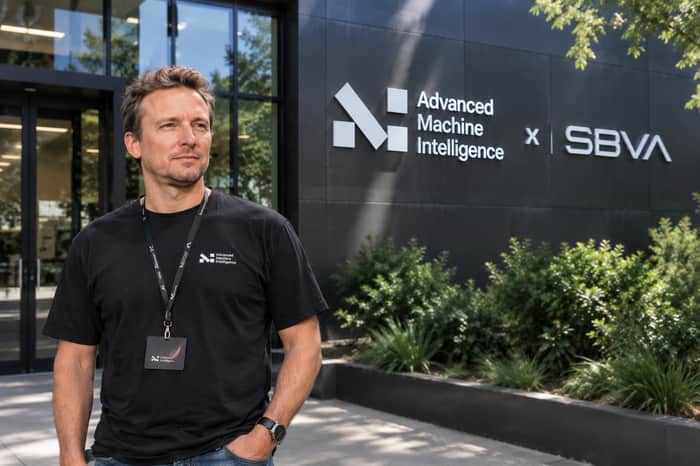
The Guy Building AI That Learns From the Real World. 🌍
Alexandre LeBrun came into this with a track record most AI founders don't have. He built Wit.ai, a natural-language platform later acquired by Facebook, then founded VirtuOz, a virtual customer service company acquired by Nuance, and later led Nabla, a healthcare AI company focused on clinical documentation. Along the way, he spent years working alongside Yann LeCun at Meta's AI research labs.
When LeCun left Meta at the end of 2025 to pursue a new research direction, he brought LeBrun in as CEO of what became Advanced Machine Intelligence, or AMI. The company launched in March 2026 with $1.03 billion in funding at a $3.5 billion pre-money valuation, operating out of Paris, New York, Montreal, and Singapore from day one. 🌐
The core bet behind AMI runs against the current of most AI headlines. Nearly every major lab is racing to scale language models further. AMI is building what LeCun and LeBrun call "world models" — AI trained on video, 3D environments, and spatial data instead of relying primarily on text. A language model predicts the next word. A world model predicts the next state of the world around it (this distinction is honestly the whole thesis lol).
The stakes here go beyond chatbots. LeBrun has pointed to robotics as one of the clearest places this matters — most robots today run fixed routines with no real understanding of context, which is part of why physical AI still makes obvious mistakes in unpredictable environments. Teaching a system to actually understand cause and effect in the physical world could change that entirely.
A few things worth sitting with here:
-
The next leap might not come from bigger language models
Real-world understanding requires a fundamentally different kind of training data. -
Reputation and trust can unlock massive early bets
Investors backed AMI on the strength of LeCun's and LeBrun's track record, before a product even existed. -
Physical-world AI is still catching up to hardware
Robots have gotten physically capable fast — the "brain" behind them hasn't kept pace yet.
The takeaway:
Sometimes the biggest opportunity isn't improving what everyone's already racing toward. It's questioning the foundation the whole industry has been building on.
What's one area where you think AI still feels "dumb" in the physical world?
That's exactly what I amplify..
Solving real audio related problems in your business..
#business #entrepreneurship #ai #amilabs #worldmodels #yannlecun #alexandrelebrun #machinelearning #innovation #technology #startups
