The hardest part of building Web3 B2B tools isn't the smart contracts—it's handling client execution without holding keys.
Hey Indie Hackers!
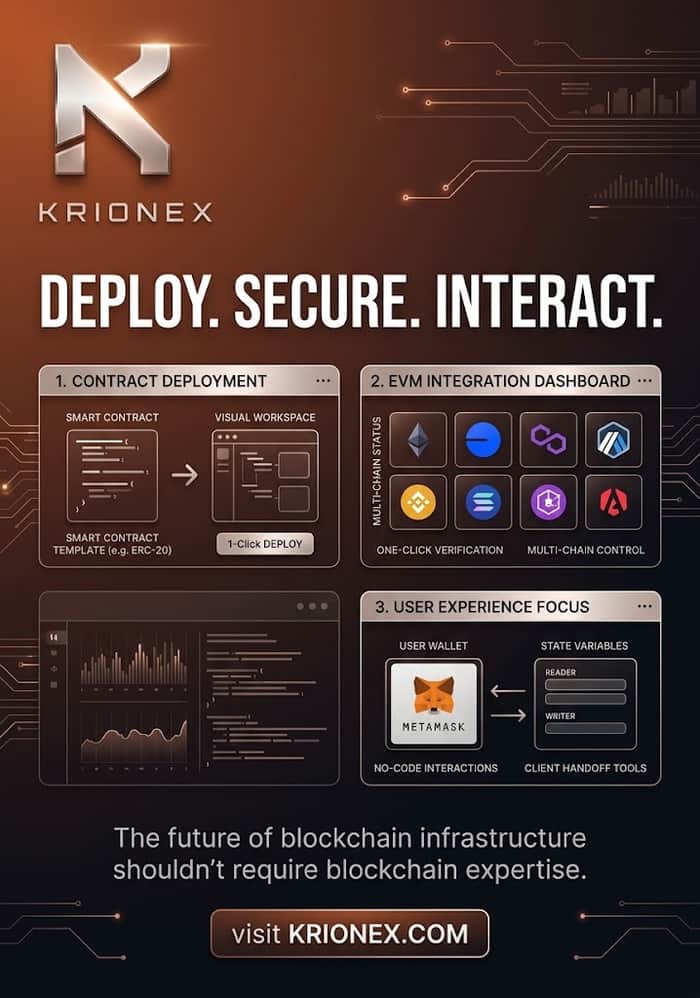
Over the past few months, we’ve been working on Krionex—a visual, non-custodial workspace for deploying, verifying, and managing EVM smart contracts.
While building for Web3 founders, development agencies, and solo builders, we ran into a core architectural dilemma that almost every Web3 SaaS faces:
The Problem:
Non-technical founders and agency account managers often need to execute basic post-deployment contract operations (like minting, pausing, or updating parameters). Currently, they either have to:
Ask a developer to run terminal/CLI commands every single time.
Paste raw ABIs directly into block explorers, which is clunky and prone to manual error.
Rely on custodial platforms that store private keys server-side—creating massive security risks.
How We Approached the Solution:
We decided to build a purely visual UI layer where every interaction is executed 100% client-side through the user’s connected Web3 wallet (MetaMask, WalletConnect, etc.). Krionex never touches, sees, or stores private keys.
Zero-Script Deployment: Select contract templates or custom code, configure variables visually, and deploy across EVM networks (Ethereum, Base, Polygon, Arbitrum, BNB Chain).
Automated Explorer Verification: Source code gets verified on block explorers automatically during deployment without writing custom verification scripts.
Visual Contract Execution: Read and write state variables directly from an intuitive dashboard instead of raw ABIs or terminal prompts.
What I’d Love Feedback On From Fellow Builders:
Onboarding & Clarity: If you check out the platform at krionex.com, is the non-custodial workflow clear, or does the technical language create friction?
Feature Priorities: For those building or working with EVM contracts, what’s the single most annoying part of your post-deployment workflow right now?
Really appreciate any honest critiques, UX feedback, or thoughts on non-custodial SaaS architectures!

The non-custodial architecture solves an obvious trust problem, but I’m more curious about the workflow outcome. Are agencies actually reducing developer handoffs for routine contract operations, or is Krionex mainly making the same execution process easier for technical users?