The 'I Need One More Feature' Trap: How to Launch Your $5k MVP with ONLY What Users Want.
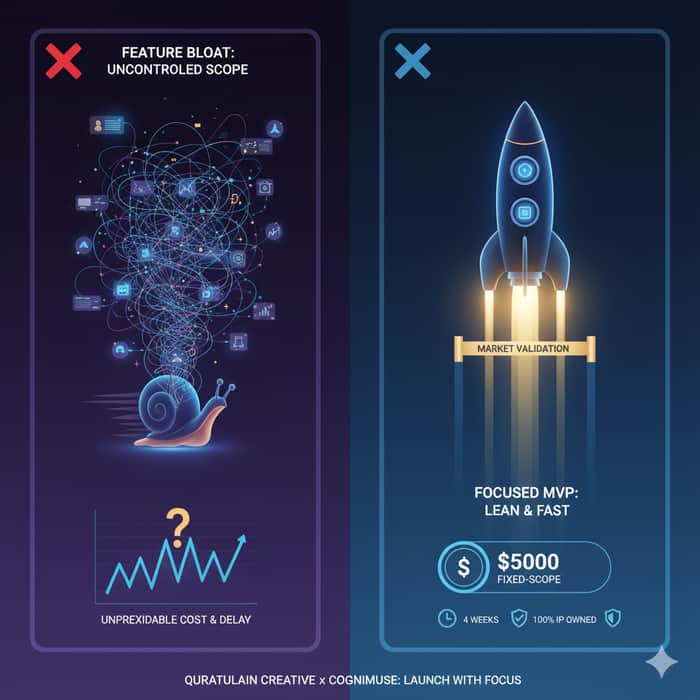
Feature creep is the silent killer of early-stage startups.
It doesn't announce itself with a bang; it starts with a founder saying, "But we also need a dashboard," or "It won't look professional without a social login." Every single added feature extends the timeline, inflates the budget, and—critically—distracts you from your core value proposition.
The result of feature bloat? A delayed, expensive product that tries to do everything for everyone and ends up failing to do anything exceptionally well.
📉 The Diminishing Returns of Over-Building
When you’re building your MVP, the goal is to validate the riskiest assumption—the one thing users must pay for or adopt.
If you spend three months building 10 features, but only one of them is the actual core solution, you have wasted 90% of your time and budget. The extra features just add noise, technical complexity, and, eventually, crushing technical debt.
The only way to avoid this trap is to enforce a minimalist boundary.
✅ How a Fixed-Price Boundary Guarantees Focus
The best way to fight feature creep is to commit to a partner and a process that is financially incentivized to keep the scope tight and focused.
This is the strategic advantage of a Fixed-Scope Retainer model, like the CogniMuse MVP Retainer (priced at $5,000).
Here’s why setting this $5,000 boundary is the most effective way to guarantee a truly Minimal Viable Product:
Financial Discipline: Since the price is fixed, both you and the development partner are highly motivated to push back against any feature that doesn't belong in the core V1. It forces you to ask: "Is this feature absolutely essential for validation?" If the answer is no, it's cut.
Hyper-Focused Scoping: The process begins with ruthless prioritization. The partner (like CogniMuse) guides you to define the single user path that delivers the core value. No distractions, just launch-ready utility.
Fast Market Feedback: By launching quickly with only the essentials, you gather real user data on what to build next. This is infinitely better than spending months building features based on pure guesswork.
Guaranteed IP Ownership: This process focuses purely on the code you need to launch, and because it’s founder-friendly, you retain 100% ownership of that clean, focused codebase from day one.
Stop chasing perfection. Start chasing validation. A clean, rapid, $5,000 MVP will always outperform a bloated, delayed, $50,000 prototype.
Lets Communicate
If you are struggling to cut features, or if your current project is already suffering from scope creep, you need expert help to simplify and accelerate.
My agency, Quratulain Creative, specializes in guiding founders to rapid-development partners who enforce the focus necessary for a successful, lean launch.
✉️ I am offering a free 15-minute MVP Scope Review to help you cut the bloat and define your launch-ready core. Email me directly to book a time: quratulaincreatives@gmail.com

The first $500 MRR is the hardest milestone because everything is manual and nothing compounds yet. The founders who get through it are usually the ones with conviction about a specific problem rather than a general vision.
What's the specific problem you're most confident about solving?
Conviction isn't the same as passion.
Passion says "I care about this." Conviction says "I've seen this break enough times that I know exactly how it fails and why current fixes don't work."
The founders who clear $500 MRR aren't necessarily more motivated. They're more specific. They can name the moment the pain happens. The day of the month. The role of the person who feels it. The workaround they're using right now that's costing them quietly.
That specificity isn't a positioning exercise. It's proof you've lived close enough to the problem to be trusted with the solution.
General vision gets investors nodding. Specific conviction gets strangers to pay.