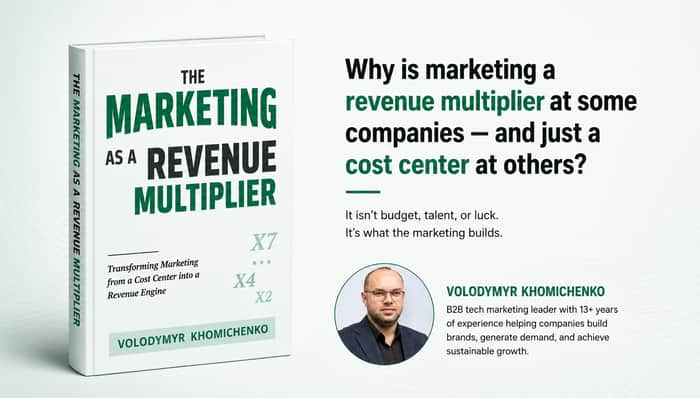
The Marketing as a Revenue Multiplier
A few months ago, I published a book called The Marketing Behind Rapid Growth. It told the stories of eighteen companies and how they grew faster than anyone expected, and I thought, when I finished it, that I had said what I had to say.
I was wrong. The book turned out to be the beginning of something rather than the end of it.
What followed was a kind of obsession. I kept studying companies — how each one found its first users, why its competitors couldn't copy it, where its growth actually came from once you stripped away the press releases — and I kept sharing what I found.
I started a podcast, telling these company stories one by one, and I started a newsletter, taking apart another company most weeks. Each company got its own post and its own episode: a single, self-contained teardown.
But with every new story, I found myself trying to do something more than tell it. I kept trying to fit them together — to see whether all these separate teardowns were pointing at the same underlying thing, and to unite them under one framework.
Week after week, company after company, the pile grew, and so did the suspicion that the real work was not another teardown. It was the synthesis.
I had studied dozens upon dozens of businesses in enough depth to argue with their own executives about how they worked; what I had not yet done was step back and draw the single map that all of them, taken together, implied.
That became the question I couldn't put down. Why do some companies turn marketing into an engine that compounds for a decade, while others — with similar budgets and arguably smarter campaigns — spend more each year just to stand still?
Every company I studied was another clue, and I had collected a great many clues without yet assembling them into an answer. The honest thing was to admit that the job was mine to do.
I had the analysis — seventy-four companies' worth of it — and what I owed anyone following along was to turn it into one thing: a single map, a single set of insights, a single framework they could actually use.
The book is here: https://khomichenko.com/marketing-as-a-revenue-multiplier/
This book is that synthesis. To build it, I had to stop adding stories and start subtracting — to take seventy-four companies and ask not what made each one special, but what they had in common, until only the durable patterns were left standing.
What survived that process is the framework these pages describe. It is not a model I invented and then dressed in examples. It is the residue of the companies themselves, the shape that remained when everything idiosyncratic was washed away.
That is what this book is: that framework, and the seventy-four companies that taught it to me.
I've tried to write it the way I wish someone had written it for me — back when I was staring at a marketing budget of my own, wondering why pushing harder on it only ever seemed to cost more and return less.
