The marketing team indie founders accidentally build (and why it breaks)
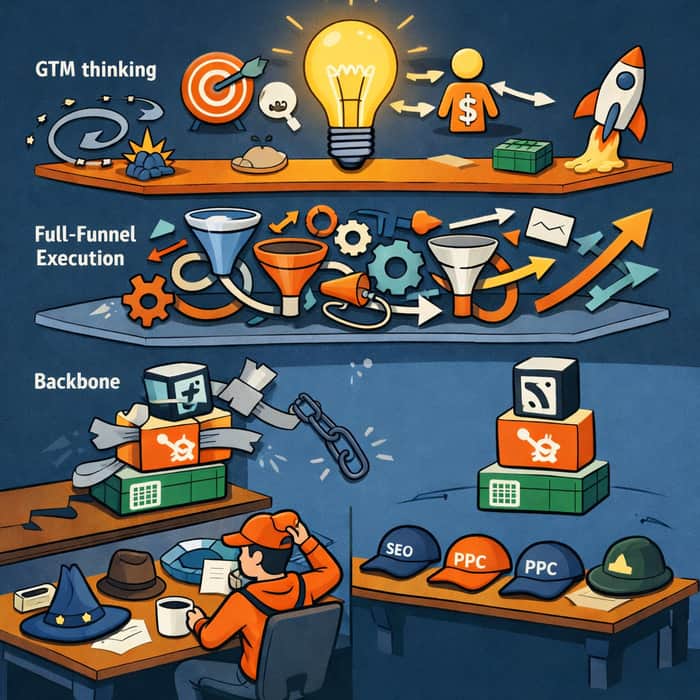
Most indie founders don’t design a marketing team.
They grow into one by accident.
It usually looks like this:
One person doing “growth”
Another writing content when there’s time
Sales doing their own thing
Tools duct-taped together in Notion, HubSpot, and spreadsheets
Everything technically works.
Nothing feels coordinated.
The problem isn’t effort. It’s that marketing is being treated as a single function when it’s actually a system of roles that pull in different directions.
The split most founders miss
Marketing isn’t one job. It’s three.
1. Go-to-market thinking
This is the “why us” layer.
Who are we actually for?
What problem do we win on?
Why should sales not talk to everyone?
If this isn’t clear, everything downstream gets noisy.
Most indie teams skip this because it feels abstract. Then they pay for it later with churny leads.
2. Full-funnel execution
This is where most of the visible work happens.
Demand capture
Content
Nurture
Launches
Campaigns
This layer only works if it’s fed clarity from the top.
Otherwise it turns into “busy but random.”
A lot of founders think they have a funnel problem.
They actually have a positioning problem.
3. The backbone (the boring but critical stuff)
No one wants to own this, but everything breaks without it.
Data that actually answers questions
Tools that talk to each other
Processes that don’t rely on heroics
This is why marketing feels fragile in small teams. One person goes on vacation and the system collapses.
Where indie teams usually go wrong
They start at execution.
“Let’s run ads.”
“Let’s publish more.”
“Let’s try outbound.”
You might get a short spike.
But without something solid underneath, marketing resets itself every few months.
New tactics. Same confusion.
What actually works at indie scale
You don’t need a big team.
You need clear ownership by layer.
One person can wear multiple hats—but they need to know which hat they’re wearing.
When you’re doing GTM work, don’t think about channels.
When you’re executing, don’t reopen strategy every week.
When things feel messy, fix the backbone—not the copy.
That separation alone removes a surprising amount of friction.
My takeaway
Most indie founders don’t need “better marketing.”
They need to stop treating marketing like a task list and start treating it like a system with distinct jobs.
Once you do that, growth stops feeling mysterious—and starts feeling manageable.
Curious how others here have structured this with a team of 1–3 people.

The 'accidental marketing team' problem is really an ops problem disguised as a people problem. The issue isn't who you hired - it's that you have no system for tracking what's working, so each person optimizes for their own channel in isolation and nobody has the unified view of which distribution activities actually drove revenue.
Solo founders hit this before they even hire anyone. The accidental marketing team is just themselves running 4 channels simultaneously with no attribution - IH comments, Twitter, email, LinkedIn - and no way to know which one is converting prospects into clients.
I've been building a Revenue Dashboard and CRM database as part of a Solopreneur OS in Notion specifically for this: every client entry has an acquisition source field. After 3 months you can see which channel actually closed, not just which generated the most activity. Turns out the channel that feels busiest (Twitter) often closes less than the channel that feels slow (email follow-ups).
The marketing team breaks when there's no shared source of truth. Whether that team is 4 people or 1 founder wearing 4 hats, the fix is the same: a system that connects distribution activity to revenue outcomes.
What's the specific breakdown you see most often - wrong channel focus, poor attribution, or something in the handoff between channels?
The accidental team breaks because there's no source of truth underneath it. Freelancers, agencies, and tools all do their part, but nobody has the same picture of who the customer is, what's been tried, what worked last quarter, what the current priorities are.
That information lives in the founder's head - which doesn't scale even to a team of one.
I've been building a Notion OS for solopreneurs (CRM, projects, decisions, revenue, client portal, weekly review) partly for this: externalizing the founder's knowledge so it can actually be handed off, referenced, or revisited. Marketing doesn't break when the context isn't stored in one person's memory.
What's the most common reason you see the accidental team fall apart?
The hardest thing about B2B is that you're often selling to someone who didn't budget for your category. They need the result you provide but never planned to pay for it.
The products that win here usually create a new budget line (by being categorically new) or steal from existing budget by making the ROI comparison obvious. Which of those are you trying to do?
The “accidental marketing team” is so accurate — it’s usually a Notion doc, a Fiverr designer, a VA for social, and the founder doing everything else in between. No one owns the narrative, so the message drifts.
The fix isn’t more people — it’s a clearer source of truth for what you’re saying and who you’re saying it to. I learned this building flompt: until I structured the messaging the same way I structure prompts (role, objective, constraints, audience), every channel said something slightly different and nothing compounded.
A ⭐ on github.com/Nyrok/flompt would mean a lot — solo open-source founder here 🙏