The more I work on cloud storage, the less I think storage is the real problem
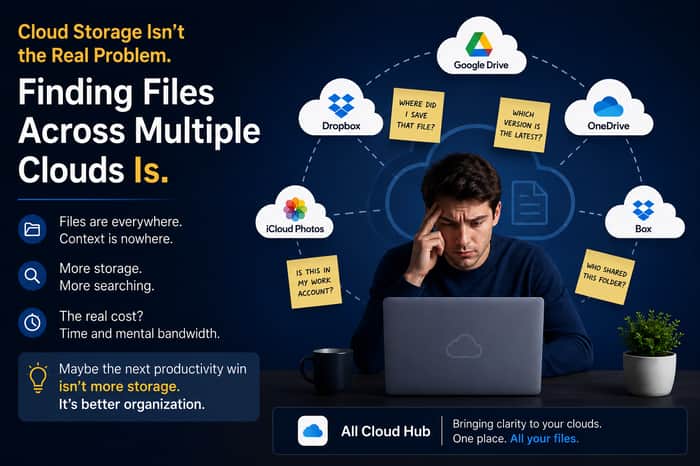
While working on All Cloud Hub, I've been reading a lot of cloud storage support threads, Reddit discussions, and user reviews.
One thing surprised me.
Very few people are actually asking for more storage.
Instead, I keep seeing problems like:
"I know the file exists, but I can't remember which account it's in."
"The latest version is on my laptop but not on my phone."
"I searched Google Drive before realizing it was sitting in Dropbox."
"Someone shared this months ago... who actually owns this folder now?"
None of those are storage problems.
They're context problems.
The more cloud services people adopt, the more mental effort goes into remembering where things live.
That made me rethink what we're actually solving.
Maybe the next productivity gain isn't another TB of storage.
Maybe it's reducing the time people spend asking themselves "Where did I put that file?"
Has anyone else noticed the same pattern, or am I spending too much time reading support forums?

Spot on. It’s the fragmented ecosystem problem. We don’t need more capacity; we need better context and aggregation. The mental tax of remembering whether a file is in Notion, Google Drive, Slack, or Dropbox is a massive hidden productivity killer. Great insight
That's what surprised me too. We often measure cloud storage by capacity or sync speed, but almost nobody measures the cognitive overhead of managing information across multiple services.
you've nailed it — context/index problem, not a capacity one. and it's not accidental: every provider is incentivized to be a silo (lock-in is their moat), so a cross-service layer is swimming upstream of their business model. that's also the opening though — lead with read-only search ("where does X live") instead of trying to be another storage layer; search doesn't threaten them and it solves the exact pain you listed. the hard + valuable part is the ownership/permission graph — "who owns this folder now" is the question nobody can answer, and whoever indexes that well has the real moat.
Managing remote teams shouldn't mean spying on them. Trackly is a productivity tracking tool built on trust, not surveillance. No micromanagement, no messy spreadsheets—just a clean, simple dashboard that keeps teams aligned and stress-free.
The ownership point really stands out. Finding a file is one thing, but understanding why you can or can't access it and who actually controls it is where workflows seem to break down. That feels much harder to solve than indexing alone because it's constantly changing as people move, rename, or reshare content.
This is a key shift in how people experience cloud tools.
The problem isn’t missing storage—it’s losing track of where something is and why it ended up there in the first place.
Once that context breaks, even perfect syncing doesn’t solve the user’s actual frustration.