The most common SEO mistake is relying on a single page website.
Every new page is a new opportunity to target and rank for a search term.
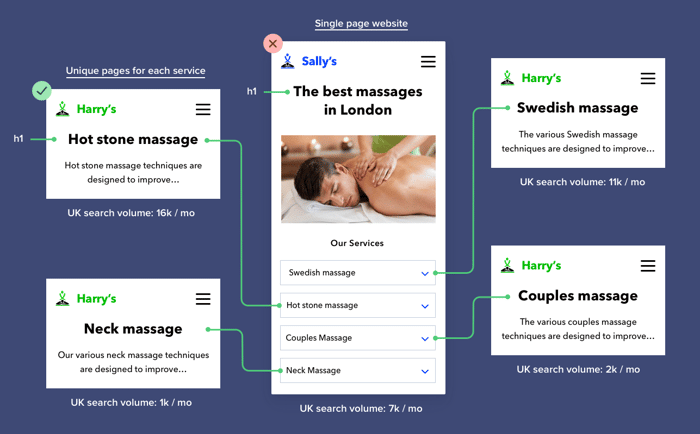
So if you’re dumping all your content on one page you’re limiting the number of search terms you can rank well for. For example, compare Harry's and Sally’s, two different massage websites (see photo)
Sally opts for a single-page website. This means she has just one page indexed by Google and can only target the “massage London” keyword. Harry creates unique pages for each different service.
He has several pages indexed by Google each targeting the different styles of massage.
Looking at the search volumes in the photo it doesn't take a genius to work out how much potential organic traffic Sally is missing out on.
Single page websites don’t just limit your impressions. They also limit your click-throughs.
Even if Harry and Sally appeared side by side on the SERP (Search Engine Results page) for the keyword “Swedish Massage London” Harry’s page will always get more clicks because it’s bespoke title better matches searcher intent. And over time Google’s algorithm will prioritise the page which gets more clicks.
This excerpt is part of a longer case study I wrote for Marketing Examples where I share some more SEO tips. Any questions / improvements I'll be in the comments :)

I don't know. It is something that Brian Dean does pretty frequently and he is the only blogger with Glen Allsop who seems to know SEO for real.
That’s true, but those are informational keywords while these are commercial ones.
Informational keywords: the user is typically looking for in-depth content. Commercial keywords: the user is typically looking for a product/service page that quickly satisfies his searcher intent.
This is a very good distinction indeed. Understanding searcher intent is vital for good SEO and effective keyword research.
thanks Andrea! That's a really useful distinction that I didn't give enough importance to.
Very good distinction! And said what I said in far fewer words.
What does Brian Dean do sorry?
I agree him and Glen are on the money.
he usually does super long guides (20k+ words) to target just one keyword when he could try to rank for more using multiple pages. He then can rank for other keywords too.
To use your own example, Brian would do a single article for the best massages in London and the depth and page authority would help him to rank not only for that keyword, but for hot stone massage and neck massage too.
I understand that what I am talking about is a bit different considering that you are talking about single pages websites but the underliying principles seem to me the same.
Obviously I could be completely wrong, I am far from being an expert and wanted to understand from you what are eventually the differences between the two situations.
I am learning more advanced SEO these days, reverse engineering successful websites and your input will be helpful for sure.
Ahh yes I see. Completely get your point. SEO is really contextual. There is no one size fits all solution.
I agree with Brian and Glen's approach of very long form copy (in the context they're in). Reason being the keywords they're trying to rank for are so competitive that only the highest quality / quantity will do.
But you have to consider searcher intent. What does the searcher want to read? That is the question. Ultimately Google just tries to rank the pages based on what they think the searcher wants to see ...
So, if you're googling "Complex SEO strategies" you're probably looking for some incredibly detailed, long, thoughtful article ... And that's why Glen and Brian's articles are the way they are.
But let me give you a counter example. Once Ahrefs tried to write a definitive, incredibly detailed article on the subject, "What is SEO?". Google originally placed it 5th and then it subsequently dropped off the SERP. Why?
Well because the "searcher intention" wasn't to read some high complex article. The searcher literally just wanted a one line summary of "What is SEO?" for those who had never heard of that term before.
So in the example I used, with the different massages etc ... The searcher intention isn't to read some 1000 page essay about Hot stone massage. That would actually do pretty poorly on Google.
They most likely just want to find a website where they can book a hot stone massage. And that's why breaking out into different pages makes sense.
thanks Harry! I will take this distinction into consideration ;)
Thanks for this one. I really need to make subpages live on Mailist landin page — finally 😂
Pleasure!
I also noticed that no one is using sitemap and robots file with single page websites. I have created a list of simple things for organic SEO growth for that:
https://cmngsn.com/blog/page/how-to-optimize-an-one-page-website-for-seo
I don't know if there is a difference (from the search engine point of view) between 1-page or 5-pages website but the main problem with Sally's website is it will not be indexed normally at all because all text is hidden from the search robots by JavaScript that is still an obstacle for them.
This comment was deleted 7 years ago
Yeahhh because of this thread I'm now re-structuring wrenches.io, too...
It's a very nesty website, and it seems that I'd want to go with many different pages instead of a couple.
Also, Harry, as we discussed on Twitter, I'd want to place some excerpts on the main page for people who won't like to go through many pages.
But thanks a lot! The whole thing would go different direction if you didn't write this
Cheers Valentine. Appreciated.
This comment was deleted 7 years ago
This comment was deleted 6 years ago
Cheers Sam. Appreciated :)