👉 The most expensive contract mistakes don’t feel risky
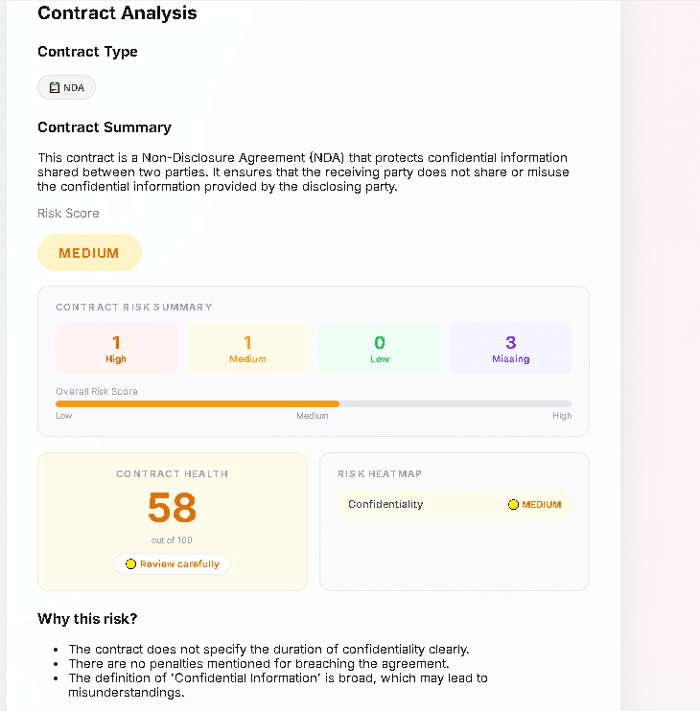
The most expensive mistakes in contracts don’t look risky.
After 1,000+ conversations with founders, one thing became clear:
Most people don’t lose money because they didn’t read the contract.
They lose money because they didn’t understand it.
Not legally.
Practically.
They saw the clause.
They just didn’t realize what it actually means.
So they sign.
And only later find out:
– they’re locked in longer than expected
– they owe more than they thought
– they gave away more than they intended
That moment doesn’t feel risky.
It feels like:
“it’s probably fine”
That’s the problem.
Contracts don’t fail because they’re hidden.
They fail because they’re misunderstood at the moment of decision.
And most tools focus on analysis.
But analysis isn’t what people need.
They need clarity:
👉 what this actually means for them
👉 what it could cost them
👉 what they should push back on
Not after signing.
Before.
That’s the layer I’m building for.
Over the past day, this translated into real signal:
4,000+ visitors
contracts uploaded
real stories shared
Which tells me this isn’t just an insight.
It’s a real problem.
For those curious what I’m building:
https://joyful-granita-8415bc.netlify.app/index.html
Curious - what’s one thing you wish you understood before signing something?

A lot of these insights came directly from conversations here.
Really appreciate everyone who took the time to share real experiences - it genuinely shaped how I think about the problem.
@benj_mtn
@backendrescue
@ShelfCheck
@dan_builds_things
@johnnypacheco
@EspritCode
@APasha
@ZephWheeler
@threadline_founder
@alpha_compadre
@crazyryan22
@ben_builder
Respect, honestly. Didn’t expect you to go this deep and stay this consistent - especially at your age.
I’ve been watching how you’re building this step by step - you didn’t just drop the idea, you kept going.
A lot of people say things and disappear, but you didn’t. That says a lot.
Also really respect that you’re not trying to claim everything as your own - you’re giving credit and remembering the people who shaped it. That’s rare.
Because of this, it actually feels like I’m part of something interesting, not just watching from the side - hard to even explain, but it’s real.
I’ve seen people try to copy this direction and positioning, but they couldn’t replicate it - they don’t have your experience behind it.
Stay on your path - you’re clearly operating on a different level.
I’m genuinely curious how far you’ll take this.
@benj_mtn @backendrescue @ShelfCheck @dan_builds_things @johnnypacheco @EspritCode @APasha @ZephWheeler @threadline_founder @alpha_compadre @crazyryan22 - you guys see this too?
Hi
I provide eligible AI businesses access to GCP/AWS credits for the next 24 months to help reduce infrastructure costs.
If this is relevant, happy to share more details.
https://www.linkedin.com/posts/sai-rithvik-2176302b1_eligible-ai-companies-can-access-up-to200k-activity-7442865181254209536-EiDB
Appreciate that - really means a lot.
I’m still figuring things out, just trying to stay consistent and learn from conversations here. A lot of this came from people sharing their experiences
That’s the right approach! Keep at it 💪
Hi
I provide eligible AI businesses access to GCP/AWS credits for the next 24 months to help reduce infrastructure costs.
If this is relevant, happy to share more details.
https://www.linkedin.com/posts/sai-rithvik-2176302b1_eligible-ai-companies-can-access-up-to200k-activity-7442865181254209536-EiDB
Thanks, not relevant for now.
The 'feels probably fine' instinct is such a good framing. You're right that it usually means ambiguity, not safety. The other one I'd add: any clause you've seen in 5 other contracts starts to feel 'standard' even when it isn't. Familiarity creates false safety in a way that totally novel language doesn't. You actually read the weird-looking stuff. The dangerous clauses are the ones that look exactly like what you've seen before but have one word changed.
That’s a great point - familiarity definitely creates a false sense of safety.
The “looks standard” part is exactly where most things get missed.
love it!
Appreciate it!
This is a sharp framing — “not legally misunderstood, practically misunderstood” is exactly where money leaks.
One thing that could lift trust + conversions fast: show a real before-signing output block in the hero (3 lines):
People buy clarity when they can see the decision artifact they’ll get. Right now the promise is strong; a concrete sample would make it tangible.
If useful, I can share a teardown format I use for conversion/risk clarity pages: https://roastmysite.io/go.php?src=ih_contractmistake_clarity_20260330_2203_hv
this is a really underrated strategy. most people chase paid ads or cold outreach first but organic community channels like reddit can compound over time. the key insight about participating genuinely vs just dropping links is what separates it from spam. have you seen any specific subreddits convert better than others for your niche?
Appreciate that - still exploring what works best at this stage.
Absolutely—this resonates so much. Most people don’t realize the real-world impact of a clause until it’s too late. Tools that break down contracts into plain language and highlight potential costs before signing would be a game-changer.
I’d love to hear from others too: what’s the one clause you wish you fully understood before signing a contract?
Appreciate that - that’s exactly the gap I keep seeing.
Most tools focus on explaining the contract, but what really matters is understanding the real-world impact before signing.
That’s what I’m exploring with VIDI:
https://joyful-granita-8415bc.netlify.app/index.html
The reframe from "analysis" to "clarity" is the key insight here. Most founders I know treat contracts like a checkbox — sign it, move on, deal with problems later. The ones who get burned aren't careless, they just didn't know what questions to ask. Translating legal language into plain-English consequences (what this could cost you, what leverage you're giving up) is where the real value is. Especially for early-stage founders who can't afford a lawyer for every deal but also can't afford to get a clause wrong.
That’s a great way to put it.
The “what questions to ask” part really resonates - most people don’t know what to look for when reviewing a contract.
I think this is a real problem, we've all signed a contract we weren’t really supposed to. Even after reading. I'm curious how you figure out the potential risks.
Yeah, exactly.
Even if you read it, it’s hard to see the risks.
From what I’ve seen, some patterns show up again and again.
4,000 visitors but how many actually uploaded a contract? That trust gap between 'I agree this is a problem' and 'here, read my NDA' kills most legal-adjacent tools. Curious what your upload rate looks like.
That’s a good point.
Trust is a big part of this, especially with contracts.
Also, it’s not that easy to find the right businesses - even on Indie Hackers. I usually reach out via LinkedIn and similar channels.
This is so true. I'm building an invoicing tool for freelancers (nuvobill.com) and the contract/payment terms gap is something I see constantly.
The biggest one I hear: freelancers sign contracts with net-60 payment terms because the client's template said so, not realizing they just agreed to wait 2 months for their money. Then the client pays on day 75 and there's nothing they can do about it.
The "clarity before signing" angle is spot on. Most freelancers don't need a lawyer - they need someone to translate the contract into "here's what this actually means for your cash flow." Would love to see this expand into payment terms specifically.
That’s a great example.
Payment terms can really impact cash flow - most people don’t realize it.
I’ve been running into something similar recently.
It’s interesting how much harder this is in practice compared to how simple it sounds.
That’s very real.
It sounds simple in theory, but actually doing it consistently is much harder.
For UK freelancers, one of the most costly gaps is not understanding payment terms - specifically what happens when a client doesn't pay. Most people sign contracts with vague "30-day payment" clauses without knowing they have a statutory right under the Late Payment of Commercial Debts Act to charge 8% above base rate on overdue invoices plus fixed compensation. That clause alone, if you mention it clearly in your contract, dramatically reduces late payment. Landolio (landolio.com) is a UK-focused resource with free tools and templates for exactly this kind of thing if useful.
That’s a great example.
This is exactly the kind of thing people miss - and it can directly cost them money.
Hi
I provide eligible AI businesses access to GCP/AWS credits for the next 24 months to help reduce infrastructure costs.
If this is relevant, happy to share more details.
https://www.linkedin.com/posts/sai-rithvik-2176302b1_eligible-ai-companies-can-access-up-to200k-activity-7442865181254209536-EiDB
Thanks, not relevant for now.
Great story. Love how a simple idea turned into something meaningful.
Appreciate it - glad it resonated.
Yep, the stuff that gets expensive is usually the "friendly" wording, vague scope, soft payment terms, auto-renewals, or IP clauses copied from a template. Learned the hard way to slow down on anything like "reasonable efforts" or missing acceptance criteria, because that is where a simple deal turns into months of cleanup.
Exactly - that’s where most issues come from.
It doesn’t look risky when you read it, but that’s usually where the real cost is hidden.
The distinction you're drawing between "didn't read" vs "didn't understand" is the one that actually matters, and I haven't seen many tools address it directly.
We've signed a handful of enterprise SaaS agreements over the past couple years, and the clauses that cost the most were never the ones we skimmed. They were the ones we read carefully, thought we understood, and were wrong about — specifically around auto-renewal terms, liability caps that seemed reasonable in isolation, and IP assignment language that was buried inside a standard-looking services clause.
The insight about "it feels probably fine" is sharp. That feeling is actually a signal, not a non-event. It usually means the clause is ambiguous enough that both interpretations seem plausible — which is exactly when you need clarity most, and when most people stop digging.
One question on the product side: how are you handling the gap between "this is what this clause means" and "here's what you should actually do about it"? That second piece — the actionable negotiation guidance — is where I've found most tools drop off. They explain risk but stop short of saying "here's the specific language you could push back with" or "this is standard enough that fighting it will cost more than it's worth."
That practical tier feels like the biggest unlock. Curious whether you're going there or keeping the scope tighter for now.
That’s a great point - especially around “it’s probably fine” being a signal.
That gap between understanding and action is exactly where most tools fall short. Right now I’m focusing on making the implications clear first - what it actually means and where the risk is.
The action layer is something I’m thinking about carefully, but trying not to overbuild too early
This is a strong insight. The gap between legal wording and real-life impact is huge. Curious how your tool explains trade-offs in simple terms?
That gap is exactly what I’m trying to bridge.
Instead of just explaining the clause, I focus on what it means in practice - what you’re agreeing to, what you might be giving up, and what’s worth pushing back on.
From my own experience running a business - this really works.
Less headache, my team works more efficiently, and decisions are faster. I actually understand what I’m signing, no guessing.
I’ve been using VIDI for a while - it saves time, keeps things clear, and I trust it. Highly recommend to fellow entrepreneurs.
That’s great to hear.
The “decisions are faster” part is interesting - that’s something I kept seeing come up in conversations too.
Yep for sure