The most expensive word in my marketing was "free"
I'm Yarin, 24, first-time founder. I'm building RecoverStack, which recovers failed subscription payments for bootstrapped Stripe SaaS. When someone's card declines, most setups just retry it a couple of times. RecoverStack reads the reasons a payment has failed and routes and then takes dedicated actions: an insufficient_funds gets retried closer to payday, an expired_card gets an email asking them to update it, a fraud flag doesn't retry at all and instead surfaces a notice to the operator. Pre-launch, no customers yet, and I'm learning the business/marketing half in public.
One of the additional marketing tools I've built was a free Stripe audit: You install it as an extension on your Stripe account, it reads your failed payments in read-only mode, and emails you back a breakdown report of which decline codes have been costing you what. No call, no signup, and nothing to pay.
Through my cold email outreached, I asked 130 people to install it. None of them did.
For a while, I read that zero as a copy problem, since a silence doesn't give you a lot to work with. Then I noticed the word I'd been leaning on the whole time was "free", and labeling an offer as "Free" does not mean it's free from commitment. Installing my extension means handing a stranger read access to your live payment data. In trust terms, that's near the top of anything I could ask for, and I was asking it from people who had never heard my name. That's the part I had backwards for months.
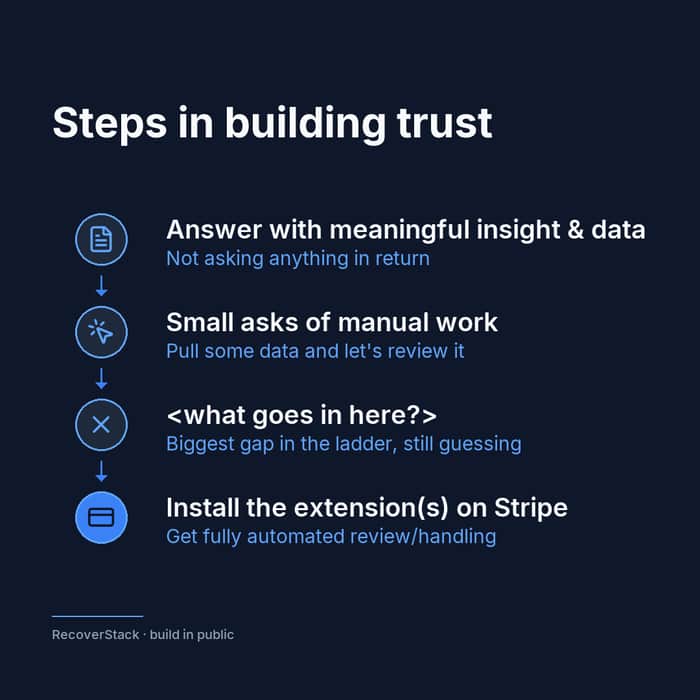
I'd built the top of a ladder with none of the steps that lead there.
To be fair, the zero doesn't prove that either. Maybe the list was wrong or the copy was bad, or maybe I just caught people on a bad week. Nobody replied, so nobody told me which one it was. Failure is supposed to teach you something, but silence doesn't really teach you anything, and you can spend a long time splitting hairs.
Then, a few weeks back someone on Reddit posted about losing 9 of their 52 trials to failed payments. I answered the question they actually asked, spacing on retries and what the codes underneath were probably telling them. At the end of my comment I also asked whether they'd like to paste a few of their decline codes so I could go through the failures with them.
8 hours later they actually posted the whole breakdown publicly. 11 failures: "insufficient_funds" 6, "try_again_later" 2, "generic_decline" 1, "do_not_honor" 1, "transaction_not_allowed" 1. And then they asked me two more questions of their own.
On the surface, looks like a big win, and my first instinct was to write that up as "the smaller ask converted". I've been sitting with it for a couple weeks, and I don't think the size is the interesting part. If it were purely about ask size, the move would be to keep shrinking it, and that gets useless fast.
What was actually different is that there were two steps instead of one. I gave them something usable initially, then the thing I asked for was reachable from there. And then they went one further on their own, because asking me two questions back sits higher up than pasting the codes did.
So here's how I'd put it now: you can't ask somebody to climb the ladder of trust immediately. You have to take them through the steps that lead there. Being useful to a specific person, in public, about the actual problem they wrote about, is a different story altogether.
There's also a thing here that's specific to building in 2026. With AI in the loop, shipping the impressive features is also the cheapest part of the whole business. I built the biggest, most polished thing I could put in front of a stranger largely because that felt right, but now I see it's ignoring the underlying trust dynamic, and I'm happy I've eventually reached that conclusion.
One thing to note though is that it's only one date point from one person, so I'm holding it as a lead worth chasing rather then something I'd bet on. And I honestly don't know what sits between "answered my question in a thread" and "gave me read access to their Stripe account". That's a missing piece in my interaction with people that still needs work.
By the way, I do have a lower-friction version, where you upload a CSV export instead of connecting anything. It helps, and it is genuinely easier. But it is the same ask with less clicking rather than a different step on the ladder, because it still opens with handing your payment data to a system you don't trust. Friction was never really the thing in the way.
Which leads me back to here. Currently, I'm working to get more of these 1:1, low-commitment interactions with people in public with nothing attached, but the way to installing an automated extension on their Stripe account is long. The middle is empty and I've been guessing at it.
So for anyone who went further down this road: how did you build your trust ladders? And looking at mine, what would you add or change about my approach? I'm interested to hear your stories, as well as what you think I could integrate in the future as well.
