The Most Underrated Job Every Startup Founder Must Do
Key Points
Minimizing risk is the most underrated jobs every startup founder must do.
For most startups the highest risk lies in the value proposition, i.e. the desirability of their product.
To minimize the risk around desirability, you have to start with discovering and defining the problem your product is solving.
Why Care?
When making an investment decision, VCs try to figure out the following:
How much cash can I expect to receive from this investment?
What's the likelihood that I will get this cash?
Put simply:
More cash + less risk = high value.
For early-stage startups, predicting cash flows is a waste of time, but managing risk is not. In fact, it's the only lever you can pull to increase your initial valuation.
This story is about uncovering and managing the hidden risks in early-stage startups.
Diving Deeper
After six failed attempts to explain my thinking about risk and startups, I decided to take a Q&A approach to it. It seemed to resonate better with some of my beta readers, and I hope it works for you too.
Q: So, what's this most underrated job all founders must do?
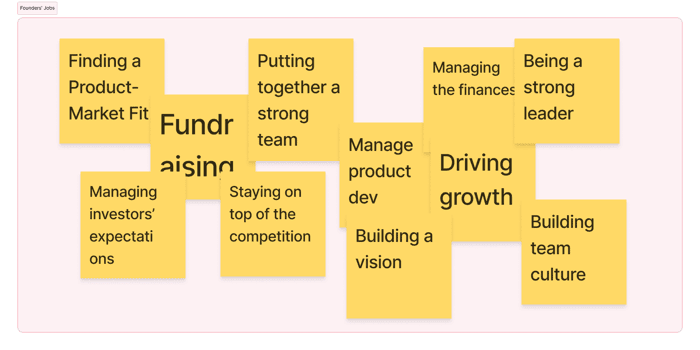
It's managing risk. If you ask founders what their key jobs are, they will give you a mix of the following:
-
Finding a Product-Market Fit,
-
Fundraising,
-
Putting the right team together,
-
Manage product development,
-
Staying on top of the competition.
The jobs on the list vary depending on the stage of the venture. Founders of growth-stage startups don't have to focus on finding a Product-Market Fit but on refining it. Those leaders will also pay more attention to building the right culture and leadership team.
The one job that is constantly missing, however, is managing risk. It's not that founders don't know about it. The ones I've spoken with are well aware of the riskiness of their venture, but they rarely think of it as a job they can actively manage. It's more like a thing that comes with the territory.
Q: Okay, but risk sounds pretty vague. What does it even mean?
Investors and founders think about risk in different terms:
Investors: Risk is the probability of the actual return being the same as the promised return. For example, if I ask you for $100 and promise to give you back $1,000 in a year, you assume some risk. There is a chance I won't give you back any of the money. Or maybe I'll give you half. This uncertainty is a risk. In the industry, it's called financial risk.
Founders: Risk is the probability that you won't realize the vision you have for your business. If you don't have a vision, we should talk, but for the sake of this argument, let's assume you do.
As a founder, you are also an investor, and you have assumed financial risk too.
Q: Okay, so what do I do next?
The first thing you have to do is uncover where the biggest risk hides in your business. I approach this part by using the following design thinking methodology.
Every successful business depends on a successful product. To be successful, a product has to excel in three areas:
Desirability: it has to be something enough people will want to buy.
Feasibility: it has to be something we can actually build with the resources we have.
Viability: it has to be profitable or at least pay for its costs in case we are running a non-profit.
Where the risk lies depends on the type of your business and its stage.
For most early-stage startups building innovative products, your focus is on finding a Product-Market Fit (desirability).
If you are at the growth stage, your primary concern will be with how to build a scalable product (feasibility).
Once you've achieved substantial growth, you focus on maximizing profitability (viability).
To be clear, you must pay attention to all three areas throughout all stages of your business. What shifts is the priority at each stage.
The Uber example
At the risk of being too lengthy, we can trace Uber's rough trajectory as an illustration.
When Uber first launched, their goal was to validate if users would actually hitch rides with strangers. They were testing for desirability. At this stage, most of the risk with Uber was in whether people would use ride-sharing.
Once Uber confirmed that people would share rides (in the way they had conceived the service), they had to focus on scaling as quickly as possible. As with any social-based platform, Uber's success depends on a large number of users. The majority of risk shifted from desirability to feasibility. The question of the day became: how quickly and efficiently can we grow this business?
Once Uber had achieved its explosive growth and essentially had locked down the market in many cities, the question of the day became: how can we extract the most value from the business? Viability became a priority.
As the graph shows, none of the areas is completely ignored at any of the stages. Only the priority changes.
&&Q: I'm at the early stage of building my startup, so most of my risk must be lying in the desirability area. How do I go about reducing it?**
Your highest business risk is tied to desirability if two things are true:
-
your venture is early stage, and
-
you are building something innovative.
Most new businesses build non-innovative products in established markets. When I was building N-casa - an interior decor e-commerce store - most of the risk was related to marketing and operations.
The same is true for most direct-to-consumer products. The risk for Endy, the Canadian DTC mattress company, lies in its marketing and operations. They don't innovate on the mattress but on the purchase experience.
But if you are early-stage and building an innovative solution, then chances are most of your risk lies in the desirability area.
The only way to mitigate desirability risk is to dive deep into discovery and user research. Gaining a deep understanding of the problems your users are facing and how they work around them will be critical to building a solution that they care about.
Q: So, how do I make such a discovery?
There are several methods you can use:
User interviews: identify potential users and interview them so you can discover pain points, behaviours, attitudes and current solutions.
Contextual inquiries: observe and interview some of your potential users.
Competitive analysis: study your competition, their offerings and customer feedback in a methodical and structured way.
I plan to write more about each of these methods in the coming weeks. For now, just keep in mind that your focus is uncovering the key problem(s) your users have. Someone famous said, "The one who defines the problem the best, has the best chance to build the best product".
How to think about risk in your business
Think of managing risk as a lens with two ends: risk and reward. Every time you have to make an important decision, ask yourself four questions:
-
What is the downside (the risk) if things go terribly wrong?
-
What is the upside if things go marvellously well?
-
What are the chances for things to go terribly wrong?
-
What are the chances for things to go marvellously well?
Be as clear and specific as you can in answering these questions. For the big, bold bets, you won't have clear answers. To make things worse (or more fun, depending on how you look at it), whatever you base your decision on will change. So, you will have to constantly keep rethinking the balance between risks and rewards. That's the hardest and most rewarding part of running a business.
If you enjoyed reading this and want to see more, check out Destructured where I write how to build amazing products through UX research and design.
