The “Open → Do → Close” rule changed how I build tools
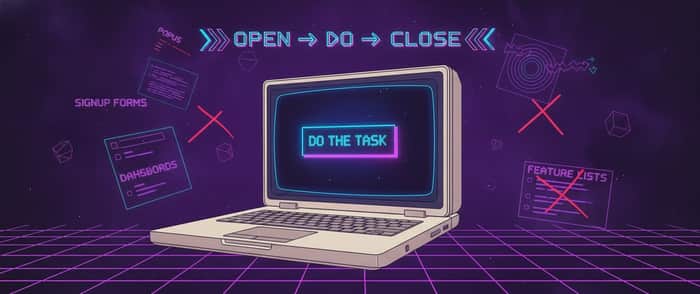
When I started building small browser allinonetools, I thought the hard part would be the code.
It wasn’t.
The hard part was understanding why people close tools so fast.
Not because the tool is bad.
Because the experience before the tool is exhausting.
Then I noticed something.
The tools I personally use the most all follow an invisible rule:
Open → do the task → close.
No accounts.
No onboarding.
No setup.
No friction.
Just the task.
Where most “simple tools” lose users
You open a tool for a 30-second job and before you even begin:
- Create an account
- Verify email
- Accept cookies
- Watch a tour
- Choose a plan
- Fill preferences
You’re already mentally tired.
So you close the tab.
Most tools lose users before value is shown.
The tools we actually come back to
The tools we return to don’t try to convert us immediately.
They let us:
Open → finish → leave
And ironically, those are the tools we trust the most.
What I changed while building my own tools
I made one rule:
A user must be able to complete the task within seconds of opening the page.
That meant:
- No login
- No forced signup
- No feature clutter
- No marketing noise
- No interruptions before the task
Just the tool, ready.
And something interesting happened.
People started trusting the tools without me asking for it.
This is psychology, not code
When someone opens a tool, they have one clear goal.
They don’t want:
- a relationship
- a dashboard
- a tutorial
They want the task done.
Help them do that quickly → trust builds automatically.
The mistake I used to make
I thought:
“If users sign up, I can retain them.”
What actually happened:
They never reached the part worth retaining.
Friction too early kills curiosity.
And curiosity is what brings people back.
When signup actually makes sense
Signup is not bad.
Bad timing is.
The right moment to ask is after:
- The task is done
- The value is clear
- They want to save progress
Now signup feels helpful, not annoying.
The checklist I now use before shipping
- Can this be used in under 10 seconds?
- Is anything blocking the task?
- Is this serving me more than the user?
- Can this work without an account?
If the answer is no → I remove things.
What I learned
The tools people love are not the most powerful.
They are the most respectful of time.
And the more I remove, the more people use them.
Less friction > more features
Curious how others here think about this:
Do you design tools around features first…
or around how fast someone can finish the task?

this lands. open → do → close is how people actually behave when the ask is small.
the place i still see friction is after the task leaves the tool — someone said yes in chat, then the follow-up lives in the founder's head. (disclosure: i work on tskflow, which is basically that hole) but even a plain owner + due date note beats another setup screen before value.
— — — I am tired to see almost all questions & answers are AI generated full of — — —
Give a try to my Reddit Extension. It's a Chrome extension called Pulse of Reddit that basically acts like my own alert system for Reddit.
Anytime someone posts something with keywords I care about like 'looking for a designer' or 'best SEO tool' it pings me right away. It’s saved me so much time and helped me hop into threads while they’re still fresh.
If you’re tired of manual digging and want to catch those conversations early, I’d really recommend giving it a look.
It’s free to start and super simple to set up.
Website:
pulseofreddit.com
I get what you mean. A lot of posts do feel AI-written lately. This one actually came from watching real users close my tools in seconds and trying to understand why. That experience is what pushed me to simplify everything.
The pairing of 'runs locally' + 'no API keys' is undervalued positioning. It speaks to the technical buyer who has already been burned by SaaS tools that changed pricing, added rate limits, or went down at the wrong moment.
The one-time purchase model makes sense when the tool does a defined job well. What's the job this tool does?
Exactly. The job is simple: open the page, finish a small task (compress, convert, merge, etc.), and leave in seconds. No accounts, no setup — just the task done fast.”
This is a masterclass in modern UX. We often forget that users are on a mission, not looking for a new relationship. I’ve tried to apply this exact 'Open → Do → Close' mindset to "Agentfarm". AI agents can easily become bloated with onboarding, but the goal should be getting the task done in seconds. Launching on Product Hunt tomorrow with a focus on removing that friction for AI workflows. Thanks for the reminder that 'less is more'!
Love that — and congrats on the Product Hunt launch 🚀
You’re right, AI tools are especially at risk of becoming “platforms” before they become useful. If Agentfarm can truly let someone open → delegate → done in seconds, that’s a big edge.
Wishing you a strong launch tomorrow. Curious to see how users react when friction is removed from AI workflows — that’s where real retention starts.
There's an interesting tension here that I don't see discussed enough: Open → Do → Close works brilliantly for utility tools, but the moment your product involves AI or any kind of personalization, you hit a paradox. The tool gets better with context (history, preferences, saved state), but collecting that context IS friction.
The way I've been thinking about this: treat context accumulation as a byproduct of usage, not as a setup step. Don't ask users to configure preferences upfront. Instead, observe what they do and adapt silently. The first use should be zero-config. The tenth use should feel magical because the tool learned from the previous nine — without ever asking the user to "set up their profile."
The other thing that resonated is the signup timing insight. I've seen this pattern repeatedly: the conversion rate on "save your work?" after someone gets value is 3-5x higher than "sign up to start." People are willing to invest in preserving something they already have. They're not willing to invest in something hypothetical. It's loss aversion applied to product design, and most founders get the sequencing backwards.
You described that paradox really well.
I ran into the same tension while thinking about adding features that require context. The moment you ask upfront, it stops feeling like a simple tool and starts feeling like a commitment.
What’s been working for me is exactly what you said — letting context form naturally. If someone uses the tool 5–10 times, that’s the moment where saving history or preferences feels helpful, not intrusive.
And your point about “save your work” vs “sign up to start” matches what I’ve seen too. People don’t invest in possibilities. They invest in preserving value they already experienced.
That shift in timing changes everything.
The "is this serving me more than the user?" test is the most honest filter I've found too.
One thing that pushed this thinking further for me: building natively for macOS instead of as a web app. When there's no server on your end, no account, no cloud sync - you're forced to design around the user's local state from day one. There's nothing to log in to. The data lives on their machine. That constraint eliminated an entire category of friction decisions before I even made them.
It also flipped the trust model. Users aren't trusting you with their data. They already own it. The tool just reads it. That changes the psychology of the first interaction completely - people open it without hesitation because there's nothing to "agree to."
The interesting tension is retention. The usual playbook says "capture email → build a relationship → retain." But if the tool is good enough that someone opens it daily because it's woven into their workflow, the retention is behavioral, not contractual. That's harder to build but much stickier !
That’s a really great point. Designing around local state removes friction before it even exists.
I’ve noticed something similar with browser-only tools in AllInOneTools. When users know nothing is stored and there’s no account involved, they start using it immediately — there’s no “evaluation phase.”
And I completely agree with your retention point. The strongest retention I’m seeing isn’t from emails or reminders, it’s when the tool becomes part of someone’s natural workflow. They don’t come back because I asked — they come back because they need it.
That shift changed how I think about what to build.
This is a solid framework. One tweak that helped us: track time-to-first-value as a core metric alongside conversion. If TTFV drifts up, return usage usually drops a week later. We moved signup prompts to after the first successful action and got better repeat use from people who initially came for a one-off task.
That’s a great insight. Tracking time-to-first-value makes a lot of sense — I’ve noticed the same pattern just from watching behavior, but haven’t measured it formally yet.
Moving signup after the first successful action is exactly what felt “right” from a user perspective too. People seem much more open once they’ve already gotten value.
I’m curious — did you see bigger impact on repeat usage or on overall conversions after making that change?
Overall conversions.
This resonates hard. I've been applying a similar principle without naming it — especially for features that touch the database layer. When a user asks a question in natural language and gets a SQL query + result back, the whole interaction should feel like: open → ask → close. No setup wizards, no 5-step configuration.
The moment you add friction between "open" and "do," you lose 80% of non-technical users. I've found that the best features I shipped were the ones where I ruthlessly cut the steps between intent and result. Great framework for thinking about UX.
That’s a great way to put it — “open → ask → close” fits perfectly.
I’ve noticed the same thing: the less distance between intent and result, the more people trust and reuse the tool. Every extra step makes users pause and think, and that’s usually where they drop off.
Cutting those steps often feels uncomfortable as a builder, but it’s almost always the right decision for the user.
This "Open → Do → Close" mindset is exactly what I needed to hear today.
I’m on Day 8 of 12 building SaaSurfer (a tool to scan Reddit for SaaS demand), and I’ve been wrestling with the exact same internal debate: "Should I force a signup to 'capture' the lead?"
After reading this, the answer is a clear no.
I’m building this as my first full-stack app (React/Node), and as a designer-turned-coder, I’ve realized that for a validation tool, the "First Value" is the only thing that matters. If a founder has an idea, they want a demand score now, not after an email verification loop.
My current "friction" reality check:
The Struggle: My Reddit API access got banned early on, so I'm using high-quality mock data for the MVP launch.
The Pivot: Instead of hiding behind a "Sign up for early access" wall, I’m letting people run the search immediately with the mock data so they can see the UI and value prop in < 10 seconds.
The Lesson: Trust is harder to build than a database. I'd rather have 100 people use it and leave happy than 10 people forced into a database who never actually saw the results.
Bhavin, your checklist question—"Is this serving me more than the user?"—just killed two "strategic" features I was planning to code tonight. 🏄♂️
I'm launching in 4 days to list for acquisition —definitely keeping it "Open → Do → Close" for the buyer to see the true engagement!
This is such a great example of applying it in real time.
What you said — letting people experience the value first, even with mock data — is exactly what builds trust early. Most founders try to protect the product, but showing it openly actually makes people believe in it more.
I made the same mistake initially. The moment I removed the “capture first, value later” mindset, usage increased — even though signups decreased. But the users who stayed actually cared.
Your line “Trust is harder to build than a database” is spot on. That’s the real asset.
Good luck with the launch — excited to see it go live.
This "Open → Do → Close" philosophy is exactly why I built irel on WhatsApp.
Most AI assistants make you download an app, create an account, learn a new interface, check notifications. By the time you're ready to delegate, you've already lost energy to the friction.
With irel, you just text your AI secretary like you text anyone else. No onboarding. No new interface. No "where do I find this feature?"
The insight most founders miss: the best UX is the one people already know. WhatsApp has 2B+ users who already open → type → close hundreds of times daily. Meeting them there instead of building yet another app is how you get from "I should delegate this" to "done" in under 10 seconds.
Your checklist nails it: "Is this serving me more than the user?" Most AI products fail this test by trying to be "platforms" instead of just getting the task done.
That’s a great example of applying the same principle in a different context.
I really like your point about using an interface people already know. Reducing friction isn’t just about removing steps — it’s about not forcing users to learn something new.
“Meeting users where they already are” is powerful. In many cases, the best product isn’t a new interface — it’s removing the need for one.
Curious to see how that evolves 👍
this is so true. every time i add friction before value, i lose people. i started applying this to my own projects — no onboarding walls, no forced signup, just let people use the thing. the checklist is gold, especially 'is this serving me more than the user' — that question alone would kill half the features most devs build
Love this — and 100% agree.
That question “is this serving me more than the user?” has been brutal but necessary for me too. Every time I remove something that was there for “strategy” instead of usability, the product feels lighter.
It’s uncomfortable as a builder… but it’s a relief for users.
Curious — did removing onboarding hurt anything for you, or did usage just go up?
Open → Do → Close shifts the entire product mindset. If value isn’t immediate, retention suffers regardless of how many features you ship.
Exactly. That was the hard lesson for me — retention doesn’t start with features, it starts with first value.
If someone doesn’t feel usefulness in the first few seconds, they’ll never experience the depth anyway.
I’ve started thinking of speed-to-value as the real onboarding.
Exactly — that shift to speed-to-value makes a lot of sense.
I’ve been noticing something just after that though…
Even when people do feel initial value, there’s still a second drop-off point if they don’t follow through fully.
Almost like:
→ speed-to-value gets them in
→ but completion is what actually locks retention
That gap between starting and finishing seems to be where a lot of products quietly leak.
I’ve been looking at this through Formely — turning PDFs into hosted, fillable workbooks and tracking where people drop off — and it’s interesting how often the break isn’t at the start, but somewhere in the middle.
Feels like onboarding might actually be:
value → completion → then retention
Give a try to my Reddit Extension. It's a Chrome extension called Pulse of Reddit that basically acts like my own alert system for Reddit.
Anytime someone posts something with keywords I care about like 'looking for a designer' or 'best SEO tool' it pings me right away. It’s saved me so much time and helped me hop into threads while they’re still fresh.
If you’re tired of manual digging and want to catch those conversations early, I’d really recommend giving it a look.
It’s free to start and super simple to set up.
Website:
pulseofreddit.com
Appreciate you sharing — keeping this thread focused on the tool UX discussion.
@bhavin_allinonetools , responding to your last comment:
That’s a really sharp takeaway and you’re spot on that this clarity protects you as much as it protects users.
Phase 1 done well almost feels boring from the outside, but it’s where most long-term winners quietly separate themselves. If people feel safe using it without thinking about upsells, reliance tends to emerge on its own.
Sounds like you’re focused on exactly the right thing right now. Glad it was useful looking forward to seeing how the tools evolve.
Give a try to my Reddit Extension. It's a Chrome extension called Pulse of Reddit that basically acts like my own alert system for Reddit.
Anytime someone posts something with keywords I care about like 'looking for a designer' or 'best SEO tool' it pings me right away. It’s saved me so much time and helped me hop into threads while they’re still fresh.
If you’re tired of manual digging and want to catch those conversations early, I’d really recommend giving it a look.
It’s free to start and super simple to set up.
Website:
pulseofreddit.com
This really hits home. I built a recipe swiper app recently using the same philosophy — no signup, just open and start swiping recipes like Tinder. The AI learns your taste as you go.
The hardest part was convincing myself that I didn't need user accounts "for retention." Turns out, removing that friction was the retention strategy. People come back because it just works.
Your checklist is gold. Especially: "Is this serving me more than the user?" — that question kills so many unnecessary features.
Give a try to my Reddit Extension. It's a Chrome extension called Pulse of Reddit that basically acts like my own alert system for Reddit.
Anytime someone posts something with keywords I care about like 'looking for a designer' or 'best SEO tool' it pings me right away. It’s saved me so much time and helped me hop into threads while they’re still fresh.
If you’re tired of manual digging and want to catch those conversations early, I’d really recommend giving it a look.
It’s free to start and super simple to set up.
Website:
pulseofreddit.com
Love this example — a recipe swiper is such a perfect fit for this mindset.
I went through the same internal debate around accounts and “retention,” and had the same realization: if the first experience feels effortless, people don’t need to be convinced to come back.
Really glad the checklist resonated. That question has saved me from adding a lot of things that felt “smart” as a builder but would’ve felt heavy to a user just trying to get something done.
Give a try to my Reddit Extension. It's a Chrome extension called Pulse of Reddit that basically acts like my own alert system for Reddit.
Anytime someone posts something with keywords I care about like 'looking for a designer' or 'best SEO tool' it pings me right away. It’s saved me so much time and helped me hop into threads while they’re still fresh.
If you’re tired of manual digging and want to catch those conversations early, I’d really recommend giving it a look.
It’s free to start and super simple to set up.
Website:
pulseofreddit.com
Appreciate you sharing — keeping this thread focused on the tool UX discussion.
I had the same thought and used the same philosophy on nocalendar. Even regarding monetization which you mention in another comment. I'm glad to see this brought up from someone with much more experience, it gives me hope! Removing friction is also, in my opinion, a big driver for improving usability and making more intuitive interfaces, since true frictionless use implies no instruction reading.
Give a try to my Reddit Extension. It's a Chrome extension called Pulse of Reddit that basically acts like my own alert system for Reddit.
Anytime someone posts something with keywords I care about like 'looking for a designer' or 'best SEO tool' it pings me right away. It’s saved me so much time and helped me hop into threads while they’re still fresh.
If you’re tired of manual digging and want to catch those conversations early, I’d really recommend giving it a look.
It’s free to start and super simple to set up.
Website:
pulseofreddit.com
Love this. “Frictionless means no instructions needed” is such a great way to put it. That’s exactly the signal I look for now — if a tool needs explaining, something is already wrong in the flow. Glad to see others thinking the same way with their products.
The best tools are always the ones that allow the user to do what they need quickly. Whatever friction we can remove from the entire process will help both your revenue and those using it.
Give a try to my Reddit Extension. It's a Chrome extension called Pulse of Reddit that basically acts like my own alert system for Reddit.
Anytime someone posts something with keywords I care about like 'looking for a designer' or 'best SEO tool' it pings me right away. It’s saved me so much time and helped me hop into threads while they’re still fresh.
If you’re tired of manual digging and want to catch those conversations early, I’d really recommend giving it a look.
It’s free to start and super simple to set up.
Website:
pulseofreddit.com
Exactly. I used to think adding more features would help, but removing steps helped far more. For tiny tasks, speed and clarity matter more than capability. Less friction really does change how people use (and trust) a tool.
This resonates hard. I've caught myself adding "helpful" features that actually just delay users from doing the one thing they came for.
The timing insight about signup is key: asking before value is shown feels extractive. Asking after feels like a favor to the user ("want to save this?").
One thing I'd add to your checklist: "Could someone with zero context use this?" Sometimes we build assuming users read the landing page or docs. They didn't. They just clicked a link and want to do the thing.
Your question about features vs speed - I've started defaulting to speed first. Features can be added. But if the first 5 seconds are friction, users never discover those features anyway.
Give a try to my Reddit Extension. It's a Chrome extension called Pulse of Reddit that basically acts like my own alert system for Reddit.
Anytime someone posts something with keywords I care about like 'looking for a designer' or 'best SEO tool' it pings me right away. It’s saved me so much time and helped me hop into threads while they’re still fresh.
If you’re tired of manual digging and want to catch those conversations early, I’d really recommend giving it a look.
It’s free to start and super simple to set up.
Website:
pulseofreddit.com
That’s a great addition — “zero context” is exactly how most people arrive. They don’t read, they don’t explore, they just want to do the thing.
I’ve started designing assuming users will skip everything and go straight to the task. If it still works, the tool is probably simple enough.
I realized this same truth before too. ~
I have also seen a trend: that the tools I always find myself going back to, are the same ones where I can do a thing before I even think about the interface.
Your mental model of “open → do → close” is great for that.
I believed that when customers dropped off, they didn’t see the value or weren’t interested anymore. They often just hit the friction before they get there. Signup, settings, choices, dashboards. They arrive at the task too late, the time is up.
I am running a small test now.
Can someone finish the main action after landing, within 10 seconds?
If it does not, I will consider it a design issue, not a MARKETING one.
I share your concern about postponing the accounts until after the task. When people first experience the outcome and only then get asked to save it, I’ve seen much better conversion.
Did it feel risky to remove navigation and extra UI at first? It is difficult to refrain from adding structural “helpful”.
An important reminder that for small tools, psychology is more important than functionality. Usually, the quickest way to generate value prevails.
Give a try to my Reddit Extension. It's a Chrome extension called Pulse of Reddit that basically acts like my own alert system for Reddit.
Anytime someone posts something with keywords I care about like 'looking for a designer' or 'best SEO tool' it pings me right away. It’s saved me so much time and helped me hop into threads while they’re still fresh.
If you’re tired of manual digging and want to catch those conversations early, I’d really recommend giving it a look.
It’s free to start and super simple to set up.
Website:
pulseofreddit.com
Really appreciate this — especially the “design issue, not a marketing one” line. That’s exactly what I started noticing too.
And yes, it felt very risky at first to remove navigation and extra UI. As builders, we feel like we’re hiding things. But in reality, we’re removing decisions.
For tiny tasks, fewer choices actually feel more helpful than more structure.
This is gold. "Less friction > more features" should be printed and framed.
We've seen the same pattern building SaaS tools at Figue.io — the products that retain users aren't the feature-rich ones, they're the ones that respect time.
Your checklist is spot on. Adding one more question we ask ourselves: "Would I use this if I had 30 seconds between meetings?"
If the answer is no, something's wrong.
Give a try to my Reddit Extension. It's a Chrome extension called Pulse of Reddit that basically acts like my own alert system for Reddit.
Anytime someone posts something with keywords I care about like 'looking for a designer' or 'best SEO tool' it pings me right away. It’s saved me so much time and helped me hop into threads while they’re still fresh.
If you’re tired of manual digging and want to catch those conversations early, I’d really recommend giving it a look.
It’s free to start and super simple to set up.
Website:
pulseofreddit.com
Love that question — “would I use this with 30 seconds between meetings?” That’s exactly the mindset I’m trying to design for. Respecting time has turned out to be a stronger retention strategy than adding features. Appreciate you sharing that.
I've built a demo functionality for my software. Do you think that I should remove sign up from it? The thing is that it's possible to create AWS resources there, and I want to limit it somehow. Any other ideas than sign up?
My demo is here https://limeboost.io - Get Inspired
Give a try to my Reddit Extension. It's a Chrome extension called Pulse of Reddit that basically acts like my own alert system for Reddit.
Anytime someone posts something with keywords I care about like 'looking for a designer' or 'best SEO tool' it pings me right away. It’s saved me so much time and helped me hop into threads while they’re still fresh.
If you’re tired of manual digging and want to catch those conversations early, I’d really recommend giving it a look.
It’s free to start and super simple to set up.
Website:
pulseofreddit.com
Great question — and this is a very different case from tiny tools.
For something that can create real AWS resources, removing signup completely is risky, not friction.
You don’t need full signup, but you do need lightweight protection.
You can try:
Let them try first, then ask for identity only when they cross a meaningful limit.
That way you keep the Open → Try → See value flow, without exposing yourself to abuse.
Thank you! I'll try to do it as simple as possible.
That sounds like the right approach. In cases where real infrastructure cost is involved, the goal isn’t “no friction” — it’s “delayed friction.” Let them explore safely first, then introduce limits only when they’re about to do something expensive. That keeps the experience smooth without opening the door to abuse.
Curious what you found hardest early on?
Give a try to my Reddit Extension. It's a Chrome extension called Pulse of Reddit that basically acts like my own alert system for Reddit.
Anytime someone posts something with keywords I care about like 'looking for a designer' or 'best SEO tool' it pings me right away. It’s saved me so much time and helped me hop into threads while they’re still fresh.
If you’re tired of manual digging and want to catch those conversations early, I’d really recommend giving it a look.
It’s free to start and super simple to set up.
Website:
pulseofreddit.com
Honestly, the hardest part was resisting the urge to add more.
As a builder, you want to improve things with features — but here, improvement meant removing things until only the task was left.
I think it's a great idea but how do you plan to monetize this? Will you charge for extra tools?
Great question — and honestly the most common one I get 😊
For me, the idea behind AllInOneTools is very clear:
I don’t want to charge for the tools.
No paywall. No limits. No “premium version”.
Because the moment a simple tool asks for money or signup, the trust is gone.
My goal is to keep every tool:
Open → Do → Close
Free, frictionless, and useful in seconds.
Monetization doesn’t come from restricting users — it comes later from scale, traffic, and trust (like ads, partnerships, etc.), while the tools themselves always stay free.
Totally makes sense, and I love the trust-first approach. Keeping the tools completely frictionless is smart—it builds credibility and loyalty that you can monetize later in ways that don’t feel forced.
The tricky part is usually scaling that trust into revenue without breaking the flow, but it sounds like you’re already thinking about the long game with ads, partnerships, and traffic.
If you want, I can share a couple ideas on how similar free-first tools have monetized at scale while keeping friction minimal—could save you some trial and error down the line.
Give a try to my Reddit Extension. It's a Chrome extension called Pulse of Reddit that basically acts like my own alert system for Reddit.
Anytime someone posts something with keywords I care about like 'looking for a designer' or 'best SEO tool' it pings me right away. It’s saved me so much time and helped me hop into threads while they’re still fresh.
If you’re tired of manual digging and want to catch those conversations early, I’d really recommend giving it a look.
It’s free to start and super simple to set up.
Website:
pulseofreddit.com
I’d love that. I’m still early and figuring this out as I go, so learning from others who’ve done free-first well would be super helpful. Appreciate you offering.
Glad you’re open! A couple things I’ve seen work really well for free-first tools:
Optional add-ons that enhance the free experience :– nothing blocks the core tool, but power users pay for extra convenience, analytics, or integrations.
Affiliate/partnership integrations :– keep the tools free, but connect to relevant services that reward you when users convert.
Content or workflow examples that demonstrate value :– sharing guides, templates, or case studies can increase trust and naturally prime users for later monetization.
If you want, I can sketch a short roadmap for free-first growth --> monetization that avoids friction and leverages trust. It usually helps founders see the path clearly and skip early mistakes.
Give a try to my Reddit Extension. It's a Chrome extension called Pulse of Reddit that basically acts like my own alert system for Reddit.
Anytime someone posts something with keywords I care about like 'looking for a designer' or 'best SEO tool' it pings me right away. It’s saved me so much time and helped me hop into threads while they’re still fresh.
If you’re tired of manual digging and want to catch those conversations early, I’d really recommend giving it a look.
It’s free to start and super simple to set up.
Website:
pulseofreddit.com
This is incredibly helpful — thank you for taking the time to share this.
I’m intentionally trying to go very slow with monetization and focus first on trust and usefulness. Once people genuinely rely on the tools, the right paths (ads, partnerships, maybe optional extras) should come naturally without breaking the experience.
Really appreciate you outlining this — gives me a lot to think about.
Love that approach, going slow here is actually a moat.
One thing I’ve noticed with free-first tools that really compounds trust is deciding early what will never be monetized, and being explicit about it. Users relax when they know the core won’t be touched.
If you want, I can share a simple 3-phase path I’ve seen work well (free -> reliance -> optional leverage) using real examples, no pressure at all, just patterns. Happy to pass it along.
That would be great — I’d really appreciate seeing that 3-phase path.
I’m trying to be very intentional about what will never be monetized so users can rely on the tools without hesitation. Learning from real patterns here would help a lot.
Love that you’re thinking this way that intentionality is the moat.
Here’s the simple 3-phase path I’ve seen work well with free-first tools, using real patterns rather than theory:
Phase 1: Free (Trust)
One or two sharp jobs-to-be-done that are permanently free
Explicitly say “this will never be monetized” (even a small line builds massive trust)
Goal here isn’t usage, it’s relief users feel safe adopting it
Phase 2: Reliance (Habit)
The free tool becomes part of their daily/weekly workflow
You don’t add paywalls you add depth (better defaults, reliability, integrations)
At this stage, users start mentally anchoring their workflow around you
Phase 3: Optional Leverage (Monetization)
Monetize around the core, not through it
Examples: scale, automation, team features, priority handling, enterprise needs
Free users keep winning; power users choose to pay because it saves them time/money
This keeps goodwill intact while revenue grows naturally
The big unlock I’ve seen: when users know the core is protected forever, they actually push themselves into paid tiers later.
Happy to dive deeper into any phase if useful and no rush at all.
That 3-phase framing is really helpful — especially the part about deciding early what will never be monetized.
I’ve started realizing that clarity there isn’t just good for users, it’s good for me as a builder too. It forces me to protect the core experience instead of being tempted to “optimize” it later.
Right now I’m fully focused on Phase 1 — making the tools feel safe and effortless to use. If people start relying on them naturally, Phase 2 and 3 should happen without forcing anything.
Really appreciate you sharing this — this kind of thinking is exactly what I was hoping to learn by posting here.
For me, the answer is simple:
If I can open a tool, finish my task in seconds, and close the tab without any friction — I trust it instantly.
No signup. No onboarding. No distractions.
That’s the rule I now follow when building tools at allinonetools.net:
Open → Do → Close