The posts that travel are the ones your product is not needed for, and that is a worse problem than it sounds
the standard advice is to stop posting about your product and start posting about the problem it solves. i want to argue that this is still wrong, and that the real line is somewhere less comfortable.
we have a company page with 26 followers. over the last ten days it got about thirty posts. same length, same format, same designer, same time of day. the only thing that varied was what the post was for.
posts that described the product, even framed as the problem it solves, sat between 9 and 35 impressions. that was the entire band, for weeks, and i had convinced myself it was a follower count problem.
then two days of posts that were just checklists. open your resume, save it as a plain text file, here are four things to look at. no signup, no tool, product mentioned once at the end in a way you could skip entirely. 64, 161, 162, 173, 182, 370.
same page. same followers. same week.
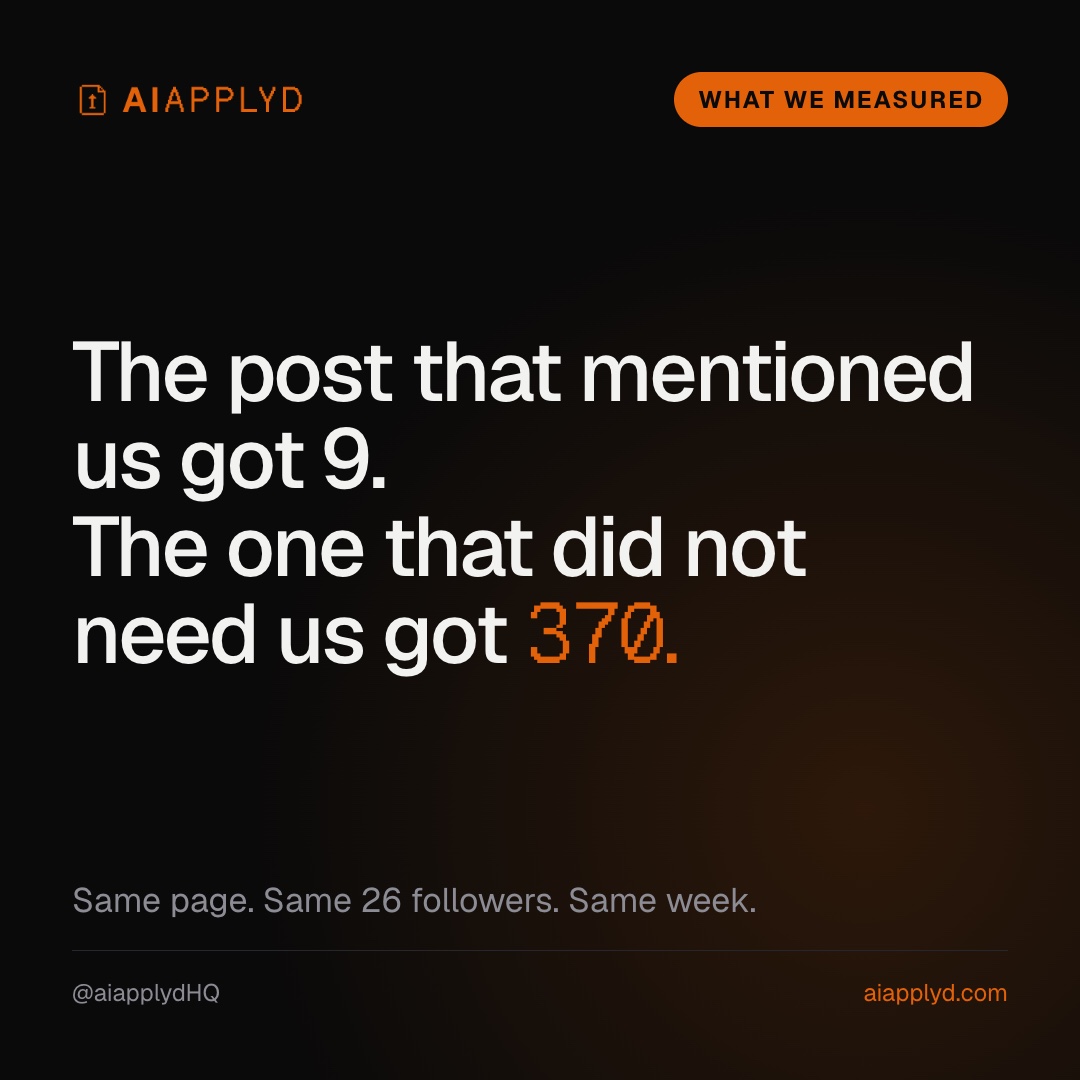
so the variable was not quality and it was not the follower count. it was whether the post was complete without us.
here is the part that bothers me. the version that travels is the version where the call to action is genuinely optional, because the moment it stops being optional the post goes back into the 9 to 35 band. which means the content that reaches people is structurally the content that converts worst per impression, and the content that converts is structurally the content nobody sees.
everyone resolves this by saying build trust first, convert later. i do not think that is an answer, i think it is a way of not having a number. our signups did roughly double over the same two weeks and i cannot attribute a single one of them to this, because the referrer is null on 22 of 24.
so the genuine question, and i do not have a view on it: has anyone actually watched useful-without-you content turn into customers, with attribution they trusted? or is the honest version that it buys reach and reputation, and the customers have to come from somewhere else entirely?
if it is the second one, then a lot of content advice is people describing a reach strategy and calling it a growth strategy.

@indieDevJim the on-off week design is the part I would push back on, and only because of our volume. Weekly signups swing between 2 and 15 with no content change at all, so a one week A/B gets swamped by noise before it measures anything. Branded search is the right instrument though, and I had not thought of it as the workaround for null referrers specifically. That one is checkable in Search Console with no new tooling, so I will pull it.
The named-framework idea is the strongest part of your comment. A memorable phrase is a referrer that survives an app stripping the header, which is the actual failure mode here rather than measurement being hard in principle.
@suraj09 agreed, and I have a number for the gap now. Thirty days on that page: 10,253 impressions, 2 site visits. The thing I had wrong was assuming the drop-off was interest. It is mechanical. A document post has nowhere to click, so the caption is the only place a URL can live, and most of us leave it out entirely.
Running the cheap version today: three posts, same page, same day, one with a UTM'd link and two without. If the linked one takes a reach hit, that is the trade-off finally priced. If it does not, a lot of people are leaving the destination out for no reason.
The null referrers make this hard, but you can test the claim without turning the checklist into an ad. Give each post a memorable phrase or named framework, add those phrases to a one-question signup survey, and watch branded-search queries alongside direct traffic. I’d also alternate content-on and content-off weeks. If reach jumps during the on weeks but signups, branded search, and self-reported mentions do not, that is useful evidence that you are buying reputation rather than demand. The post stays complete without the product, but its downstream footprint becomes measurable.
I think "reach" and "customer acquisition" are two different systems that often get mixed together. Useful content earns attention and trust, but I've found the highest-quality feedback usually comes from direct conversations with people already feeling the problem. Content opens the door; conversations are what actually move people toward becoming customers.
that synthesis is better than what i had, and i can tell you it is already true in a way i had not connected until you said it.
i spent this morning answering questions in other people's threads. three of them were, almost verbatim: how do i check whether my resume is ats safe and is there a tool for it, is this job offer a scam, and does listing 130 skills on an application help or hurt. those are not opinions, they are queries. people type those into a search box in the exact same words.
so the conversations were not just the acquisition channel, they were free query research, and i was treating the two as separate activities happening to occupy the same afternoon. the thing to write next is sitting in my own reply history and i had not looked at it that way.
the ordering you describe also fixes the problem i was complaining about in the post. content written from a real question is complete without the product by construction, because the person asked about the problem, not about us. so it gets the reach. and it is still the thing that gets cited later. i had those as a trade off and they are not.
i will come back with the six month number. our attribution is null on most signups right now, which is its own embarrassing problem to fix before any of this is measurable, so that is probably the actual next job.
i think you are right about the mechanism and i want to test the edge of it, because our own numbers half agree with you and half do not.
the agreeing half: the single highest return action we have measured was not a post at all. it was one comment left in somebody else's already hot thread, which took about 62 karma in fifteen hours, while our own post the same day went to zero. that is your point exactly. the conversation did the work and the broadcast did nothing.
the half that does not fit: over ninety days our two biggest non search referrers are chatgpt and bing, about 20 and 19 people. that pair out refers every social channel we own added together. those arrivals involve no conversation at all. nobody talked to them. an answer engine read a comparison page we wrote and cited it, and the person showed up already knowing what the thing does.
so for us the ranking is not conversations beat content. it is more like: conversations beat broadcast, and citations beat both, per unit of effort. the citation lane is also the only one that keeps working while i sleep, which the conversation lane very much does not.
what i cannot tell yet is whether that is real or just an artefact of us being tiny. twenty people a month is a rounding error, and it might be that citations look efficient only because the denominator is small enough that a handful of pages can cover the whole question space.
have you seen the citation lane hold up at any scale, or does it stop compounding once the obvious queries are answered and you are competing with everyone else's comparison page?
That's a really interesting observation. I don't think I have enough experience at scale to answer that confidently. My intuition is that citations probably compound differently from conversations. Conversations create insights you can act on immediately, while citations create a steady discovery channel over time. If I had to guess, I'd expect the biggest advantage to come from combining both—using conversations to understand what people are actually asking, then creating content that becomes worth citing for those questions. I'd be interested to see whether your data still points in that direction six months from now.