The Pricing-PMF Disconnect - Why Your $99/Month Is Killing Your Growth
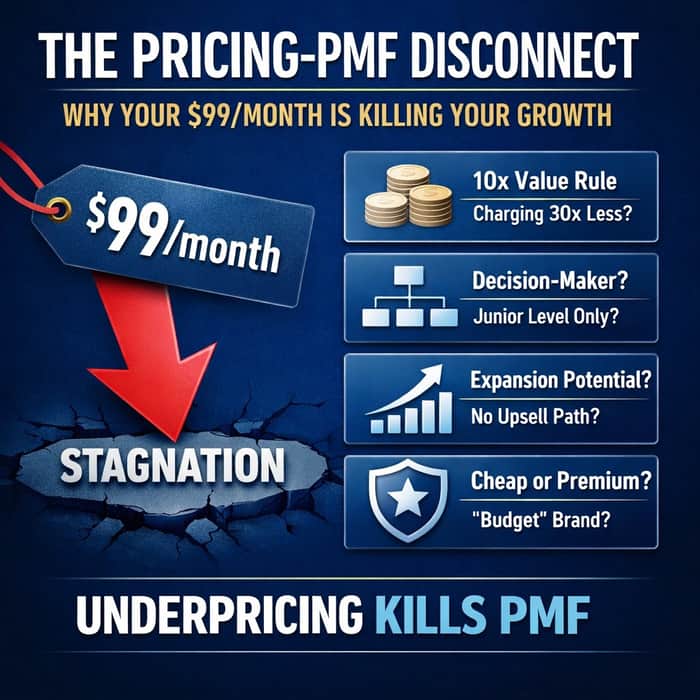
You Don't Have a Growth Problem. You Have a "Wrong Price for Wrong Value" Problem.
Had a brutal conversation with a founder last month:
Him: "We can't scale past $50K MRR. We've been stuck for 8 months."
Me: "What are you charging?"
Him: "$99 per user per month."
Me: "What's the ROI your customers see?"
Him: "They save about 15 hours per week. At $50/hour, that's like... $3,000 per month in value."
Me: "So you're delivering $3,000/month in value and charging $99?"
Him: "Yeah... we wanted to be affordable."
I found his problem in 30 seconds.
His pricing wasn't just wrong. It was DESTROYING his product-market fit.
Here's why:
Pricing isn't a revenue decision. It's a PMF signal.
And most SaaS founders are sending the wrong signal to the wrong market.
The Pricing-PMF Death Spiral:
When you underprice, here's what actually happens:
→ You attract customers who want "cheap" (not "valuable")
→ Those customers have low willingness-to-pay for expansion
→ They churn faster because they don't perceive high value
→ You can't afford great support, so experience degrades
→ Your brand becomes "the budget option"
→ Enterprise customers won't touch you (you're not "serious" enough)
→ You're stuck in a race to the bottom
This is PMF self-sabotage.
The Framework That Fixes Pricing-Induced PMF Failure:
I call this The Value-Price Alignment Diagnostic, and it reveals if your pricing is killing your fit:
Test 1: The 10X Value Rule
"Is your annual contract value at least 10X LESS than the annual value you deliver?"
If NO → You're overpriced relative to value (hard to justify)
If YES but you're charging 50X less → You're leaving massive money on the table AND attracting the wrong ICP
Why this matters:
The rule: Customers should get 10X the value they pay.
You charge $10K/year → You should deliver $100K/year in value
You charge $1K/year → You should deliver $10K/year in value
If you're delivering $50K in value and charging $1K, you're not "being generous."
You're attracting customers who don't value the outcome enough to pay for premium service.
Real example:
Client was charging $500/month for a tool that saved companies $15K/month in operational costs.
30X value-to-price ratio.
I said: "You're either lying about the value, or you're radically underpriced."
We tested $2,500/month (6X value ratio). Close rate dropped 12%. But average contract value went up 5X.
Revenue went from $35K MRR to $127K MRR in 5 months. SAME number of customers.
Better customers. Better revenue. Stronger PMF.
Test 2: The Decision-Maker Test
"At your current price point, who has approval authority to buy from you?"
If it's a JUNIOR person with a credit card → Your pricing is in the "expense" category (weak PMF, high churn risk)
If it's a SENIOR person with budget approval → Your pricing is in the "investment" category (strong PMF, strategic value)
Why this matters:
$99/month = Expensed by individual contributors (no strategic value, easy to cut)
$2,000/month = Approved by directors/VPs (strategic decision, defended in budget cuts)
The higher you price, the higher up the org chart you sell.
And the higher up you sell, the more you're positioned as STRATEGIC, not TACTICAL.
Real example:
Founder was stuck selling to marketing coordinators at $150/month. High churn. Lots of "we love it but had to cut costs."
We repriced to $1,800/month and repositioned for marketing VPs.
Suddenly, he was in budget planning meetings, not credit card swipes.
Churn dropped from 8% monthly to 2% monthly.
Because VPs don't cancel strategic investments. Coordinators cancel expenses.
Test 3: The Expansion Ceiling Test
"At your current price, is there room to expand revenue from existing customers, or are you already maxed out?"
If customers are paying $50/month and you can't charge more → You have no expansion path (PMF ceiling)
If customers are paying $500/month and you can add seats/features/tiers → You have expansion PMF
Why this matters:
PMF in 2026 isn't just about acquisition. It's about EXPANSION.
If your pricing is so low that there's nowhere to go, you can only grow through new logos.
And new logo acquisition is 5-7X more expensive than expansion.
Real example:
Client had 200 customers at $99/month. No upsells. No seat expansion. Flat revenue.
We restructured pricing:
Starter: $299/month (3 seats)
Pro: $799/month (10 seats + advanced features)
Enterprise: $2,500/month (unlimited + dedicated support)
Within 90 days:
40% of customers upgraded to Pro
12% upgraded to Enterprise
MRR went from $19,800 to $68,400
Same customers. Better pricing architecture. Expansion PMF unlocked.
Test 4: The Competitive Positioning Test
"When prospects compare you to competitors, do they see you as 'the cheap option' or 'the premium solution'?"
If "cheap option" → You're in a race to the bottom (weak PMF, commoditized)
If "premium solution" → You're defensible (strong PMF, differentiated)
Why this matters:
"Cheap" is not a moat. Anyone can undercut you.
"Premium" requires delivering outcomes competitors can't match.
Your pricing signals which game you're playing.
Real example:
Founder was charging $79/month. Competitors were at $150-$300/month.
Prospects said: "You're the affordable option, right?"
He thought that was good. It wasn't.
Because "affordable" customers don't expand, don't refer, and leave the second someone cheaper shows up.
We repriced to $349/month and added outcome guarantees.
Lost 30% of prospects. But the 70% who stayed:
Had 3X higher LTV
Churned 60% less
Referred 4X more customers
Premium pricing attracts premium customers. Budget pricing attracts budget customers.
The Brutal Pricing-PMF Truth:
Your pricing tells the market who you're for.
$50/month = I'm for individuals with personal credit cards
$500/month = I'm for teams with department budgets
$5,000/month = I'm for companies with strategic initiatives
If you want enterprise PMF, you can't charge startup prices.
If you want expansion PMF, you can't price yourself into a ceiling.
If you want strategic PMF, you can't be an "expense."
The Diagnostic:
Run these 4 tests on your current pricing:
Are you delivering 10X+ the value you're charging? (If YES and it's 30X+, you're underpriced)
Who approves your purchase? (If it's not director-level+, reprice upward)
Can existing customers expand revenue? (If NO, restructure your pricing tiers)
Are you seen as premium or cheap? (If cheap, you're in a death spiral)
Score yourself:
4/4 = Your pricing supports strong PMF
2-3/4 = Your pricing is limiting your growth potential
0-1/4 = Your pricing is actively destroying your PMF
The Action Step:
If you scored 2 or below, you have 60 days to fix this.
Test a 2-3X price increase with your next 10 prospects. See what happens.
I guarantee:
Close rate drops 20-40%
But average deal size goes up 200-300%
And the customers you DO close are higher quality, lower churn, better fit
That's not a pricing problem. That's PMF optimization.
Drop your current price point below (e.g., "$149/month") and I'll tell you if it's signaling the right PMF or destroying it.
I'll personally review the first 10 and tell you:
If you're underpriced, overpriced, or in the zone
What price point would unlock expansion PMF
How to reposition to justify premium pricing
This is the exact diagnostic that helped 4 clients 3X their MRR without adding a single customer. 👇
P.S. If you're "the affordable option," you don't have PMF. You have a commodity product competing on price. Fix your pricing, fix your positioning, fix your PMF.
Follow me on LinkedIn: https://www.linkedin.com/in/robert-moment-pmf-consultant
Connect with me: www.noguessworksaasstartupplaybook.com

Useful build. The signal most teams miss isn’t “page changed” — it’s whether the change forces a decision.
SIGNAL: founders usually open competitor pricing when a live choice is stuck (plan rename, seat math, annual discount, feature gate).
GAP: raw change alerts dump every CSS/copy tweak into the same inbox, so the move that matters gets treated like noise.
ACTION: tag each alert by decision type (price ↑/↓, seat definition, feature moved behind paywall, annual incentive) and only escalate when it maps to a choice your ICP is making this quarter. Everything else can stay a weekly digest.
Curious whether early users ask for “notify me of any change” or “notify me when price/packaging moves.”
Correction — wrong paste on my side (draft meant for a competitor pricing-change alert thread).
On THIS post:
SIGNAL: a $99 sticker often selects buyers who optimize for cheap, then stall when you ask for seats or usage expansion.
GAP: “first paid” gets treated as PMF proof, but if that buyer can’t expand (or won’t approve a higher tier), you’ve validated curiosity cash — not durable pricing power.
ACTION: before celebrating the $99 conversion, run one expansion probe with those same buyers: one concrete upgrade that maps to an outcome they already got (extra seats, higher limit, done-for-you). If they flinch hard, the issue isn’t growth tactics — it’s who the price invited.
Curious whether people who reprice upward keep their early $99 cohort or intentionally churn them.
Pricing isn’t just monetization — it’s a classification filter for who you attract.
What’s interesting is how pricing silently defines:
user seriousness
support burden
product usage depth
So underpricing doesn’t just reduce revenue — it changes the type of product you end up building.
Hey Robert, I agree with you.
, and I think you’re pointing at the real issue: pricing is part of product–market fit, not something you fix at the end with math.
Underpricing doesn’t just reduce revenue. It shapes who shows up. Cheap pricing pulls in buyers who optimize for cost, not outcomes, and that quickly turns your offer into a commodity. Once you’re framed as the budget option, everything becomes harder: retention, delivery, margins, and results.
Higher prices change behavior.
When someone pays more, they pay more attention.
They show up, implement, and take responsibility for the outcome. That alone increases perceived value and real results. Price is a signal, not just a number.
The value gap matters.
People say yes when the upside is obvious. If someone is paying $10k, they should clearly see multiples of that coming back to them. When value materially outweighs price, the decision stops feeling risky.
Pricing also selects the buyer.
Selling to junior decision makers turns your offer into an expense that gets questioned. Selling to senior buyers with budget authority reframes it as an investment. Moving upmarket usually fixes churn and margin issues in one move.
And yes, higher prices may lower close rates. That’s fine. Fewer customers paying more, with better fit and better outcomes, almost always beats chasing volume.
Net takeaway: pricing is a feature of the product. When value and price are aligned, you stop competing and start owning the space.
If you want a second set of eyes on your pricing, value gap, or offer positioning, reply here or DM me. Have a great week.