The product iceberg
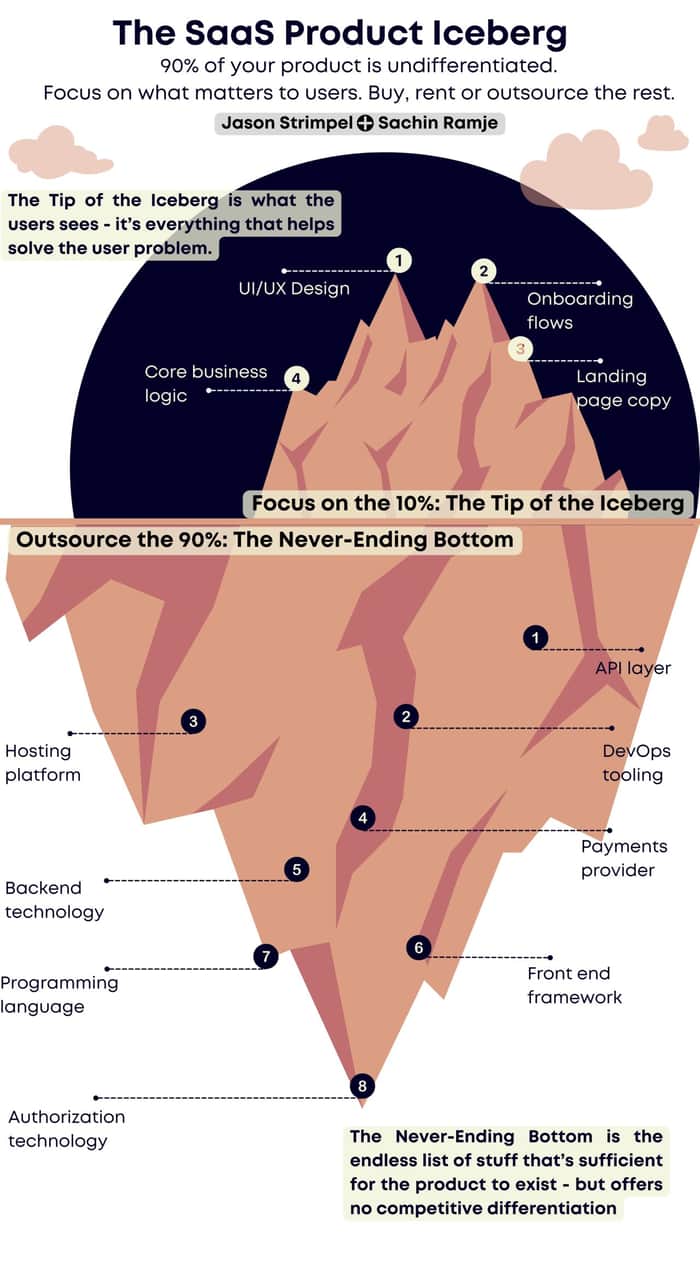
Most people building products focus on the wrong thing.
Infrastructure. Code. Libraries. Frameworks.
These don't differentiate your product.
Truth is, 90% of a SaaS product is undifferentiated. This is the Never Ending Bottom. The endless list of stuff that's sufficient for the product to exist - but offers no competitive differentiation.
10% of the product is what differentiates it from the competition. The Tip of the Iceberg is what users see - it's everything that helps solve the user problem.
Focus on the 10% - the Tip of the Iceberg.
Buy, rent or outsource the rest - the Never Ending Bottom.

Thanks for sharing @jasonstrimpel. I truly agree that your USP definitely is going to be onboarding flow, UI/UX Design and the landing copy. What do all of these unite? The touchpoints with the actual customer, heavily user experience activities. You must learn and understand as much as possible about the the users you serve and their problems. The next step is to find out a nifty solution how to fix their problems, better than the competitors. Mostly, it's the tip of the iceberg that differentiates you. Beware though that back-end problems, when not in your hands, can easily mess up the tip of the iceberg which in return will make users unhappy for sure.
How do you embedd a highly user-centered driven product mindset (UX) in order to differentiate?
Great question. There’s some tactical things like remove all jargon, make the copy very simple, and make it easy to reach the core functionality.
Onboarding is a great example. It’s the first time a user interacts with your product. You want to move them from 0 to productive as fast as possible. If you do it well, users become power users and stick around. If you don’t users get confused, frustrated, and quit.
Great illustration, it naturally conveys all the parts that make up a product. You are totally right. As developers we often get caught up with tasks underwater, it's essential to internalize that the technology does not matter for a long time in a products life.
No doubt that later on, the right stack can boost your product another 10% against your competitors.
Upgrading your tech stack once the product is successful is, however, a champange problem.
Tech can differentiate but only if it directly serves to solve a customer problem. At some point, clunky tech degrades the CX so badly it becomes a problem. It’s a bit asymmetric that way.