The Production Incident That Changed How I Think About Blockchain Infrastructure
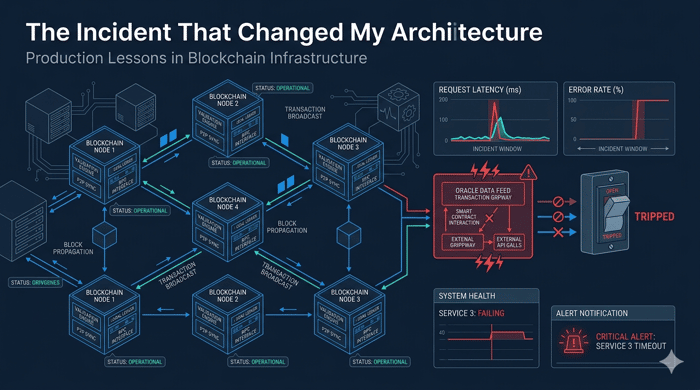
Most blockchain discussions focus on consensus algorithms, transaction throughput, or smart contract security.
Production systems taught me a different lesson.
Many outages don't begin with the blockchain itself.
They start with the assumptions we make around it.
One realization that changed my engineering mindset was this:
Every dependency will eventually fail.
The question isn't whether a failure will happen.
It's whether your architecture expects it.
Here are five principles that have become part of how I evaluate blockchain infrastructure today.
1. Every external dependency is a potential failure point
RPC providers, databases, queues, caches, APIs, and cloud services all introduce risk.
The more dependencies you add, the more carefully you need to think about failure isolation.
2. Healthy services can still produce unhealthy systems
Each component might appear healthy on its own.
But when latency increases across multiple services, users experience failures long before monitoring dashboards show red alerts.
3. Graceful degradation is often better than perfect availability
If one subsystem fails, users shouldn't lose access to everything.
Returning partial functionality is often a better experience than complete downtime.
4. Incidents reveal architecture weaknesses
Postmortems shouldn't focus on assigning blame.
They should answer one question:
What assumption failed?
Improving that assumption often prevents an entire class of future incidents.
5. Reliability is designed, not added later
Monitoring, retries, circuit breakers, back-pressure handling, and observability work best when considered during system design rather than after launch.
The biggest lesson I've learned is that production engineering is less about preventing every failure and more about building systems that recover quickly when failures occur.
These lessons continue to shape how I approach blockchain infrastructure and distributed systems.
— Peesh Chopra
Question for other founders and engineers:
What's one production incident that permanently changed the way you build software?
