The Real Bottleneck in AI Workflows Isn’t the Model — It’s the Way We Use Prompts
The Real Bottleneck in AI Workflows Isn’t the Model — It’s the Way We Use Prompts
You now you can create your prompts right in your editor as your ai agent doing the work on the side, with Lumra's Vscode Extension
There’s a point most of us hit the wall when working with AI tools.
At the beginning, it feels fast and almost magical — you type something, get a response, tweak it a bit, and move on. But as soon as your workflow gets even slightly more complex, things start to break down.
Prompts become scattered.
You start copy-pasting from old notes.
You tweak small parts over and over again.
And without realizing it, you’re no longer building — you’re juggling.
The Problem: Prompts Don’t Scale Well
The core issue isn’t the AI. It’s that prompts are usually treated as disposable inputs instead of something structured.
But the moment you:
- reuse logic
- iterate multiple times
- depend on consistent outputs
…your prompts stop being simple text and start becoming a system.
The problem is, most tools don’t support that shift.
What Changed My Perspective
Instead of trying to manage prompts across notes, tabs, or random documents, I started looking for ways to bring structure into my actual workflow.
That’s why i created Lumra.
What stood out wasn’t just the idea of organizing prompts—but doing it directly inside VS Code.
Why VS Code Changes Everything
Having this inside the editor feels different.
No switching tabs.
No breaking focus.
No digging through old messages.
Instead, you can:
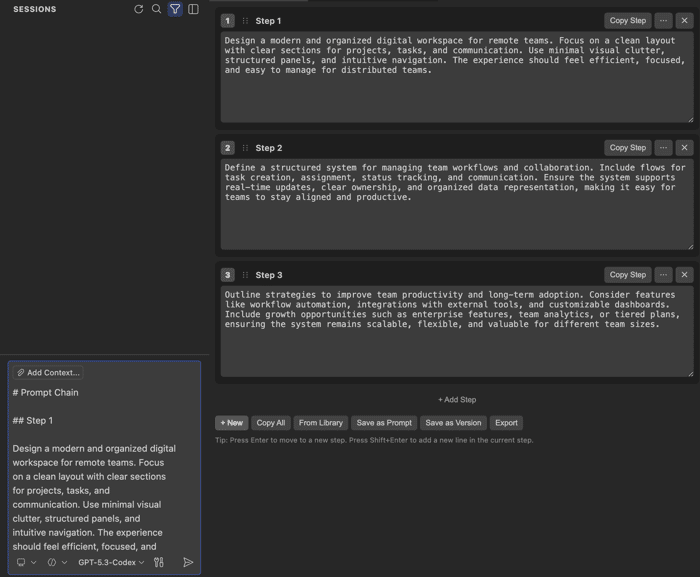
- plan prompt chains step-by-step
- iterate in a structured way
- reuse and refine parts over time
It starts to feel less like “prompting” and more like building a system that evolves.
The Subtle Shift That Actually Matters
The biggest difference isn’t convenience — it’s consistency.
When your prompts are structured:
- outputs become more predictable
- iteration becomes faster
- and your workflow starts compounding instead of resetting every time
That’s when AI stops being something you experiment with
and starts becoming something you can actually rely on.
Curious how others are approaching this — are you still treating prompts as one-offs, or have you found ways to structure them over time?

I tend to create a summary after a while - then go from there. Helps not losing the thread and also ensuring AI has all the required information in the latest message
That’s a really solid approach.
Summarizing along the way is almost like maintaining state manually — you’re keeping the “context window” clean and relevant instead of letting it drift.
I’ve noticed the same thing: when you don’t do this, the conversation slowly degrades and the outputs get noisier. A quick structured recap resets everything and keeps the quality high.
I've seen the same in the tool I'm building: prompt & response structure is everything!
At some point you realize it’s not about the model anymore — it’s about how you structure the interaction.
Same prompt, same model… but different structure → completely different results.
That’s actually what I’ve been focusing on lately: treating prompts + responses as a system, not just one-off inputs. Once you do that, the consistency jump is huge.