The Real Cost of Hiring Your First Engineer- What No One Tells You
I spent three weeks obsessing over our seed deck. Revised the TAM slide six times. Ran our unit economics through every stress test I could think of.
And, when it came to hiring our first engineer, I thought I was being equally careful. I had a budget in mind. I compared salaries. I even negotiated hard.
I still got it wrong.
That decision cost us four months and a significant chunk of runway.
Not because the engineer was bad. But because I didn’t understand what I was really paying for.
I went in thinking I had done the math. Turns out I had only done part of it. Salary, yes. Everything else, including the weeks it took to hire, the ramp-up, the way it pulled me away from actual product work, I had not thought through any of it."
If you're about to make your first engineering hire, this is what I'd go back and tell myself.
Why the Salary Number Is a Lie
When I made that first hire, I anchored on compensation. Most founders do. But the salary ended up being ~55% of the real cost.
The real cost of an engineering hire breaks down across three layers that most founders don't map out upfront. Here’s what fills the gap:
Direct Costs (the obvious ones)
Salary or contract fee
Benefits (add 20–25%)
Laptop, software licenses, and cloud access
Indirect Costs (where it gets expensive)
20–30 hours per week spent on sourcing, screening, and interviewing
5 weeks of hiring delay pushed our launch timeline
6 weeks ramp-up before meaningful output
Risk Costs (the ones no one tells you about)
Rushed code created technical debt
Constant context switching hampered my actual founder work
Replacing a mis-hire cost me 1.5–2x salary
Salary is the floor, not the ceiling. Once I started mapping the full picture, it completely changed how I evaluated which hiring path made the most sense for our stage.
The Three Hiring Models, And When Each One Actually Makes Sense
I didn’t pick one approach. I tried multiple, mostly out of necessity.
A Full-time Engineer
Like most founders, this was my first instinct. I thought: real startups hire full-time engineers early. And it's not wrong, it's just often mistimed.
Why I did it
Wanted someone to “own” the product
Believed long-term alignment would pay off
What actually happened
6 weeks to hire + noticed period
Burn started immediately
Product direction was still evolving → mismatch
Where it works
You have product clarity
You’re post-PMF ( Product-Market Fit) or close
Where it breaks
Early ambiguity
Short runway
Undefined scope
Contractors/ Freelancers
After my first full-time mis-hire, I swung to contractors. For specific, bounded work, such as an MVP feature, a prototype, or a key integration, it worked really well.
Why I did it
Engagement in 3-7 days
Productivity within two weeks
No long-term burn commitment
What actually happened
Hired within days
Initial velocity was great
But continuity collapsed
Where it works
Clearly scoped tasks (MVP, landing page, feature)
Short-term execution
tight timelines
Where it breaks
Evolving products
Ongoing maintenance
Anything requiring ownership
Contract-to-Hire
This became my personal favorite after a few rounds of hiring. Bring someone on as a contractor for 60 to 90 days with an option to convert to full-time. Both sides are evaluating each other with lower stakes, which completely changes the dynamic. By day 90, you already know how each other works. That made it the smoothest onboarding I have had.
Why I did it
Wanted real signal before committing to a full-time hire
90-day contract with deliverables tied to actual milestones
Option to convert full time
What actually happened
Lower pressure on both sides
Real evaluation based on actual work, not interviews
Smooth transition when it worked
Where it works
Early-stage teams
Unclear long-term needs
High cost of mis-hire
Where it breaks
Slightly higher short-term cost
But significantly lower long-term risk
Time-to-Hire vs Time-to-Product: The Metric That Matters
Cost per hire is a clean number. It feels like the right thing to track.
But what actually determines whether a hiring decision was good or bad is the time to reliable output, i.e., how quickly you went from "we need an engineer" to "we're shipping."
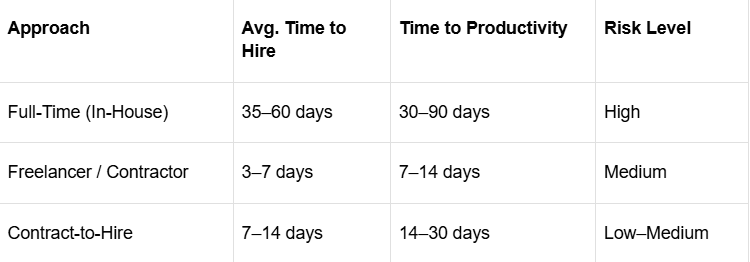
Insight: The fastest hire isn’t always the fastest path to shipping. Focus on the fastest path to reliable output, and that's a function of vetting quality, not just speed.
How to Actually Decide
I now run three filters before I post anything or start any conversation:
Runway- Less than 12 months? Don't take on long-term fixed costs. Start with a contractor.
Product clarity- No stable roadmap yet? You need an adaptable builder, not a specialist. Contractor or contract-to-hire keeps your options open if scope shifts.
Validation- Already proven out the role, you know what needs building and what good looks like? Then a full-time hire makes sense. If not, contract-to-hire lets you figure that out without the full commitment.
What I’d Do If I Started Again
Start with contract-to-hire
Skip job boards at the early stage
Use a hiring platform for faster time-to-productivity
Move to full-time only after product direction stabilizes, and the engineer has already proven fit
One thing that genuinely helped us move faster without compromising on quality was working with a talent partner instead of sourcing cold. We used Uplers, the shortlisted engineers were strong, the speed was real, and we didn't spend weeks filtering resumes. Worth knowing about if you're at that stage.
The real question is not which hiring model costs less. But which one costs less, given where your product is right now. That answer changes every six months. So should your hiring approach.

