The Real Cost of Unproductive Meetings: Why Too Many Meetings Hurt Productivity
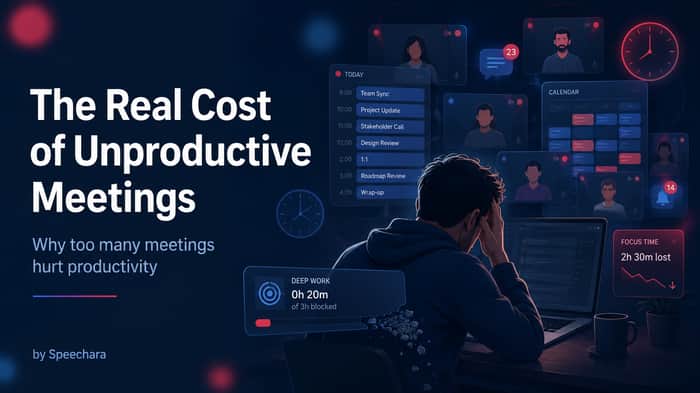
A calendar packed with meetings can look like a productive workday.
Often it is not.
Most teams genuinely need meetings. Problems have to be discussed, decisions have to be made, clients need to be heard, and sometimes five minutes of conversation can replace an hour of messages.
The trouble starts when meetings become the default answer to everything.
Need a status update? Meeting.
Need to ask three people a question? Meeting.
Need to tell everyone something that could fit into six lines of text? Somehow, also a meeting.
Each meeting looks small on its own. Together, they can consume the time people need to do the work discussed during those meetings.
The direct cost is easy to underestimate. A one-hour meeting with ten people is ten employee-hours. At an average fully loaded cost of $60 per hour, one weekly meeting represents $31,200 of employee time over a year.
That does not mean every meeting is wasteful. A meeting that closes a major deal or solves an important technical problem may be worth far more than its direct cost.
The better question is: was having all ten people together for an hour the best use of those ten hours?
The hidden cost is often even bigger. Meetings break the day into fragments. You may have 45 minutes before the next call, but that is not always enough time to get deeply into a difficult programming problem, proposal, or design. Then the meeting ends, another short block appears, and the day finishes without a long uninterrupted stretch of focus.
Bad meetings also reproduce. When decisions, owners, and next steps are not recorded clearly, people remember the conversation differently. A few days later someone asks what was agreed, and another meeting appears to reconstruct the first one.
The patterns behind unproductive meetings are usually familiar:
- nobody knows what the meeting is supposed to achieve;
- too many people are invited just in case;
- the discussion could have been an async update;
- nobody captures the decisions and next steps;
- the outcome is not accessible to people who were not there.
Distributed teams add time zones and language to the problem. A fast technical conversation can be tiring when it happens in a second language, with interruptions, accents, weak audio, or unfamiliar terminology. Someone may understand most of the discussion while spending a lot of attention making sure they did not miss the important part.
There is no perfect meeting template, but useful meetings tend to have a clear reason, only the necessary participants, a short agenda, captured decisions, named owners, and an accessible outcome afterward.
This is where AI can help, although it cannot make an unnecessary meeting necessary.
Live transcription, translation, meeting history, and summaries reduce the administrative work around a conversation. People can focus on listening instead of typing notes. Someone who missed the call can catch up. A decision made three weeks ago does not have to depend on somebody's memory.
That is the problem we are working on with Speechara. The goal is not to create more meetings. It is to help teams get more value from the conversations they already decided were worth having.
The best meeting may still be no meeting. Cancel it, send the update, ask the question in chat, or record a short message when that is enough.
But when a real conversation is necessary, it should leave something useful behind.
What meeting did you remove, shorten, or redesign that made the biggest difference to your team?

The part about meetings reproducing themselves really resonated with me. I've experienced that cycle more than once, and I've been thinking about a similar pattern in our recent writing on how systems evolve around the way organizations actually work.
A conversation happens, but the useful context isn't preserved clearly enough. A few days later, another conversation is needed just to reconstruct what was already decided.
It makes me think the real output of a meeting isn't necessarily the conversation itself. It's what remains afterward - the decision, reasoning, owner, and context that someone can still understand later without having been in the room. When useful context isn't preserved, organizations end up repeatedly paying to recreate it.
That resonates. We’ve seen something similar with Speechara: the transcript is useful, but the real value is being able to recover the decision and context later without replaying an entire meeting. We’re experimenting with treating the meeting record as a handoff: what was decided, why, who owns it, and what happens next. The hard part is preserving enough context without creating another document nobody reads. Have you found a format people actually revisit after the meeting?