The section that actually makes people use your product (it’s not the hero)
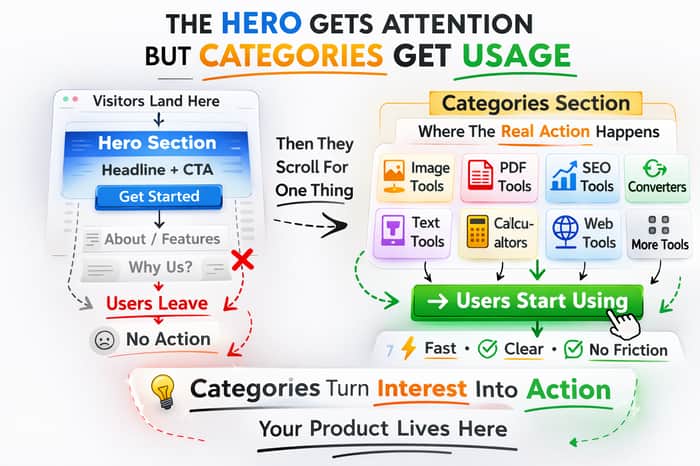
When I launched AllInOneTools, I obsessed over the hero section.
Headline.
Copy.
Positioning.
I thought:
If the hero is good, people will use the product.
I was wrong.
The hero gets attention.
But the categories section gets usage.
What users actually do
Builders imagine this:
Landing → read hero → understand product → explore
Reality looks like this:
Landing → scroll → scan → find their tool → use it
Nobody was reading my intro.
They were looking for one thing:
“Where is my tool?”
They didn’t want explanation.
They wanted location.
The moment this became obvious
Watching early users changed everything.
They scrolled past:
• Hero
• Description
• Branding
And stopped at:
• Image Tools
• PDF Tools
• SEO Tools
• Converters
Not curiosity.
Task intent.
That section decided whether they stayed.
Or left.
Categories aren’t navigation
They are activation.
Their job isn’t to look nice.
Their job is simple:
Help users find their task in seconds.
If users find it → they act
If they hesitate → they leave
Even if your product is great.
The biggest mistake I made
I optimized the hero first.
I should have optimized categories first.
Because:
Tools are the product.
Categories are the entry points.
The mental model I use now
Hero → gets attention
Categories → create usage
Without categories, your homepage is just a promise.
Categories turn it into action.
Curious how others think about this
When you design your homepage…
What do you optimize first?
Hero?
Or the section where users actually start using the product?

Cold outreach scales linearly - same effort per reply every week. It's necessary for early traction but the founders who get to $10k+ MRR almost always layer in a compounding channel underneath it. SEO, community, partnerships, or product-led growth.
What's the channel you're betting on to build independently of your outreach?
Good point. I’m mostly betting on product-led growth and SEO — if someone searches for a tool and finds it quickly, the product markets itself.
this maps exactly to what i found building an AI video tool. users didnt care about our fancy pipeline description or the tech stack explanation. they wanted to see: script → images → video. three steps, visible immediately.
the task intent framing is key. people arrive with a job in mind, not curiosity. for tool-based products especially, the homepage should function like a restaurant menu - dont explain the cooking philosophy, show me what i can order.
one thing that extended this insight for us: we added the most popular tool as the default landing state. instead of showing categories and making them pick, we showed the image generator already loaded with an example. reduced time-to-first-action from ~30 seconds of browsing to immediate interaction. the category picker was still there, but the default state was already doing something useful.
One small change that made a big difference for me was showing actual tools inside each category — not just the category names.
Users don’t want to explore categories.
They want to confirm instantly: “Yes, my tool is here.”
That single change reduced hesitation and increased usage more than any hero copy tweak I made.