The Self-Host Versus Saas Decision, Told Through Routing Data
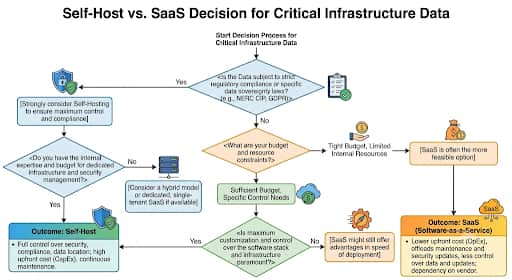
Every technical founder eventually faces the same fork for some critical capability: do you rent it from a service, or do you run it yourself? The default answer for the last decade has been rent. SaaS is faster to start, someone else handles uptime, and you avoid the operational burden. But there is a specific category where that default quietly breaks down, and it is worth understanding because the same logic applies far beyond the example I want to use.
The example is routing intelligence, the data that networks use to understand how traffic moves across the internet. It is niche, but the decision it forces is one almost every infrastructure business hits eventually. So it makes a clean case study in when self-hosting stops being ideology and starts being arithmetic.
Why rent is the sensible default
Start with the honest case for SaaS, because it is strong. When you are small, renting a capability is almost always right. You pay a predictable fee, you skip the setup, and you offload the maintenance to a team whose whole job is keeping the thing running. For anything that is not core to what you do, that trade is excellent, and founders who agonize over self-hosting non-critical tooling are usually optimizing the wrong thing.
Routing lookups fit this perfectly at first. Public services let you check who originates an address block, whether an announcement is cryptographically valid, and who owns a given prefix, all without running anything. If you touch that data occasionally, there is no reason to build.
Where the default breaks
The break comes when a rented capability becomes load-bearing. Three things change at once, and they compound.
The first is rate limits. Public services are built for occasional interactive use, so the moment you try to automate queries or wire them into monitoring, you hit ceilings that were never designed for machine traffic. The second is data exposure. Every query you send tells an outside party what you are looking at, which for operational or security work is information you may not want to share. The third is availability coupling. Once your ability to respond to a problem depends on someone else's service being up, their outage becomes your outage, usually at the worst possible time.
Notice that none of these are visible while the capability is peripheral. They only appear once you depend on it. That is what makes the self-host decision so easy to get wrong: the costs are back-loaded, and by the time you feel them, you are already built around the rented version.
The routing example made concrete
This is exactly the pattern that produced Netomics, which FastNetMon launched recently as a self-hosted routing intelligence platform. Its whole premise is that for operators who depend on routing data, the public-service model has quietly stopped fitting, which is why the company built it to be self-hosted from the start.
Instead of querying separate external tools, the platform ingests live routing feeds and joins them with historical data, ownership records, and cryptographic validation via RPKI into one model that runs inside the operator's own infrastructure. The pitch is not that self-hosting is virtuous. It is that once routing data is something you use constantly, owning it removes the rate limits, keeps your queries private, and cuts the dependency on an outside service's uptime.
FastNetMon founder Pavel Odintsov put the reasoning in operational terms: "Internet routing has become critical operational infrastructure, yet many organisations still depend on multiple external services to understand what is happening in their own networks. We built Netomics to give operators complete ownership of their routing intelligence while making it easier to troubleshoot incidents, automate workflows and improve routing security."
How to spot the line before it costs you
The useful skill is not deciding self-host versus SaaS once. It is noticing when a capability has quietly crossed the line, because the crossing is gradual and the invoice does not warn you. A few practical signals tend to show up first.
You find yourself writing retry logic and backoff around a third-party API purely to stay under its limits. That is a sign you are using a service in a way it was never priced or built for. You catch yourself hesitating before sending a query because of what it reveals about what you are investigating. That is a sign the data is more sensitive than the rented model assumes. And you realize, usually during a postmortem, that an outage you suffered was actually an outage in a dependency you do not control. That is the loudest signal of all, and it almost always arrives after the fact.
The teams that handle this well treat those signals as a trigger to reassess, not as background noise to route around. Reassessing does not always mean self-hosting. Sometimes the answer is a better vendor, or a paid tier with real guarantees. But the reassessment has to happen deliberately, because the alternative is discovering the line only when an incident drags it into view.
The general lesson for founders
Strip away the networking specifics and you are left with a heuristic worth keeping. Rent by default, but watch for the moment a rented capability crosses from convenience to dependency. The signals are consistent across domains. You start scripting around rate limits. You feel uneasy about what your queries reveal. You notice that an outage in a service you do not control now takes part of your product down with it.
When those signals show up, the arithmetic has changed even if the invoice has not. The question is no longer "is self-hosting worth the effort" but "can we afford to keep this on infrastructure we do not control." For a payments company that might be fraud tooling. For a data business it might be the pipeline. For a network operator it is routing intelligence. The domain differs, the decision does not.
The mistake is treating self-host versus SaaS as a fixed philosophy rather than a moving line. It moves as a capability becomes central to your business. The teams that handle it well are the ones who notice the line moving and act before an incident forces the issue, rather than after.
Renting is the right first answer. It is just rarely the permanent one for the things you cannot afford to get wrong.

