The "So What?" Problem: Why Smart Health Data Hits a Dead End (And How Physics Fixes It)
The "So What?" Problem: Why Smart Health Data Hits a Dead End (And How Physics Fixes It)
We are drowning in data but starving for solutions.
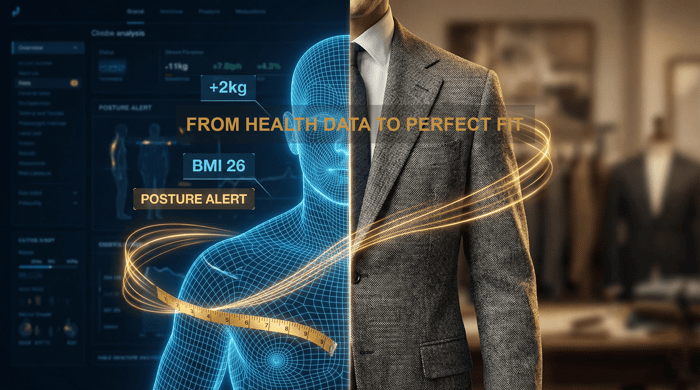
Every morning, millions of men step on smart scales. The app syncs. It tells them: Weight up 2kg. BMI (Body Mass Index) overweight.
Then it stops.
The device has done its job (delivering data), but it has failed the user (delivering value). It sells awareness, but it delivers anxiety. The user looks at the red numbers, feels guilty, and goes to work in a tight shirt that highlights exactly what the app just warned him about.
This is a broken product loop.
I’m Rosie, founder of a Phygital Tailoring platform. I’ve spent the last three years building a bridge between digital data and physical reality. When I look at your health app’s dashboard, I don't see a medical chart. I see a set of missing coordinates for a physical environment (clothing) that currently doesn't exist.
Here is why health data is "dumb" without a physical backend, and how we are trying to close the loop.
The Reality: It’s Not Just "Buying Clothes"
Skeptics often tell me: "Tailoring doesn't scale. You can't connect a Fitbit to a sewing machine."
Actually, we have spent the last 900 days building exactly that infrastructure. Watching users interact with my platform, I realized we aren't just a "shop." We are a Processing Unit.
The user enters a design and performs a self-scan via their phone - guided by a strict protocol (feet 7 inches apart, arms relaxed) to capture their exact geometry. We don't rely on standard templates. We extract the raw data - posture, shoulder slope, and volume distribution - and transmit it to our facility in Vietnam.
There, we combine algorithmic pattern-making with veteran craftsmanship to execute a garment that respects the user's biometric reality. We built this because digital data needs a physical destination. Without it, the data is just noise.
The "Correlation" Trap (Or: Why Weight is a Liar)
One of the biggest lessons from my dataset is that biology is nonlinear.
A common objection from engineers is: "You can't automate clothing based on health data. Weight loss doesn't equal size loss."
You are absolutely right.
I’ve analyzed scans where a user lost 3kg on the scale but increased their chest circumference due to muscle gain. If I used a linear algorithm based on that smart scale's data to automate his shirt size, I would have sent him a garment that strangled his lats.
This is where the "Phygital" model corrects the "Digital" error. We don't use health data to make the clothes blindly. We use it as a Trigger.
Health data is the Smoke Alarm; 3D Scanning is the Firefighter.
When a health app detects a significant trend (e.g., a +/- 5% mass variance), it shouldn't just award a digital badge. It should prompt a Re-calibration Event. It’s the signal that says: "Your geometry has shifted. Your environment is now obsolete. Let's re-scan."
The "Posture" Myth vs. Tactile Proprioception
Another area where data falls short is Posture. Your watch might buzz to tell you to stand up, but five minutes later, you are slouching again. The data is ephemeral.
There is a temptation in marketing to claim that a bespoke suit can "fix" back pain. Let’s be clear: That is pseudoscience. A shirt cannot cure kyphosis. Any fashion brand claiming their product medically corrects your spine is either lying or selling you a rigid brace.
However, tailoring has an ancient, non-medical feature that biohackers often overlook: Tactile Proprioception (Feedback Loop).
In mass-market clothing, armholes are cut huge and low to fit everyone. This creates a "dead zone" of fabric. You can slouch, hunch, or roll your shoulders forward (the "Tech Neck" syndrome), and the fabric doesn't react. It enables your bad habits.
In our logic, we cut a high armhole and a specific neck-point alignment. It’s simple physics: When you stand straight, the fabric feels weightless. The moment you slump, the high armhole gently catches your axilla.
It is not a brace forcing you into position. It is a sensory cue. It connects the "Digital Warning" (from your posture app) to a "Physical Sensation" (in your meeting), reminding your brain to reset your frame.
Closing the Loop
Why does this matter? Why would anyone pay for a custom garment just because their data changed?
Because humans crave Validation.
Biohackers spend hundreds of dollars on supplements and trackers to feel optimized. But clothing is the interface between that optimized body and the world. Wearing a "trophy" garment that fits the new geometry of your body is the ultimate validation of your hard work. It turns a boring spreadsheet number into a tangible reward.
- Health-tech optimizes the Body.
- Phygital Tailoring optimizes the Environment for that Body.
If we want to solve the "So What?" problem of health data, we need to bridge the gap between the App Store and the Wardrobe. I have built the Last Mile Infrastructure - from the 3D logic layer to the production line - ready to execute.
I’m looking for partners in the health-tech space who are tired of selling anxiety and are ready to start selling a complete lifestyle solution.
