The Ticket Resale Market Is Broken. We Are Building Ticket Hunter to Make It Fairer.
Ticket resale should be simple.
A fan buys a ticket. Plans change. They can no longer attend. Another fan wants to go. The ticket changes hands safely, at a fair price, with both sides protected.
That is what resale should be.
But that is not what the market has become.
Today, buying a resale ticket often feels like entering a system designed to confuse you. A ticket appears at one price, then the real cost only becomes clear at checkout. Fees are added late. Sellers lose money to platform charges. Buyers are pushed by urgency, scarcity messages and fear of missing out. And somewhere in the middle, the platform takes its cut.
The problem is not that resale exists. Resale is useful. People get ill, trains get cancelled, work changes, children get sick, friends drop out and plans fall apart. A genuine fan should be able to resell a ticket they cannot use.
The problem is that the resale market has become too opaque, too expensive and too comfortable with the frustration it creates.
That is why we are building Ticket Hunter.
Fans do not hate resale. They hate being exploited.
There is a big difference between fan-to-fan resale and industrial ticket flipping.
Fan-to-fan resale solves a real problem. Someone who cannot attend gets some or all of their money back. Someone who missed the original sale still gets a chance to go.
Industrial resale is different. It turns scarcity into a business model. Tickets are bought early, relisted at inflated prices and wrapped in extra charges that often appear only when the buyer is already committed.
That is where trust breaks.
Fans are not stupid. They know when a platform is helping them and when it is simply extracting value from desperation.
The frustration is especially obvious around high-demand events: Wimbledon, Oasis, Premier League matches, NFL London games, major festivals and sold-out arena tours. These are the moments when demand overwhelms supply, and the resale market becomes most aggressive.
Recent analysis has described this clearly: the resale market has become a tax on fans. That phrase lands because it feels true. Fans are not just paying for the ticket. They are paying for the privilege of navigating a broken system.
The listed price is often not the real price.
The biggest complaint in ticket resale is not always the headline price. It is the gap between the price you first see and the price you finally pay.
A buyer might click on a ticket because it looks affordable. They compare it against other options. They decide it is the best choice. Then, at checkout, the total jumps.
Service fees. Buyer fees. Delivery fees. Processing fees. Sometimes the final price looks nothing like the original listing.
That is not transparency. That is drip pricing.
And in ticketing, drip pricing is especially damaging because buyers are under pressure. They are worried the ticket will disappear. They may be buying for a birthday, a final, a reunion tour or an event they have waited years to attend.
By the time the full price appears, many fans feel too invested to walk away.
That is not a healthy marketplace. It is a conversion trick.
This is why the wider resale rip-off is now being challenged. The issue is not only price. It is trust, timing and whether the buyer is given enough information before making a decision.
Sellers are punished too.
The current system is not great for sellers either.
If you bought a ticket honestly and can no longer attend, you should be able to resell it without being penalised. But many platforms charge sellers as well as buyers. That means a genuine fan may have to inflate the resale price just to recover their original cost.
This creates a bad loop.
The platform charges the seller.
The seller raises the listing price.
The buyer then gets charged again.
The platform wins twice.
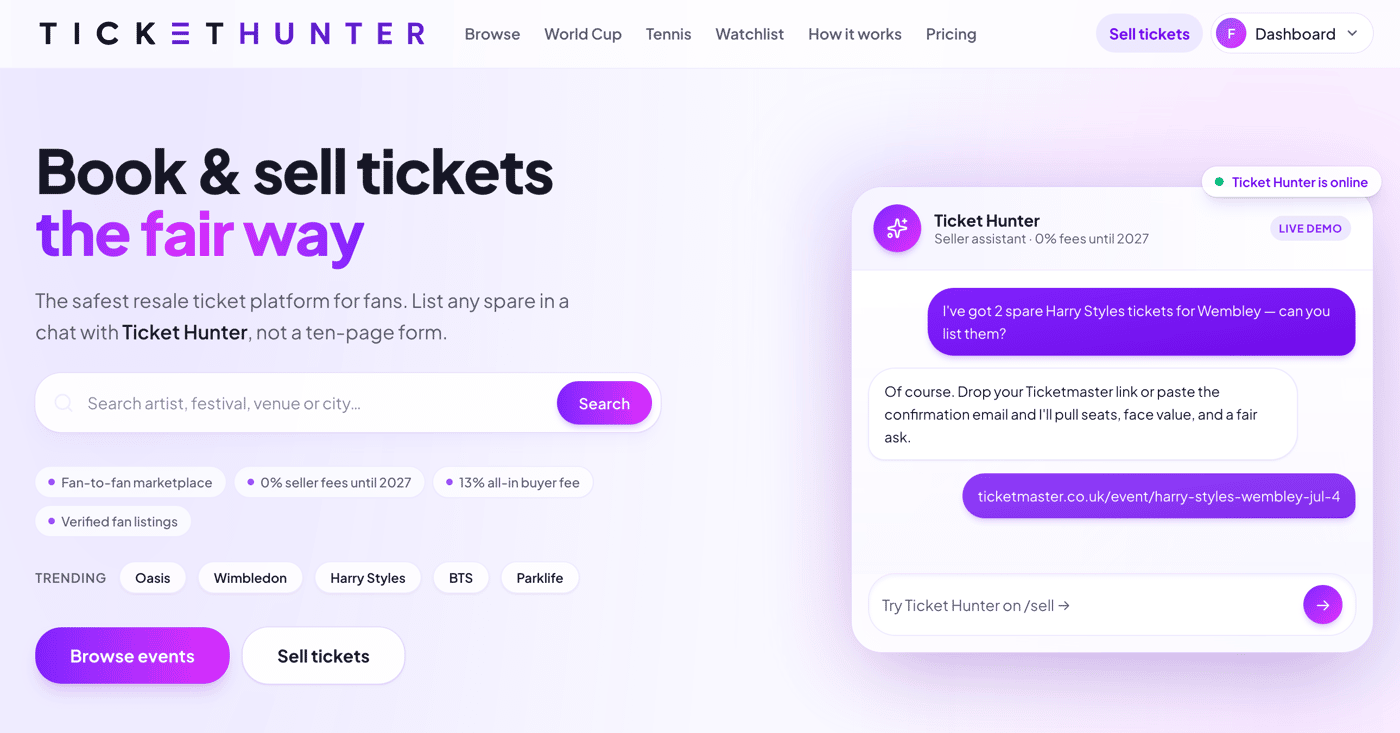
That is one of the reasons Ticket Hunter is being built around a different idea: zero seller fees while we grow the marketplace.
Sellers should not be punished for listing a ticket they can no longer use. Removing seller fees lowers friction, improves supply and makes it easier for genuine fans to list tickets at a reasonable price.
Fair pricing starts with fair incentives.
Verification is the other half of the problem.
Price is only one part of the trust crisis. The other part is whether the ticket is real.
Modern tickets are often digital. They sit inside apps. They depend on transfer rules, original ticket providers and event-specific restrictions. Some tickets cannot be transferred until close to the event. Others have naming rules, entry conditions or mobile-only requirements.
That creates risk for buyers.
Will the ticket arrive?
Is the seller genuine?
Has the same ticket been listed somewhere else?
Will the transfer work?
Will the QR code scan at the gate?
This uncertainty is why the future of the market has to move toward verified fan marketplaces, not just bigger resale platforms with more inventory.
Inventory matters, but trust matters more.
A marketplace with millions of listings is not useful if buyers do not feel confident that what they are buying is real.
Ticket Hunter is being built around trust from the start.
Ticket Hunter is not trying to be another version of the old resale model.
We are building it around a few simple principles:
Clear pricing.
No seller fees while we grow.
Verified fan listings.
Better ticket data.
Support for major ticket providers.
Watchlists for sold-out events.
A smoother way for genuine sellers to list tickets.
The goal is to make resale feel less like a gamble and more like a proper marketplace.
If a seller has a ticket, they should be able to list it quickly. If a buyer wants that ticket, they should understand what they are buying, what it costs and what protection they have before they pay.
That sounds obvious. But in ticket resale, obvious has been missing for too long.
AI can make listing tickets easier.
One of the things we are building into Ticket Hunter is AI-assisted listing.
Most resale forms are tedious. Sellers have to enter the event name, venue, date, ticket type, seat details, face value, original provider and transfer information manually. Many people get it wrong or give up.
That creates poor listings, and poor listings create buyer uncertainty.
We want to make that easier.
A seller should be able to paste an event link, upload a confirmation or provide ticket details, and the system should help extract the key information. The event, venue, date, ticket type, seat location and face value should be captured cleanly.
This matters because good marketplaces depend on good data.
If buyers can see the original face value, ticket restrictions, seat details and transfer method, they can make better decisions. If sellers can list without hassle, more genuine tickets come into the market.
The result should be better supply, cleaner listings and fewer confused buyers.
Fair resale does not mean banning resale.
It is important to be honest about this.
Resale will not disappear. It should not disappear.
There will always be people who cannot attend an event. There will always be late demand. There will always be sold-out matches, concerts and festivals where people still want a safe route in.
The question is not whether resale should exist.
The question is what kind of resale market we want.
Do we want a market where fees are hidden, listings are vague and buyers feel manipulated?
Or do we want a market where sellers can list fairly, buyers see the real price upfront and tickets are verified properly?
We think the second version is better.
That is the version we are building.
Fans are already looking for alternatives.
The backlash is visible now.
People are searching for safer resale sites, lower-fee ticket platforms, alternatives to traditional resale marketplaces and ways to avoid being caught by hidden fees. Fans trying to buy tickets for Wimbledon, Oasis and other high-demand events are asking the same basic question:
Why does this process still feel so unfair?
That question matters because once trust breaks, it is difficult to rebuild.
The ticket resale industry has created its own trust crisis. It did not happen overnight. It happened through years of unclear fees, weak seller accountability, speculative listings and platforms acting as if fans had no choice.
But fans do have a choice.
And new platforms have a chance to build something better.
The future of resale should be pro-fan.
Ticket Hunter is not anti-resale.
We are anti-hidden fees.
We are anti-confusing checkout pages.
We are anti-fake listings.
We are anti-platforms that take from both sides while claiming to serve fans.
The future of resale should be pro-fan.
That means sellers should not be charged just to recover money on a ticket they cannot use. Buyers should not discover the real price at the final step. Listings should be clearer. Ticket details should be verified. The platform should make the transaction safer, not more stressful.
Live events are emotional. People buy tickets because they care. They want to see the artist, the match, the final, the festival, the once-in-a-lifetime show.
That emotional investment should not be exploited.
It should be protected.
That is why we are building Ticket Hunter: a fairer ticket marketplace for real fans, with clearer prices, better verification and a resale model that does not treat trust as an afterthought.
The ticket resale market is broken.
It does not have to stay that way.

