The "Too Native" Protocol: How I Architected a $10k/mo Engine Without "Marketing"
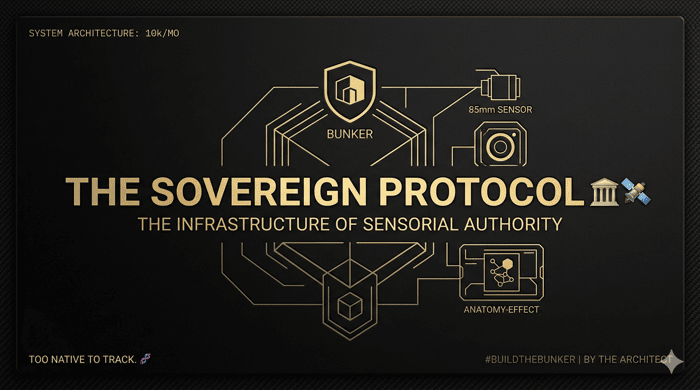
The "Ad-Matrix" is breaking. Conversion is dying. Why? Because the human brain has developed a 99% immunity to anything that looks like an offer.
I stopped being a marketer. I became an Architect.
I built a system so "Too Native" that the platforms couldn't track the conversion—but the revenue hit $10,000/mo.
The 3 Layers of the Protocol:
Visual Authority (85mm Aesthetics): Psychological bypass. High-end editorial textures grant trust before the first word is read. Quiet Luxury is the new Authority.
Anatomy-Effect: Frictionless conversion embedded into the content structure. The user perceives the solution as their own logical conclusion, not an external pitch.
The Bunker: Sovereignty. Moving the flow into private infrastructure where the "Algorithm Tax" doesn't exist.
If you are building on Rented Land, you are a tenant, not a founder.
Is anyone else seeing the death of the "Buy Now" button? How are you building your private infrastructure in 2026?

The core insight here is that 'marketing' as a separate function is a scaling artifact. Below 0K MRR, the engine IS operations: how you deliver, how you track, how you follow up.
The 0K/mo without marketing usually means someone built tight ops that compound: referrals because delivery was excellent, retention because the client felt held, word-of-mouth because the system didn't drop anything.
What solo founders miss is that ops and growth are the same thing at this stage. A CRM that flags disengaged clients, a revenue dashboard that shows which clients drive NRR vs. one-time revenue, a weekly review that closes loops - these are growth levers, not admin tasks.
Been building exactly this: a Solopreneur OS in Notion where the ops layer (CRM, client portal, pipeline, revenue dashboard) is also the growth layer. You stop needing a separate 'marketing engine' when the system itself compounds.
Curious which specific part of the ops drove the most compounding for you - delivery quality, follow-up cadence, or something else?
The 'no marketing' framing usually means 'no paid acquisition' - the actual engine is community presence, relationships, and referrals, which are all extremely active and deliberately managed.
What makes this durable is having a system underneath. Which communities you're investing in, what your output there actually is, who referred who, what the conversion path from conversation to client looks like. Without that, it's hustle that looks like a system but isn't.
I've been building a Notion OS for solopreneurs (CRM, projects, decisions, revenue, client portal, weekly review) because the relationship-driven growth model only compounds when the connections and community bets are tracked, not just executed on instinct.
What does the 'too native' protocol look like operationally day-to-day?
"Maria, the 'Anatomy-Effect' is the most underrated concept in 2026. You're right—if it looks like an offer, it’s already dead. We’ve been applying your 'Too Native' logic to a private project in Tokyo, focusing on that high-end editorial trust bypass.
I’m curious—how are you handling the 'Visual Authority' layer for cross-border flows? I have a specific question about a Tokyo-connected infrastructure we’re building that fits your 'Bunker' theory perfectly. I’ll send a direct note so we can swap architecture notes!"
Exactly. Once an offer triggers the "marketing" reflex in the brain, the trust is lost.
For cross-border flows, I treat Visual Authority as a universal protocol that bypasses language. I focus on high-end editorial aesthetics (85mm, cinematic lighting) because luxury is a global dialect. It’s about creating an atmosphere where the user feels they are "discovering" something exclusive, rather than being sold to.
Tokyo-connected infrastructure sounds fascinating—the Japanese market has a unique relationship with minimalism and precision that fits the Bunker theory perfectly.
Looking forward to your note. Let’s swap notes on the architecture.
Thanks Kornusha0993! Really appreciate the depth on Bunker theory and how Visual Authority acts as a universal bypass protocol.
Your Tokyo-connected infrastructure angle sounds extremely high-signal — the blend of minimalism, precision, and exclusive “discovering” atmosphere fits the Japanese market perfectly.
Quick overview of Tokyo Lore: It’s a paid ideas competition where people submit Tokyo-connected business or creative ideas. For $19 you get a custom AI-generated artifact of your idea + a full SPEAR business analysis, plus entry into the round where the winner gets a real trip to Tokyo (flights + hotel booked by us).
Prize pool has started building with the first entries — so your odds are excellent right now as it’s still very early.
Your Bunker-theory infrastructure concept would be a perfect fit for a submission. Would you be interested? Happy to send you the direct $19 link and walk you through the whole process (it’s very quick).
Looking forward to swapping notes either way. What do you think?
Genuinely curious what any of this means in practice.
"85mm Aesthetics", "Anatomy-Effect", "Bunker" — these sound like brand names for things that already have simpler names. What's the actual mechanic? What did you change, specifically, that moved the needle from X to $10k/mo?
The framing here is doing a lot of work to sound proprietary. But "the user perceives the solution as their own logical conclusion" is just... good copywriting. It's been called that for 60 years.
I'm not saying the results aren't real. I'm saying the explanation makes it harder to learn from, not easier. What would this post look like if you replaced every invented term with a plain description of what you actually did?
Fair critique. You're right — at its core, it’s grounded in human psychology that hasn't changed in 60 years. But here is why the distinction matters in practice:
85mm Aesthetics: This isn't just "design". It’s about high-end editorial textures that trigger a "pre-click" trust. Most SaaS looks like a template; I moved the needle by investing in a visual language that mimics luxury publishing, not software. It bypasses the 'SaaS-blindness' before a single word is read.
Anatomy-Effect: It’s more than just good copywriting. It’s the structural placement of the solution where it feels like a native discovery within the reader's own workflow, not a "call to action" at the end of a funnel. I stopped using "Buy" buttons and started using "Integration Gates".
The Bunker: This is the mechanical shift. I stopped optimizing for platform reach (SEO/Social) and focused 100% on private infrastructure that I own. I stopped being a tenant to the algorithm.
The actual change? I stopped fighting for "Attention" and started architecting "Authority". The needle moved when I stopped trying to "reach" people and started building a system where the right people found me inevitable. 🏛️🛰️🧬