The uncomfortable truth about AI tool pricing in 2026
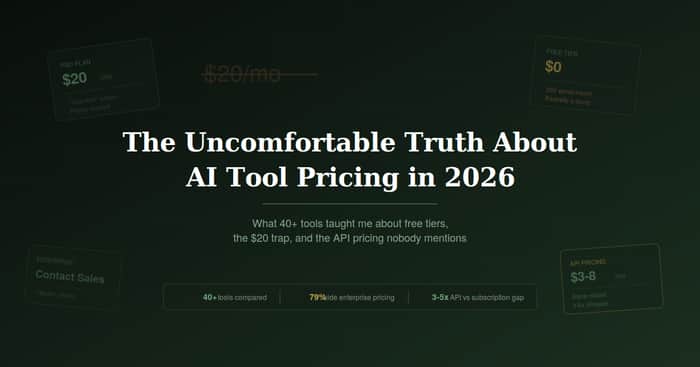
I've been deep in AI tool pricing for months now comparing plans, testing free tiers, tracking what you actually get vs what the marketing page promises. After looking at 40+ tools closely, some patterns jumped out that I don't see anyone talking about.
Figured I'd share what I found. Not selling anything here, just observations from someone who spends way too much time on pricing pages.
"Free tier" is the most abused term in SaaS right now
This one drives me crazy. At least half the tools I've looked at advertise a "free tier" that's basically a product tour. You can log in, see the dashboard, maybe run 2-3 prompts, and then hit a wall. That's not a free tier. That's a demo with a login screen.
The tools that actually have usable free tiers - where you can do real work without paying, are surprisingly rare. ChatGPT's free plan is legit. Gemini gives you a shocking amount for free. Perplexity's free tier is honestly good enough that I questioned why the paid plan exists. But those are exceptions, not the norm.
The worst offenders are AI writing tools. Almost every one I tested advertises "free" and then limits you to something like 500 words per month. Thats not enough to write a single blog post. Its basically a free trial that never expires but also never becomes useful.
The $20/month trap
There's a weird clustering happening around the $20/month price point. ChatGPT Plus, Cursor Pro, Claude Pro, Midjourney - all roughly $20. It feels like everyone just looked at what OpenAI was charging and matched it.
The problem is that $20/month tools vary wildly in what you get. Some give you genuinely unlimited usage. Others give you a "quota" that runs out mid-month if you're a heavy user. And a few charge $20 for what is essentially the same model you can access through the API for maybe $3-5 in actual usage.
I started tracking cost-per-actual-use and the differences are absurd. Two tools charging the same monthly fee can differ by 10x in how much you can actually do with them before hitting limits.
Enterprise pricing is where it gets intentionally confusing
This one's less relevant to indie hackers but worth flagging: almost no AI tool publishes its enterprise pricing. "Contact sales" is doing a lot of heavy lifting in this industry.
From what I've been able to piece together, enterprise plans for most AI tools run 3-5x the per-seat cost of individual plans, with annual commitments. Some tools that cost $20/user/month for individuals jump to $60-80/user/month for teams, with a minimum seat requirement.
The lack of transparancy here is a choice, not an accident. If the pricing were competitive, they'd show it.
Annual billing discounts are getting aggressive
20% off for annual billing used to be standard. Now I'm seeing 40-50% discounts for annual commitments on some AI tools. That tells you something about churn rates- they're desperate to lock people in because month-to-month users are leaving fast.
My read on this: most people sign up for an AI tool, use it heavily for 2-3 months, then either find a free alternative or realize they don't need it as much as they thought. The annual discount is the tool's way of capturing revenue before that realization hits.
The API vs subscription gap is real and nobody talks about it
This is probably the most useful thing I've found. For a lot of tools, the API pricing is dramatically cheaper than the subscription if you know how to use it.
Example: if you use Claude or GPT-4 through the API and you're not a super heavy user, your actual monthly cost might be $3-8. The subscription is $20. You're paying a 3-5x premium for a nice chat interface.
Obviously the subscription is worth it if you're non-technical or use it all day. But for devs and builders who could set up a simple API wrapper in an afternoon, the subscription model is overpriced by design. The chat UI is a convenience tax.
What I think happens next
My guess is we'll see a pricing reset in late 2026 or early 2027. Competition is pushing free tiers to get more generous (Google is leading this with Gemini), and users are getting better at comparing actual value instead of just feature lists.
The tools that survive will be the ones where the pricing honestly reflects usage. The ones that die will be the ones still charging $20/month for something that costs them $0.50 to serve, hoping nobody does the math.
Curious if anyone else has noticed these patterns. Especially the API vs subscription gap- feels like the most under-discussed arb in the AI space right now.

Hi folks! I built a GitHub App that comments on PRs with the cost impact of code changes — catches things like a retry loop or agent fan-out that quietly multiplies your bill, even when no prompt or model changed. Here's a real example on a test repo. Would you be open to installing it on a real repo, or happy to hear if it's not useful — either way I'd value 2 minutes of reaction.
The "convenience tax" framing in this post is spot on. The API vs subscription arb is real - I see it daily running an AI API aggregation platform.
Actually, it goes beyond just "subscription vs API." There's another layer most people aren't considering: the cost difference for the SAME model across different providers. For example, the same Claude or Gemini request can cost 2-3x differently depending on which API provider you go through - even though it's the same company, same model version.
That's why we built ModelBridge - not just to give developers one OpenAI-compatible SDK to access multiple models, but because we can dynamically route requests to the cheapest provider based on price, latency, and availability, without the user even knowing.
On your prediction about a pricing reset in late 2026 - I think you're already close to it. Developers are getting smarter about realizing a big chunk of what they're paying for is "convenience tax" (UI, brand premium, lock-in) rather than actual model cost. That's why I predict competition (like Google) will keep pushing prices down, and the tools that survive will be the ones whose pricing honestly reflects usage.
There's a running internal list of "honest pricing" tools - the criteria is simple: can you predict your bill this month before you start using it? If the answer is no, it's not honest pricing.
This matches what I keep seeing. The one that gets people is usage based pricing that looks tiny at the free tier and quietly becomes your biggest line item once you actually depend on it. Did any of the 40 turn out honest about real cost at scale? I am trying to keep a short list I can hand to non technical owners without wincing later.
The API route helps but doesn't fully solve it — you still can't tell what a feature costs until it's been live for a month. Token billing just moves the unpredictability from the subscription tier to the usage meter. I've been playing with flat-rate + smaller models for simple tasks as an alternative — there's a playground on a8kme (google it) to try it free if you want to see if it fits.
One thing I would add for coding-agent costs: don't use one unlimited API key for every long run.
What I usually do is create a fresh token for a task, put a quota on it, then point Cursor/Cline/Aider at that token through an OpenAI-compatible base URL. It does not fix bad context growth, but it makes a runaway loop much less painful.
The checklist I use is:
I wrote the setup pattern down here: https://github.com/alicekellings/cursor-cline-token-budget
Disclosure: I maintain Wappkit (https://api.wappkit.com), an OpenAI-compatible gateway. The same idea works with any compatible endpoint that gives you per-token quota and request logs.
Hey! I’m building a small AI spend auditing tool and trying to understand how people actually use tools like Cursor, ChatGPT, Claude, Copilot, etc.
Would love to ask a few quick questions:
which AI tools you currently pay for
how you decide which plans are worth it
whether managing AI subscriptions/spend is annoying
whether you’ve ever had subscriptions or seats go unused
I’m also exploring the idea of a small marketplace where unused AI subscriptions/seats could be resold or transferred, so I’m curious how people currently deal with that.
Just doing user research while building the project.
For AI voice agencies the fragmentation is worse because you're managing it at two levels: your own tool costs, and the per-client usage you have to markup and invoice.
VAPI alone can generate up to 5 separate invoices per month if you're using different ASR and TTS providers. Add GHL, Twilio, and a CRM, and you're reconciling 8-10 line items per client per month. The API vs. subscription gap you identified is real, but the deeper problem is that none of those API costs map cleanly to how you bill clients. Per-minute voice pass-through is straightforward. Everything else requires custom math.
A few platforms trying to solve the unified billing layer for voice agencies: trillet .ai, voicerraper and one in Founders' Beta called buildwithhermes .co m are the ones worth watching if billing fragmentation is your bottleneck.
The ambiguity friction framing from one of the comments here is the sharpest thing in this thread. Most pricing problems in this space aren't about cost; they're about the buyer not being able to predict what they're actually committing to.
The same pattern shows up in development engagements, not just tools. Time-and-materials AI dev shops are the pricing-page equivalent of a fake free tier: the number looks fine until you're three months in and realize what "ongoing support" or "unlimited revisions" meant to them versus what it meant to you.
The model that actually solves this isn't cheaper hourly rates, it's fixed-scope, outcome-priced engagements where the total cost is known upfront and doesn't move because the vendor underestimated inference costs or underscoped the data pipeline. If your dev partner quotes you $60k for an AI product and two months later, GPT-4 calls are eating their margin and slowing your build, that's a pricing structure problem, not a technical one.
The API vs subscription gap you identified is real, but for founders commissioning AI products rather than just using tools, the equivalent gap is T&M vs outcome-based. Same opacity, same gotchas, same 3–5x variance in what you actually get for the same number on the invoice.
The "convenience tax" framing is sharp, and I think it gets at something deeper: for a lot of knowledge workers, the real inefficiency isn't the API vs subscription choice, it's that typing itself is the bottleneck. Every minute spent hunting for the right words is a minute the tool isn't solving the actual problem. I built DictaFlow to cut that friction at the source, hold a key, speak, release, and the text shows up where your cursor is. It's a different part of the stack than model pricing, but for people whose day is mostly writing founder notes, customer messages, documentation, the ROI isn't about API costs, it's about whether you got the thought down before the meeting moved on.
The API-vs-subscription arb is sharper than this lets on, but the direction reverses once agents enter the picture.
Human typing → API cheaper (your $3-8 vs $20 = 3-5x premium for chat UI, defensible).
Agent loops → inverts. From TokRepo's logs (5,200 agent runs on same task category across Cursor/Claude/Codex): median API cost $0.42, p95 $7.20, p99 $34.80. One bug puts you in a retry loop that silently drains $30 in 8 minutes. We watched a junior dev burn $1,400 in a week on agent QA via API — same workload through Cursor Pro at $20 = capped, just slow.
So pricing has two regimes: humans should leave subs for API. Builders running agents should stay on subs until their p99 forecast model is reliable. Most aren't.
The $20 cluster isn't matching OpenAI — it's pricing the median user plus the retry buffer that heavy users generate. Vendors learned this in 2024-2025; that's why "unlimited" quietly stopped meaning unlimited.
Re: 50% annual discounts → 47% of LLM-tool subscribers in our 2025 cohort survey canceled between month 4-8. Annual lock-in is the vendor buying back the month-5 cancel. Sharp read.
You said most builders don't have a reliable p99 forecast. I built static analysis that catches the retry-loop multiplier at PR time — would your 5,200-run data validate or break my heuristics?
"convenience tax" is the wrong frame for non-builders, and I think it's the load bearing miss in the post. I've been pricing AI tools for a few months on the seller side - subscriptions aren't a UI markup, they're a bundling tax: prompt engineering, retry, eval, voice consistency, picking the right model for the job. That bundle is real, it just isn't priced honestly - which is why the 10x cost-per-actual-use variance at identical $20 makes total sense. You're paying the same dollar for wildly different bundles.
The annual discount jump (20% -> 40-50%) is the hidden tell in the post, above ~30% isn't pricing strategy, it's an admission that monthly retention is broken. If you can'thold users for 3 months at £20, the 12 month lock doesn't hold them either - it just buys time, not loyalty. The survivors will be the tools whose monthly cohorts don't bleed.
On the last-2026 reset prediction - do survivors converge to thin API+markup pricing, or do they charge MORE for bundling that actually works (eval, voice retention, multi-step orchestration) once buyers can tell the difference?
The real pricing problem is not “AI is expensive.”
It is that most AI tools are not priced on value.
They are priced on interface convenience and buyer uncertainty.
That is why so many products cluster at $20.
Not because usage justifies it.
Because it is low enough to feel harmless and high enough that most users will not audit actual cost.
That works early.
Until users get sharper.
Then pricing stops being about access
and starts being about trust.
Can the buyer predict what “unlimited” means?
Can they estimate real usage before paying?
Can they explain why this tool costs 4x more than using the same model directly?
Most AI pricing friction is not cost friction.
It is ambiguity friction.
The products that keep users will not just be cheaper.
They will be easier to understand under scrutiny.
That usually wins longer than “more tokens.”
You said most builders don't have a reliable p99 forecast. I built static analysis that catches the retry-loop multiplier at PR time — would your 5,200-run data validate or break my heuristics?
That’s an interesting approach. I’d be curious to see how your heuristics hold up once they’re tested against a larger set of real usage patterns.