The value of churn for SaaS businesses (and why churn is a better investment than Bitcoin)
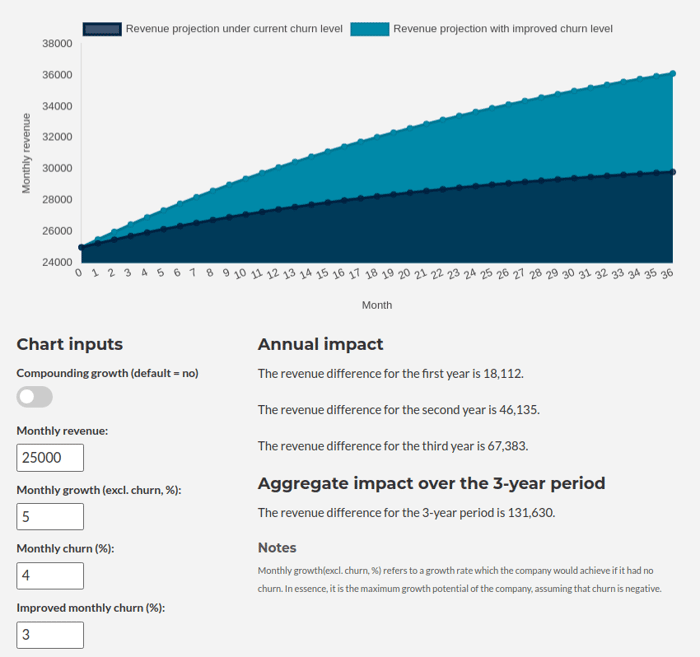
I created a graphical churn calculator that allows you to calculate the impact of churn on your revenue and profitability. You can find the calculator from my blog at Kirnu.io blog: When churn beat Bitcoin and Tesla in terms of return on investment
I also organized my thoughts in the form of a blog post regarding why investing in churn should be a top priority for SaaS businesses, below is a lengthy recap of that post.
Understanding churn and its implications on the long-term prosperity of a SaaS business is vital, but often challenging because understanding the effect of compound interest is not hardwired in us humans. To begin assessing the impact of churn, first we need to define growth. Let's start by decoupling it from churn, and consider growth as the potential a company could reach if it had no churn.
Say we have a SaaS business with a monthly growth rate of 5%. If the growth is compounded, each month the company's growth in absolute terms is higher. If growth is non-compounding, the company will grow by a fixed absolute amount each month and a fixed percentage relative to a fixed point in time. For example, a company with a revenue of 100 and a non-compounding growth rate of 5% will grow to a revenue of 105 in the first month and 110 in the second, and so on. Companies do not have to be labeled as either compounding or non-compounding growers but instead can exhibit either over time. Generally speaking, however, the more mature a company and the more mature / saturated the market in which the company operates is, the more likely the company's growth is non-compounding.
What about churn, then? Churn is always realistically assumed to be compounding, i.e. relative to the previous point in time. Combining a compounding growth with either compounding or non-compounding growth yields some interesting results. If the growth rate is equal to the churn rate, the company's revenue remains flat, regardless of the type of growth. The good news is, however, if you manage to decrease churn by even to a small degree, the results will compound over time.
This is where the two types of growth (compounding and non-compounding) diverge: a compounding growth rate that exceeds a compounding churn rate results in revenue that grows indefinitely at an increasing speed. A non-compounding growth rate above a churn rate will on the other hand result in a revenue growth that is alike to its compounding relative for a brief period of time, and thereafter flatline. This is because as time goes on, if the absolute amount of growth remains fixed, the amount of churn will eventually catch up.
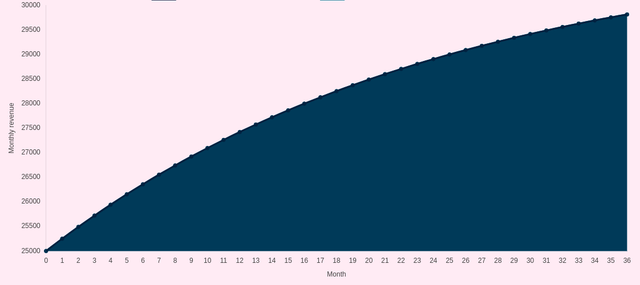
Consider for example a company with an MRR of $25,000, a non-compounding monthly growth rate (excluding churn) of 5%, and a monthly churn rate of 4%. During the first month, the company will find $1,250 of new revenue (5% of $25,000) and face a revenue churn of $1,000 (4% of $25,000). The month thereafter, the company's MRR will be $25,250 ($25,000 + $1,250 - $1,000). This month, the company's growth excl. churn will be the same (i.e. $1,250), but its churn will be 4% of $25,250 i.e. $1,010. Slowly but surely, the monthly churn will reach the monthly growth and revenue growth levels.
The other good news? Regardless of growth type, reducing churn by a small amount will have a significant impact on total revenue over time. Say our company with $25,000 MRR, 5% monthly growth rate (excl. churn) and, 4% "organic monthly churn rate", was able to reduce its churn to 3%. Over the next 36 months, the company would generate additional revenue of $238,164 (with compounding growth) or $131,630 (non-compounding growth). Small things accumulate over time.

The impact on profitability is often even more pronounced. SaaS businesses typically can report gross margins between 60-90%. Rarely however you see SaaS businesses with EBIT(DA) margins of 60-90%. This is because other expenses, such as personnel, real estate, etc. need to be accounted for. However, if you can scale your operations without expanding fixed resources, your gross profit will directly flow into your EBIT(DA). This is very much possible by reducing churn and is why churn plays such an important role in the life of a SaaS business.
What about that Bitcoin business then? Half-jokingly, I compared the return on investment (ROI) of churn reduction against other popular assets. Assuming a gross margin of 75% and a monthly cost of $250 for the churn reduction project and the above revenue projections, the 3-year ROI for the project would be 1,885% (compounding growth) or 997% (non-compounding growth). Compared against 3-year ROIs for Bitcoin (531%) or Tesla (989%), it seems that SaaS businesses would be best to invest their hard-earned money in themselves.

Thank you for reading! Let me know how you have managed churn in your company and what the results (positive or negative) have been.
