The "Vibes" Are Over: Why 2026 Belongs to Neuro-Symbolic AI
The "Vibes" Are Over: Why 2026 Belongs to Neuro-Symbolic AI
We spent the last three years teaching AI to talk. Now, we finally have to teach it to think.
By Victor Michael Gil, Bitterbot AI - December 14, 2025
As we stare down the barrel of 2026, the AI landscape feels strange.
On the surface, we are living through the most linguistically impressive moment in history. The Large Language Models (LLMs) on our phones can draft sonnets, debug Python, and simulate empathy with terrifying precision. To the casual observer, the Turing Test isn't just dead; it’s been buried.
And yet, if you’ve been paying attention this year, you’ve noticed the shift.
The "magic" has worn off. We have realized that despite their eloquence, our models still hallucinate citations, buckle under basic logic puzzles, and gaslight us when challenged. We built a parrot with a library card, but we are slowly realizing it doesn't actually know how to read.
This isn’t a bug to be patched in the next update. It is a structural ceiling.
As 2025 closes, the "Scale is All You Need" era is officially ending. We are waking up to a crisis of meaning, not because AI can’t speak, but because it speaks without grounding. The industry knows it, and it is driving a quiet but violent architectural revolution: The return of Neuro-Symbolic AI.
The Crisis Beneath the Fluency
To understand why 2026 will look different, look at the failures of 2024/25.
We spent billions trying to make LLMs "smarter" by feeding them more data. But bigger models didn't produce better reasoning; they just produced better impressions of reasoning.
Ask a pure LLM to reason across unfamiliar constraints, and the cracks show immediately. It doesn't fail because it lacks knowledge; it fails because it lacks a "world model." It predicts the next token based on statistical likelihood, not logical necessity.
We hit the limit of "vibes." Now, we need truth.
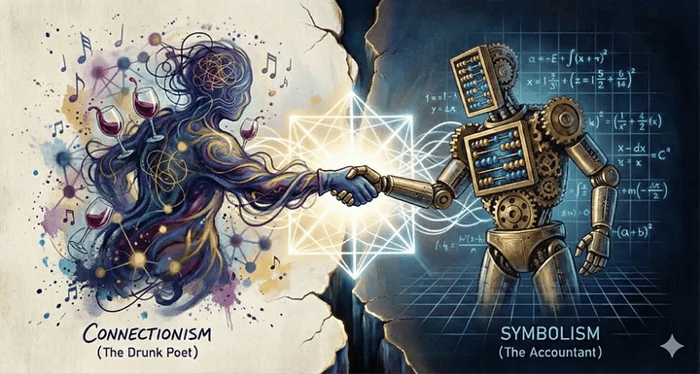
The Drunk Poet and the Accountant
Artificial Intelligence has always been a civil war between two tribes:
- ** The Connectionists (Neural Networks):** They believe intelligence emerges from learning patterns in messy data. (The Drunk Poet: Creative, flexible, occasionally insane).
- The Symbolists (GOFAI): They believe intelligence is the manipulation of explicit rules and symbols. (The Accountant: Rigid, precise, boring, but always correct).
Deep Learning won the last decade because the real world is messy, and "Accountants" are bad at messy. But language, true, functional language, demands more than pattern recognition. It demands structure.
By mid-2025, it became clear that the Drunk Poet couldn't be trusted with the nuclear codes, or even a complex legal contract.
Enter Neuro-Symbolic AI. It is the marriage of these two tribes. It uses the neural network to handle the messy perception of the world, and the symbolic engine to handle the logic.
System 1 Talks. System 2 Thinks.
The easiest way to visualize this shift is through Daniel Kahneman’s framework:
● System 1: Fast, intuitive, associative.
● System 2: Slow, deliberate, logical.
Current LLMs are the ultimate System 1 engines. They generate hypotheses and linguistic intuition at light speed. But they have no "brake." They do not pause to verify if their output makes sense.
Neuro-symbolic systems force a System 2 process. Instead of asking the LLM to solve a math problem by guessing the next word, the system uses the LLM to translate the problem into a formal language (like Python or SQL), and then passes it to a deterministic solver.
The Neural component proposes; the Symbolic component disposes.
This turns reasoning from a performance into a process. It allows for something pure deep learning never could: Accountability.
The "Vibes-Based" Economy vs. The Grounded World
Why does this matter for 2026? Because the low-hanging fruit is gone.
We have already automated the tasks that require "good enough" text (marketing copy, emails, summaries). The next frontier, healthcare, finance, autonomous agents, requires "provably correct" decisions.
In these fields, the Symbol Grounding Problem is lethal. An LLM understands "Apple" only because it appears near words like "pie" or "iPhone." It has no concept of an apple as a physical object. A neuro-symbolic system, however, can bind the word "Apple" to an entity with properties, constraints, and causal rules.
This enables:
● Traceability: You can see exactly why the AI made a decision.
● Correction: You can fix a logic error without retraining the whole model.
● Consistency: The model won't change its answer just because you phrased the question differently.
How the Sausage is Made (in 2026)
We aren't just theorizing anymore. The architecture of the coming year falls into three buckets:
- The Translator (The Dominant Pattern): The LLM acts as a user interface for a calculator. It translates natural language into code, executes it, and translates the answer back. This kills hallucinations for factual tasks.
- The Symbolic-First Engine: Symbolic logic runs the show, using neural networks only for heuristics, like AlphaGeometry suggesting a proof strategy that a logic solver verifies.
- Differentiable Logic: The holy grail. Embedding logical constraints directly into the neural network's math. Hard to build, but incredibly efficient.
Across all three, the insight is the same: Structure beats scale.
The Meta-Cognitive Layer
The most exciting development for 2026 isn't a bigger context window; it’s self-awareness.
We are seeing the rise of "Meta-Cognitive Controllers", layers of the AI that decide how to think. A truly competent agent needs to know when it’s bullshitting. It needs to know when to use its intuition (System 1) and when to call a symbolic solver (System 2).
Intelligence isn’t just thinking. It’s knowing how to think.
Fluency is Solved. Meaning is Not.
As we toast to the new year, the hype cycle is dead. Good riddance.
We are moving away from the era of the "Magic Chatbot" and into the era of the Reliable System.
LLMs will remain the interface of the future, they are unmatched at nuance, tone, and translation. But the engine of the future is hybrid. The regulated industries are already quietly switching over. They know that "vibes" are great for a chat, but disastrous for compliance.
We have spent decades teaching computers to talk like us. The challenge of 2026 is teaching them to understand what they are saying.

This nails the structural problem that's been nagging at me for months while building with LLMs. The 'Drunk Poet vs. Accountant' framing is exactly right — and the practical consequence for anyone building real products on these models is brutal: you can't ship something reliable if your outputs are stochastic by design.
The part that resonates most is your consistency point. We've been living this failure mode: same prompt, same model, same user input, but subtly different output on Tuesday vs. Monday. For anything user-facing, that inconsistency is a silent trust killer. Users don't see 'non-determinism.' They just see 'this thing is unreliable.'
What we're finding even short of full neuro-symbolic architectures: the biggest practical gain comes from adding a thin constraint layer on top of LLM outputs — enforcing the 'Symbolic Disposer' role at inference time. Let the neural component generate, but validate every output before it propagates. Not elegant, but it works today.
One thing I'm wrestling with: do you think the neuro-symbolic shift arrives for indie builders as libraries we stack on top of existing models, or does it require fundamentally different model architecture from the ground up? The practical answer matters a lot for whether this is a 2026 thing or a 2028 thing.