The Visual Debt Crisis: Why Creative Bottlenecks are the New Technical Debt
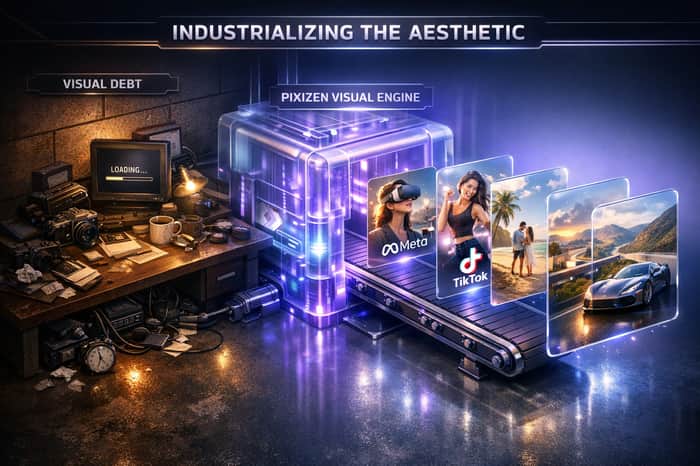
As indie hackers, we are obsessed with optimizing our stacks. We shave milliseconds off our TTFB, automate our CI/CD pipelines, and obsess over database indexing. But there is a massive, unoptimized leak in most of our workflows: Creative Production.
When we built Pixizen under the Zenbitx umbrella, we realized that "Visual Debt"—the gap between a high-quality product and its amateur-looking marketing—is the silent killer of conversion.
Here is the intellectual framework behind why we shifted from viewing design as "art" to viewing it as Visual Infrastructure.
-
The Fallacy of the Manual Studio
Most founders still treat product photography as a discrete, manual task. You take a photo, you edit it, you post it. This is linear thinking. In a world of infinite scroll, you don't need a photo; you need an industrialized output. We built Pixizen to turn a single raw capture into a scalable asset library, moving the workflow from "craftsman" to "factory." -
Solving for "Surgical Precision"
The biggest critique of AI in creative work is the loss of integrity. Generative models often "hallucinate" details—changing a button on a gadget or the texture of a fabric. For an entrepreneur, this is a lie to the customer. We focused our engineering on Surgical Precision: maintaining 100% texture integrity while the AI handles the cinematic environment. -
The Aesthetic of Trust (Glassmorphism & Motion)
Trust is a technical requirement. On the web, trust is often signaled through design maturity. We integrated glassmorphism and butter-smooth transitions into our output not just because they look good, but because they signal "Global Standard." When a bootstrap founder in Dhaka can produce the same cinematic quality as a Fortune 500 brand, the playing field is leveled. -
Infrastructure Over Tools
A tool helps you do a task; infrastructure changes how the task is done. By integrating server-side tracking (stape.io) and robust GTM configurations directly into our growth strategy, we ensured that our visual engine wasn't just making "pretty pictures"—it was generating data-backed lead growth.
The Lesson for Indie Hackers:
Don't just build a product; build the machine that markets the product. If your creative process is still manual, you aren't scaling—you're just working hard.
We are currently refining this engine and would love to hear how other hackers are automating their "Visual Debt."
Check out the engine: pixizen.io
#IndieHackers #SaaS #VisualInfrastructure #GrowthHacking #AImarketing #Zenbitx #ProductDesign
