The week OpenAI raised $4B for enterprise deployment - and why it doesn't change anything for how we build products
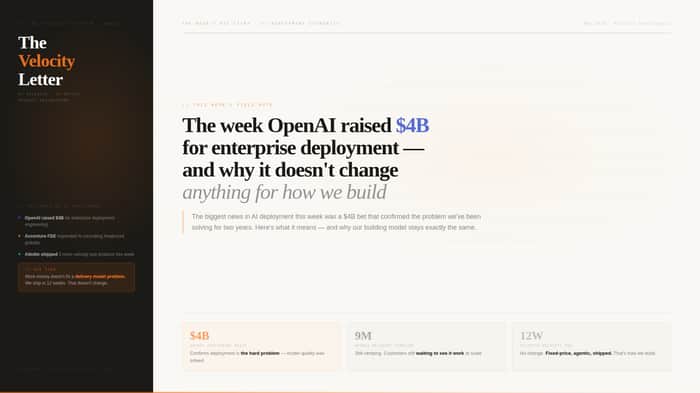
I'm going to say the unfashionable thing: the OpenAI Deployment Company announcement is genuinely impressive, and it has absolutely nothing to do with most of the founders reading this.
That's not a knock. It's just an accurate read of who that model is built for — and who it isn't.
What Actually Happened
On May 11, 2026, OpenAI launched a standalone business unit backed by $4 billion from TPG, Goldman Sachs, Bain Capital, McKinsey, and around 15 other institutional partners. They acquired Tomoro, an applied AI consulting firm, to bring roughly 150 Forward Deployed Engineers (FDEs) on day one.
The FDE model is elegant. Specialist engineers embed directly inside large client organizations, live inside their tech environment for months or years, and redesign mission-critical workflows around AI capabilities. The results are documented: 20–50% efficiency improvements across financial services, manufacturing, and telecom. Morgan Stanley's deployed AI assistant hit 98% adoption, which is an extraordinary number for enterprise tooling.
This is a real solution to a real problem. Gartner says 95% of enterprise AI pilots fail to reach production. Not because the models are bad. Because deployment is hard, and most organizations don't have the internal capability to close the gap between API access and operational use.
OpenAI just raised $4 billion to help Fortune 500 companies close that gap. That's a legitimate business, and it will probably work for the clients it's designed for.
Here's the Part That Matters for Product Founders
The FDE model requires:
- A $10M+ transformation budget
- An 18+ month timeline
- A massive organization with highly complex, legacy workflows to redesign
If you're building a healthcare platform, a logistics product, or a fintech tool for an underserved market, the OpenAI Deployment Company is not for you. Not because it's bad, but because it's architected for a completely different scale of problem.
The $4B announcement validated something critical: deployment is the hard problem in AI, not the models themselves. But the solution for the enterprise and the solution for everyone building actual products are structurally different things.
We figured this out the hard way, three years ago.
What We Built Instead
We spent eight months iterating on a fixed-price, outcome-based delivery model before it actually worked. The core unit is what we call an AI Velocity Pod: 3–5 senior engineers governing a layer of specialized AI agents running in parallel — test generation, code review, documentation, regression validation — under human oversight with defined review gates.
The structural difference between these approaches comes down to execution:
Enterprise FDE Model:
[Embedded Engineers] ──> [Redesign Workflows] ──> [Months/Years] ──> [Enterprise Shift]

AI Velocity Pod Model:
[Elite Human + AI Pod] ──> [Own Deliverable] ──> [38-Day Median] ──> [Production Software]
The model only works if you can define the deliverable precisely before development starts. That discipline constraint felt like a limitation at first, but turned out to be the ultimate feature. No scope creep. No T&M (Time & Materials) drift. No "we need three more months" conversations.
Three years in, the metrics speak for themselves: 38-day median delivery, 300+ products shipped, across 21 countries.
The clients that fit this model are product companies, healthtech startups, logistics firms, and mid-market teams that need to ship a specific thing to production on a defined budget and timeline. Not to "explore what AI might do for us," but to ship something real.
The Thing the $4B Announcement Actually Confirmed
The FDE concept was originally invented by Palantir in 2008. It looked expensive and weird for a decade. Then Palantir returned 640% over five years, logging an impressive 85% revenue growth and 133% US commercial growth in Q1 2026.
Three major AI deployment models launched within 10 days of each other in May 2026: OpenAI's embedded FDE company, Accenture's ServiceNow FDE program, and the fixed-price pod model we've been running for three years. All of them are variations on the same insight: the technology is not the bottleneck. Deployment discipline is.
What is different is the price point, the timeline, and who is sitting on the other side of the contract.
For anyone building products outside the Fortune 500: this announcement doesn't change your options. It just confirms you've been right to take deployment seriously all along.
Let's Open It Up to the Community
For founders who have hired agencies or consultants for AI-adjacent builds — what was the thing that actually broke the engagement? Was it scope ambiguity, timeline slippage, or something else entirely? Let's talk in the comments.
Relevant Resources
- How AI Velocity Pods work → (Replace with your destination link)
- Startup MVP delivery frameworks → (Replace with your destination link)
Tags: #ai-engineering #enterprise-ai #software-development #tech-trends
