Their pricing model was accidentally their best sales channel. They had no idea.
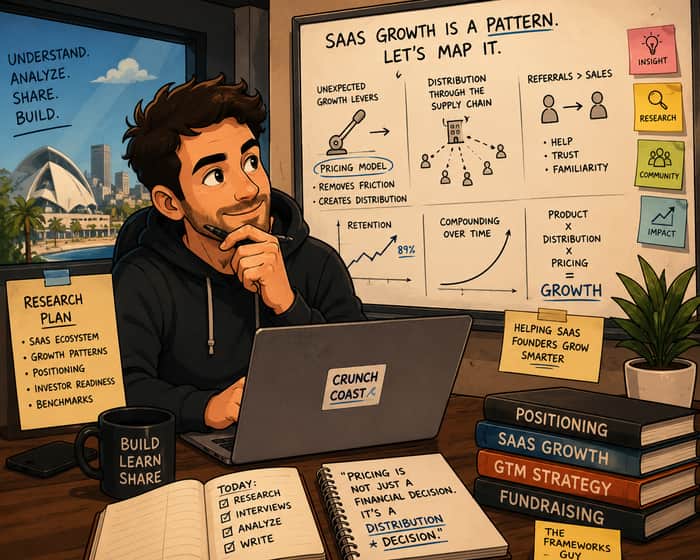
A B2B SaaS founder I worked with had no per-seat pricing.
Every competitor charged per user.
He didn't.
Clients could add as many users as they wanted — subcontractors, clients, technicians — without paying a cent more.
Everyone thought it was a weird business decision.
Turns out it was their best growth lever.
They just didn't know it yet.
What was actually happening
His clients were service companies with subcontractors working on-site across different locations.
Because there was no per-seat limit, subcontractors accessed the platform for free.
They used it.
Got comfortable with it.
Started recommending it to their other clients.
One client became a referral engine for three more.
The platform spread through an entire industry supply chain.
Not because of marketing.
Not because of sales.
Because the pricing model removed the friction that would have stopped it.
The moment we realized it
I was doing a GTM audit.
I asked:
“Where do most of your new clients come from?”
He said:
“Honestly, mostly referrals. Clients recommend us to their suppliers, suppliers recommend us to their clients…”
I asked:
“Why do you think that is?”
He paused.
Then said:
“Because everyone already knows the platform. The subcontractors have been using it for free.”
That was the moment.
He hadn’t designed a referral program.
He hadn’t built a partner ecosystem.
He had accidentally built a distribution network by removing a pricing constraint.
What changed after we mapped it
The sales pitch changed.
Instead of:
“We’re flexible and affordable.”
It became:
“Every company in your supply chain will already know how to use this on day one.”
The ICP got sharper.
The best customers weren’t the ones with the biggest budgets.
They were the ones with the most subcontractors.
Because every subcontractor was a potential future client.
Even retention started making more sense.
Their 89% retention wasn’t just because the product was good.
Switching meant disconnecting an entire supply chain that had already built workflows around the platform.
The lesson I keep seeing
Most founders think about pricing as a revenue decision.
Questions like:
- How much should I charge?
- What pricing model maximizes revenue per customer?
Those are often the wrong first questions.
A better one is:
Who touches my product because of how I charge?
Because:
- who touches your product determines who discovers it
- who discovers it determines how fast you grow
Pricing is not just a financial decision.
It’s a distribution decision.
Curious:
Have you ever discovered a growth lever in your business that you didn’t intentionally build?
What's next?
I'm studying how B2B SaaS companies grow:
• pricing & distribution dynamics
• GTM evolution
• investor readiness
• fundraising benchmarks
• unexpected growth loops
If you're a SaaS founder, operator or investor working on similar challenges, I'd love to hear your experience.
Connect with me:
