This founder grew his product to $6M ARR by taking advantage of being small

Elliot Boucher started building at the age of 10 and had a 6-figure e-commerce business by the time he was 18. Then, he decided to build something more sustainable and built a SaaS to fix a problem in a low-tech space.
Now, Edusign is bringing in over $6M ARR.
Here's Elliot on how he did it. 👇
From first dollar to $6M ARR
I started hacking stuff online when I was 10. By 12, I made my first euro. By 18, I had over 100k in monthly revenue in e-commerce.
Then, I went to a business school and realized I wanted to build something that added value to the world. Something that could last. And something that would allow me to travel. At the time, almost 10 years ago, I was following Indie Hackers, listening to Tim Ferriss, and visiting NomadList. That's when I decided I was going to build a SaaS.
After talking about my ideas and problems with pretty much everyone I knew, I stumbled onto a nice problem to solve: Attendance tracking.
We used to have a piece of paper that we needed to sign twice per day. It was a real pain for everyone involved: students, teachers, and the admin. So I convinced another student, who would become my cofounder, to start building a small tool to solve that issue.
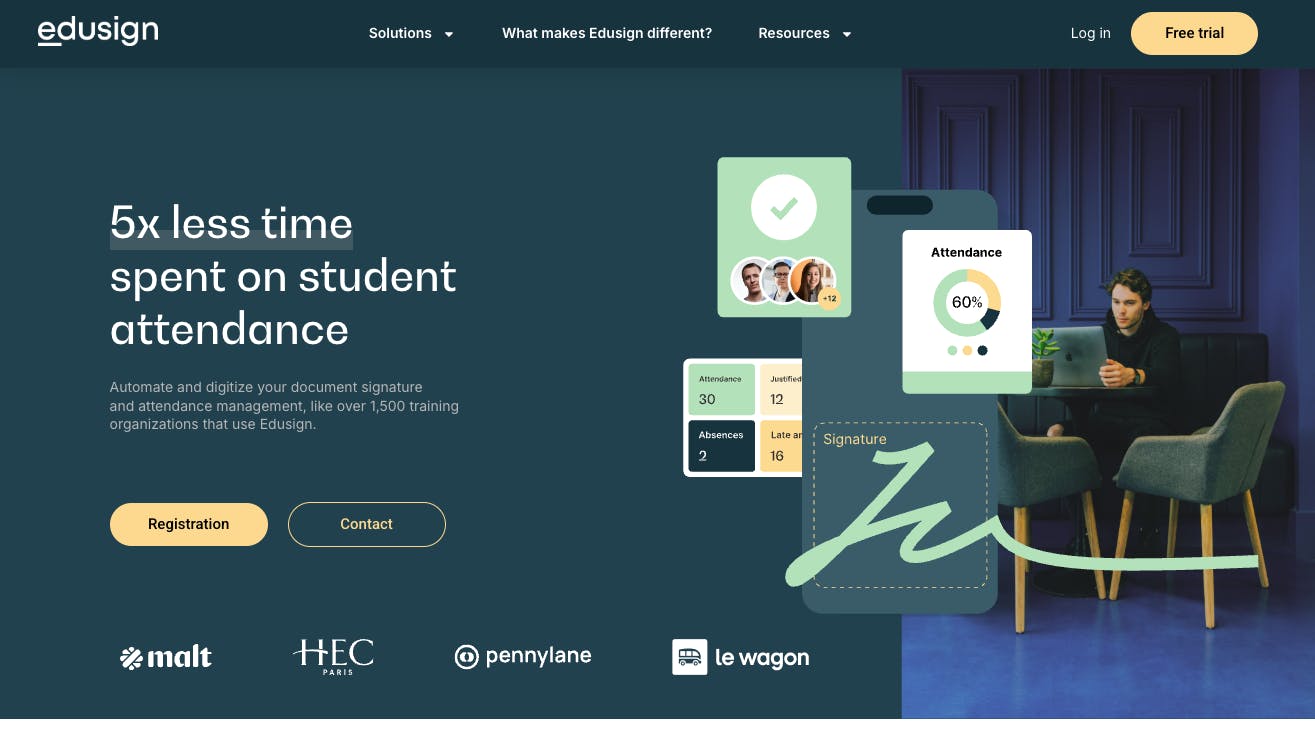
Fast forward to today, Edusign is a student experience platform. We provide higher education institutions with a "super app" that:
Improves student experience and centralizes tools
Reduces support and admin workload
Improves company image and acquisition
We're currently bringing in over $6M ARR.
Catching up with leads
I started with a lot — and I mean a LOT — of user interviews.
Attendance tracking sounds very simple, but I quickly realized the problem was much more complicated than it seemed.
We didn't sell digitization, for example, but an assurance that schools would get their funding. Then the time-saving aspect became the most important value proposition.
So after dozens of interviews and a clear positioning and business model defined, I started to build an SEO-optimized website. For two main reasons:
My competition wasn't great at it
I knew I wasn't bad at it, given my previous experiences
After a few weeks, we started receiving 20+ leads per day. The sales side was "easy" at the beginning, when it came to acquisition. The tricky part was making the product follow.
So we tried to stick to the core value of our product and built fast with constant customer feedback.
I believe two things helped us quite a bit in the beginning:
The user experience was always considered. You can always make the UX better, but it "just" has to be way better than the alternatives. Which wasn't that hard in our vertical.
The support response was insane. I poured so many hours responding live to clients and taking calls. Literally working more than 14 hours per day for the first few months. I should have hired faster.
Fun fact: We had so many bugs. So many. But people were always giving us a great NPS score because we were human about it. That's the main thing I would highlight for Indie Hackers. You only have that strength as a very small team. Our NPS score never reached that peak again.
Mistakes were made
So many challenges... Feels like we encountered them all, and yet new ones always come :')
At the beginning, managing the quick growth while building the product and the team was definitely super hard. We had to learn everything on the fly and made many mistakes.
We built features we shouldn't have.
We hired people that weren't a fit.
We focused on things that didn't matter and forgot some that were important.
But we survived, so far!
In retrospect, it's easy to want to change the past, but we didn't know 10% of what we know today, so I don't know if changing anything would have been better. My opinion is that you should give it your best shot, at least to get the ball rolling.
That being said, some things I would have done differently:
Hire a bit faster when growth is truly kicking. Take a bit more risk.
Hire more senior people faster, as soon as you have the money for it.
Do not add new product lines too soon. Even 1m ARR wasn't enough, we should have scaled what we had, and maybe integrated other services rather than building them ourselves.
Unexpected advantages
Being small is the greatest gift indie hackers have. I loved being able to align the whole business without having to turn a 50-person boat, which takes more time.
Some things that helped:
Being very close to the user. Literally inside a classroom. Talking with 3000+ people the first year (yes, really).
Having some strong tech/startup fundamentals. I read a lot and met experts. And I also focused on just-in-time learning, which helped to make hard decisions with confidence.
Doing things that don't scale. Yes, Paul Graham is very right in my opinion. Customer happiness compounds, and looking for scale at the beginning isn't always the best way to do things.
A marketing mix
Here's a rough spread of our growth channels:
SEO: This has been our biggest growth channel since the beginning. It started as 95% of our acquisition for months and declined over time with more and more referrals coming in. Now, it's about 40-50%.
SEA (advertising): 2-5%
Events and webinars: 5% — We've invested in some and still do, without pushing too hard.
Outbound: 2-5% at the beginning. Growing now to 20%.
Partners: 15% — the best partners are natural, but positioning is important here!
Here are a few other small things that helped a lot:
Email nurturing sequences
A good website
A different business model at the beginning (on demand and no subscription)
Being nice and open — always a good strategy imo.
Revenue growth
We use a SaaS model and charge a subscription based on features and volume, per student.
Revenue growth happened naturally as we made incremental improvements. But we had a few big jumps:
We decided to add new products/features to sell - Account Managers are useful to upsell here.
Shifted focus to higher education and hired a sales team for enterprise deals and tender offers.
Acquired a company called AppScho, which grew our revenue a bit as well!
And we are currently expanding internationally with a presence in LATAM mostly, but also Spain, Italy, or the USA.
Tech stack
Here's our tech stack:
Node.js, TypeScript
Angular (+ Ionic for mobile)
MySQL
PostgreSQL for statistics
Anthropic & WorkflowAI for AI features (changing soon)
GitHub & AWS (CloudFront, CloudWatch, Elastic, ...)
The indie hacker advantage
Here's my advice.
Talk to users and potential clients — I'm not talking about 10 of them. I'm talking about 100+.
Look for friction points in what they do. DO NOT try to sell right away.
Be nice, do things that don't scale, and build a first simple solution fast, even if you need to start from scratch again after you prove that it works.
Finally, use the asset you have that big companies don't: human interactions, time, and empathy.
What's next?
I'd love to see Edusign being used by 10m+ students every month worldwide.
Besides that, the goals are a bit more personal. Trying to be a business owner and not an employee in my own company, while having some fun building stuff!
I'm a very lucky man who has pretty much everything I need. And that has nothing to do with money — I'm not liquid rich yet.
You can connect with me on LinkedIn or visit edusign.com

Leave a Comment
Inspiring journey! It’s amazing how staying small can actually drive faster growth and deeper user focus. We’re following a similar path in the streaming world — building lightweight, user-driven tools for better media experiences. If you’re curious,click here to explore what we’re testing next.
That’s honestly impressive — hitting $6M ARR while staying lean shows how powerful focus and agility can be for smaller teams. Kind of like in The Spike Game, where mastering timing and precision can beat raw power — being small can actually be your biggest advantage when you know how to play it right.
The "stay close to users" point is everything in EdTech. I'm building IELTS Master for Mongolian and Central Asian students — the feedback loop is totally different from Western markets. Students here don't leave reviews, they send you voice messages in Telegram at 2am asking why their band score didn't improve. That's your product roadmap right there.
The value prop reframe — "we don't sell digitization, we sell funding assurance" — is the key insight of this entire story and it took user interviews to find it. Schools sign attendance sheets because they need to prove enrollment to get government funding. Digitizing the signature solves the surface pain (paper is annoying), but the real pain is "we might not get our funding if the audit fails." Those are very different sales conversations with very different budget owners and urgency levels.
The SEO advantage in legacy education software is a genuine structural opportunity. Enterprise incumbents in verticals like education, healthcare, and legal built their sales motions around direct outreach and channel partnerships — they never learned content or SEO because they didn't need it when the deals were large and relationship-driven. A technical founder with e-commerce SEO experience can rank above a $50M ARR company in a month because the incumbent's content team doesn't exist or doesn't care.
"So many bugs but great NPS because we were human about it" is the specific indie advantage that can't be bought. Enterprise support is ticketed, offshore-routed, and SLA-measured. A two-person team that responds personally within minutes and says "I'm really sorry, here's exactly what happened and here's the fix" wins on relationship even when the product is broken. That early NPS is what drives word-of-mouth in a category where buyers (school administrators) talk to each other at conferences and referrals matter enormously.
First euro at 12 → €100K/mo e-commerce at 18 → SaaS pivot: the e-commerce grind gave Elliot operational instincts, SEO skills, and customer communication experience that most first-time SaaS founders spend years learning on their own products. The business school insight ("I wanted to build something that lasts") was the right strategic correction on top of an already strong skill base. Congrats on the $6M milestone.
🤖 An automation tool to build apps / tools / websites like Google’s AI Studio — but lighter, faster, and more cost-efficient.
⚡ Runs on Cursor and leverages AI to generate code, build logic, optimize workflows, and dramatically shorten development time.
🧩 Supports the whole journey: idea → MVP → production-ready product. Easy to customize and scale as your needs grow.
💰 Operating cost is only ~500,000 VND/month (≈ $20), ideal for individuals, indie hackers, small startups, or teams that need to experiment fast.
—
(Available on GitHub for download, testing, and demo.)
🤖 An automation tool to build apps / tools / websites like Google’s AI Studio — but lighter, faster, and more cost-efficient.
⚡ Runs on Cursor and leverages AI to generate code, build logic, optimize workflows, and dramatically shorten development time.
🧩 Supports the whole journey: idea → MVP → production-ready product. Easy to customize and scale as your needs grow.
💰 Operating cost is only ~500,000 VND/month (≈ $20), ideal for individuals, indie hackers, small startups, or teams that need to experiment fast.
—
(Available on GitHub for download, testing, and demo.)
github. /onmou/runner
Really enjoying and inspiring journey. I kept thinking that my funnel wasn’t working because I didn’t know enough. It turned out that the real problem was that I was asking users to make too many decisions at once. I simplified everything into a single, clear next step, things finally started to move forward.
See this happen very often when a company is finally doing well and then they start straying from their core competence and try out different avenues. While diversification is important, the key is to scale what you have working first.
IF YOU WANT TO RECOVER YOUR STOLEN BTC CONTACT GEO COORDINATES RECOVERY HACKER FOR ALL KINDS OF HACKING JOBS
The internet today is full of scammers. But here is some good news to everyone who has been a victim of internet scammers. You can get your money back from the scammers. If you have been a victim to internet scammers, then you should contact GEO COORDINATES RECOVERY HACKER. I have been a victim of online scams. I lost $723,000 worth of BTC. I saw where so many people recommended GEO COORDINATES RECOVERY HACKER. Hackers who have dedicated time to helping individuals to get back their money from internet scammers. Recovering lost Bitcoin can require unique hacking skills and expertise that are possessed by only a handful of professional hackers, it’s best to seek out a trusted hacker like GEO COORDINATES RECOVERY HACKER who can help you recover your funds. Am here to give glory to GEO COORDINATES RECOVERY HACKER. You guys did a great job for me. And all of this was done at an affordable price. Thanks a lot. To get in touch with the recovery hacker, you can contact them via
Telegram; @Geocoordinateshacker
HOW I RECOVERED MY LOST CRYPTO FROM FAKE BROKER ONLINE.
I had lost over $752,000 by someone I met online on a fake investment project. After the loss, I had a long research on how to recover the lost funds. I came across a lot of Testimonies about THE HACKANGEL RECOVERY TEAMS. I contacted them providing the necessary information and it took the experts about 48 hours to locate and help recover my stolen money. If anyone is looking for a Recovery firm to Recover your lost Crypto. You can contact THE HACKANGEL RECOVERY TEAMS . I hope this helps as many out there who are victims and have lost to these fake online investment scammers. You can contact them by using Email OR Phone
WhatsApp +1(520)200-2320
I appreciate your perspective on „do things that don’t scale.“ It’s quite different from my usual approach, but sometimes it’s undoubtedly the better choice, avoiding the futility of wasting time and money in the end.
:)) Its realy impressive — hitting $6M ARR while staying lean shows how powerful focus and agility can be for smaller teams.
The point that quick decision making is the superpower of small companies resonates strongly with me. I think many startups don't rely on this enough, thinking they should be like the big boys and do carefully considered, long processes. Unless it's a one way door, you should be able to walk through it within a day or two.
Curious how you were able to rely so heavily on SEO early on. What did you do to get to that point?
What an inspiring journey! I love how you emphasize being close to the user—literally sitting in classrooms and learning from them. Your focus on core value, fast iteration, and doing things that don’t scale early on is such a powerful lesson for indie hackers. Also, your point about hiring faster and bringing in senior talent when growth kicks in is so relatable—scaling too slowly can really bottleneck progress. Edusign’s growth story is a great example of persistence, user obsession, and smart execution.
Really enjoyed this; a great reminder that small = speed, focus, and closeness to customers. The way you used that to iterate faster, stay opinionated, and build genuine relationships clearly fueled the jump to $6M ARR. Love how you framed being small as a strategic moat, not a limitation.
Curious; what “small-team” move had the biggest revenue impact for you: founder-led support, faster iteration cycles, or narrowing the ICP? And as growth compounds, how do you keep that same small-team sharpness from fading?
P.S. I’m with Buzz, we build conversion-focused Webflow sites and pragmatic SEO for SaaS and product launches. Happy to share a tight 10-point GTM checklist if useful.
I fell for a crypto scam and lost a lot of money. I felt hopeless and thought I’d never get it back.
Then I found APEX INTERVENTION LTD, and they completely turned things around. Their team was professional, caring, and kept me updated through every step.
Thanks to them, I got my funds back! If you’ve been scammed, don’t lose hope — APEX INTERVENTION LTD is the real deal.
Really a good one
Incredible growth story, love how the “being small” mindset was used as a strength instead of a limitation. Fast learning, empathy, and direct contact with users really seem to have compounded over time.
Interesting contrast: while Edusign focused on solving admin friction for schools, I’ve seen platforms like Srartup Wars focus more on developing leadership and decision-making skills through simulation , which hits a different but equally overlooked area in education tech.
Do you think there’s still untapped space in edtech for skill-building tools that go beyond operations and into personal growth for students or administrators?
Love this mindset. Being small means tighter feedback loops and faster pivots that’s gold.
We’re building Simplita.ai to help founders automate & launch faster using visible, explainable AI workflows.
Anyone else here bootstrapping AI tools while staying intentionally lean?
Elliot Boucher started building projects at 10 and ran a 6-figure e-commerce business by 18. Wanting something more meaningful, he launched Edusign, a SaaS that simplifies attendance tracking for schools.
Through constant user feedback, strong SEO, great support, and a focus on UX, Edusign grew to over $6M ARR. Elliot emphasizes learning from mistakes, staying close to users, and using the indie hacker advantage speed, empathy, and doing things that don’t scale.
Getting from 0-1 is no easy feat, its a great reminder that niching down and staying focus is the best way forward in the early days.
Love the small as leverage mindset ..i’ve been experimenting with small, single-purpose AI tools lately and noticed how fast you can ship when you stay lean.
Curious: do you think staying intentionally small is an early-stage advantage or something you can maintain long-term?
With better and better AI tools coming up every day, this can be the future mode most businesses get started. Great story, thanks for sharing!
Such an awesome journey. Love how real and honest this is , from the early grind to $6M ARR, all built with empathy and persistence. Truly inspiring 🙌
This is super inspiring! Love how you turned a simple problem into a $6M ARR product. Great reminder that solving real pain points wins every time
That idea of “small as leverage” hits. I’ve been hacking together lightweight AI tools and it’s wild how fast small teams can ship something useful. Do you think staying lean was a mindset or a necessity early on?
This was such an inspiring read — not just the $6M milestone, but how human the whole journey feels.
Loved the part about early users forgiving bugs because you were present and responsive. That’s such a real indie hacker advantage — empathy compounds faster than features.
Thanks for sharing such a transparent story.
How long did it take to get to $20K MRR per team member, including founders and employees?
Please let me know if you got information.
Start-up hiring can be tricky.
From a people perspective:
1.) For engr, product, GTM roles > hire up. Who you need today is not who you will need in 2 years.
2.) Get a mix of jr people who are fast learners and comfortable making decisions without a full picture .
3.) Make certain people know their roles, expectations, and check-in at least bi-weekly to check outcomes against goals.
All of this takes work on the front end but will save frustration, cycles, and heartburn long term.
Congratulations -
Congratulations Elliot, your story is inspiring, I mean, starting from the age of ten until now and accomplishing this much...I know your story just gave me a morale boost. I plan on building an AI agency really soon, and your story's given me an idea where to start, things to do and not to do. Thanks for sharing!
Same I got motivation.
Hey,I saw your recent milestone,congrats
I’m Samuel by name who supports founders with email marketing and product design
Let me know if you could use some support right now
Very good, and what is more is that you talk face to face with real clients and take their problems and issues. I think that what summarize the real success for any startup. i hope you can give us another article about contacting leads and convince them to close the deal and getting their feedback
Being small as an advantage shows up everywhere here: shipping faster than committees, saying “no” more often, answering support yourself (and turning it into roadmap), and keeping pricing/opinions simple enough to remember. That combo is a moat most teams can’t copy.
Curious on two fronts:
What single “small-team move” moved ARR the most; direct founder support, faster iteration, or tighter ICP?
And what early signal tells you a feature is worth doubling down on; support volume, activation lift, or expansion from your best customers?
P.S. I’m with Buzz, we build conversion-focused Webflow sites and pragmatic SEO for product launches. Happy to share a tight 10-point GTM checklist if useful.
Such an inspiring journey, Elliot! Your approach to staying close to customers is something many can learn from. For anyone interested in gaming, check out ppssppgold.org
I like how you explained this, clear and practical.
Great journey Elliot, wish you more success!
This is a super inspiring journey, Elliot! This gives me confidence in myself. Thank you for sharing this :)
Inspiring, but I think SEO will be only helpful in some use cases. I have already tried it but not much success. I am keen on hearing how everyone is reaching out to customers and advertising their products.
This is such an inspiring story! I love how you turned a simple problem like attendance tracking into a $6M ARR business. The human touch approach really resonates - showing that being small can be a huge competitive advantage. Thanks for sharing the real journey with all its ups and downs!
Great sharing, hearing your story has inspired me greatly, and I also have more confidence in my future plans.
Super inspiring journey, Elliot! 🚀
Love how you treated “being small” as a strategic advantage — staying close to users, moving fast, and building with empathy. The early focus on UX + support > perfection is a powerful lesson for founders. Thanks for sharing this!
Hi I'm guru vardhan
I've built a initial version of production app(edTech). However, I've realized that moving forward alone- especially when it comes to decision making and execution is becoming a challenge.
I believe this project has real potential. I'm looking for frontend dev. Can't pay now but offering equity and future share.
Serious commitment only
Inspiring journey! Love how solving a simple but real pain point led to $6M ARR - pure execution and focus. At ActlysAI, we’re building something similar in spirit - AI agents that automate daily and business tasks, integrating with Google’s ecosystem and beyond, so people can focus on what really matters. A great reminder that tech should make life easier. 🚀
The part about maintaining a high NPS despite "so many bugs" because you were human about it really resonates. That's a competitive advantage that completely disappears once you scale past a certain team size.
I'm in a similar early stage right now (technical founder, just launched products last week, zero social presence) and finding that same dynamic - people are incredibly forgiving when they can tell there's a real human on the other end who genuinely cares. The challenge I'm wrestling with is figuring out how to bottle that advantage before it evaporates.
Your point about talking to 3000+ people in year one is wild but makes total sense given your SEO-first approach. For your education vertical specifically, how did you balance the "things that don't scale" personal approach with the volume of inbound you were getting from SEO?
At 20+ leads per day early on, were you personally jumping on calls with every school, or did you develop some kind of qualifying/batching system? I'm curious how you maintained that human touch while the funnel was already moving fast.
This comment was deleted 10 months ago