This survey is what we used to sell EveryMon before it was made
This is the process we used when we were creating EveryMon, each part of our survey form broken up into bits to help you plan out your next survey, our goals:
-
Validate our assumptions with data.
-
Do people understand the problem we are trying to solve?
-
Build a list of interested people who have opted into exploring our product.
As I cannot post images on here (Could be my ignorance of how to use the site) I'll keep it to text only, apologies for the many lines, tried to break it up best as I could with the editor here.
There is no intro page to the survey as we'll have messaged/shared with an intro if someone chooses to click on your link, get them to progress quickly.
- What type of alert emails do you receive
Data backup success / failure
Cybersecurity related
Hardware related
Business specific app
Other (Free form text)
We had three things to gain with this question, confirm what we thought our product could be used for, remind the users of areas we could cover and catch any outliers of things we had missed.
- Are you a Managed Service Provider? (MSP)
Yes
No
This is an identifying question, we could leave it to the end but its an easy positive/negative you can do early, it keeps the forward momentum. This shows us if this audience is where we should focus on initially, if we could not get enough people in this segment to answer, how will we connect with them after launch.
- How many alert emails do you/your team receive per week
1-10
10-30
30-80
80-150
150-350
350-600
600+
unknown
Our pricing is based on volume, so its important to discover how much volume is there with potential users, this is a ballpark estimate not meant to be precise but it also reminds them of the problem that we are trying to teach.
A. In the Target breach of 2014, which cost the company $252 million and led to the resignation of its CIO and CEO, an alert reported the breach.
Due to the high volume of alerts and the frequency of false alarms, the IT security team ignored it.
There is no answer for this, it is a comment, a little bit of priming for their personal pain point:
- 30% of IT professionals miss alert emails because there are just too many of them, would you say this is true of you or your IT team?
Yes
No
We had primed with "Look what happened to Target" and we're planting the seed, this could be a problem for you. Almost nobody answered no to this question.
B. In the case of one business, the IT manager did not receive his email alerts regarding failed backups. Had there been an outage, they would have lost nearly £10k per hour in lost sales orders.
Another pain point primed, the cost of downtime, Gives their brain a few seconds to think about the next question.
- Downtime can happen when alert fatigue sets in, how difficult would 1 day of downtime be for you?
Not enough to care about, we can cope with 1 day of downtime
Enough to hurt, so we want to prevent it.
Going down for a day would bankrupt the organisation
Don't know the cost of 1 day of downtime
Almost no one answered 1 or 3. Most answered 2 or 4, its weighing extremes and triggering how much pain would there be.
C. The average enterprise faces 2543 flagged log items per month, of which only 23 need action.
Some organizations receive more than 300 alerts per day.
Teaching the concept.
- You currently recieve X email alerts per week, if we could get rid of those notifications so you are only contacted when there is a problem to be fixed, would that be helpful to you?
Yes
No
The X is linked to question 3, where you can personalise and link back to previous answers, do so.
D. Whether for data backups or security systems an SMB IT pro will spend hours per month on email alerts alone.
You get a bit of screen space to teach and educate but keep it as short as possible.
- How important is it to solve alert fatigue and free up more time for you?
Scale 1 - 4
Why not 1-5? We don't want a safe polite middle option, It is also weighting their previous answer.
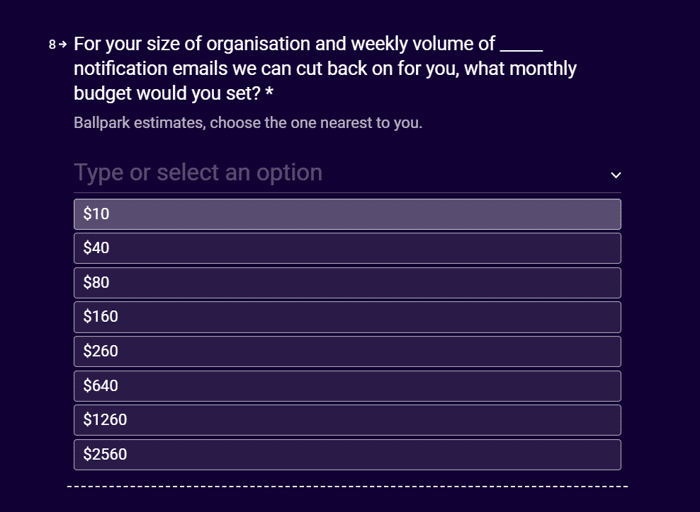
- For your size of organisation and weekly volume of X notification emails we can cut back on for you, what monthly budget would you set?
$10
$40
$80
$160
$260
$640
$1260
$2560
The hardest question of all. What shall we charge?
What is the customer ready to accept?
What happens if my cost is too much?
We answer it by going back to question 3, they've told us how many alert emails they get every week, so we're asking how much would you spend to get rid of them and in the math, the number of notifications they wanted to get rid of linked back to how much they were prepared to spend.
I'd like to say I came up with math genius to have done this but it was a fluke. What we originally wanted was to link a ballpark budget back to the size of company and volume of alerts per month.
- What products do you use?
This will help guide our focus for integrations, List all the products you use that generate alerts for you (i.e Veeam, Datto, Connectwise)
What is our number one product we need to integrate with and support? Now we know, now we can focus development effort on that.
Having just asked how much they are prepared to spend, now we're asking what can we do to make a better solution for them.
- We are building a software tool which solves Alert Fatigue for IT pros, the tool is already in alpha state and a beta is weeks away.
Would you like to be contacted to see the tool and to learn more about it?
Yes
No
If Yes, they get asked their name and email
If No, we ask them again but promise not to give them subscription spam or automated nonsense that people are tired of.
Conditional logic is useful.
Final question
"Comments you would like to share?"
This is a free-flowing paragraph text box, deliberately left at the end, never partway through.
Ending page, going back to conditional logic.
We show one ending screen with a glimpse of the product, either with the persons name and a pledge we'll contact them soon or a website link they can visit if they said we can't contact them.
What we gained from spending time on the survey:
-
We proved and disproved assumptions/plans we had made.
-
We built a list of interested early adopters/beta testers/first customers
-
It helped us build our sales/marketing plan.
-
Gave us access to a lot of product feedback and ideas.
I'm going to share a link to the survey just so you can see how it works properly: https://darait.typeform.com/to/kgJc7E
If you know someone who is in IT, feel free to send it their way :)
