This Week in AI: The Gap Is Getting Clearer
Runway pushed out Gen 4.5 last week. The videos look wild, but the bigger story is the direction the whole industry is moving toward tools that think a little, not just execute instructions. At the same time, companies are quietly plugging AI into internal workflows. Less manual work, more reasoning and planning handled by systems instead of people. And with all this, GPU demand is exploding again.
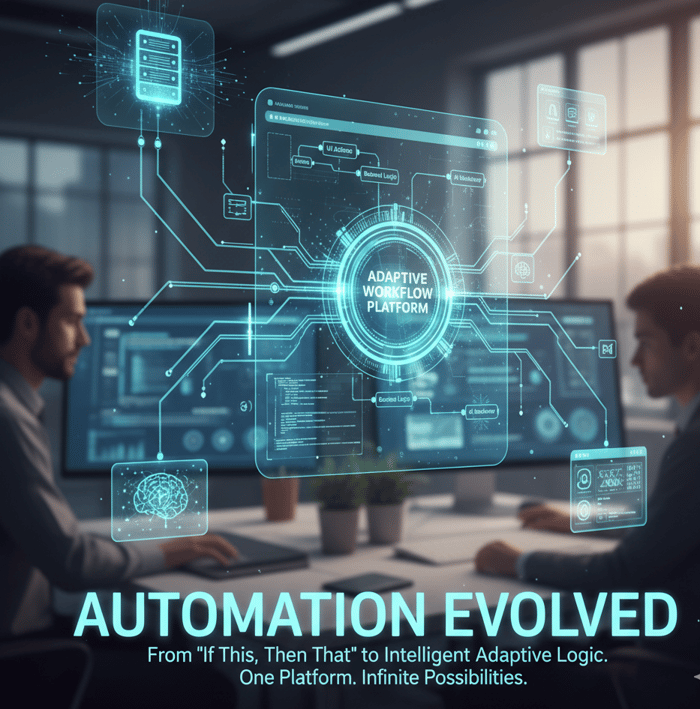
The takeaway is simple. Automation is shifting from “if this, then that” to adaptive logic that reacts to real context. Rigid tools are going to feel old very fast.
That’s the space we’ve been building for. Our platform lets users combine UI actions, backend logic and AI behaviour inside one workspace. No juggling tools. No patching. Just workflows that fit how teams actually work.
Feels like the market is finally waking up to the problem we started with.

The shift to 'adaptive logic' is exciting but also scary for debugging.
I recently reverted my project from an LLM-based system back to a strict mathematical algorithm (Box-Muller transform) precisely because I needed the output to be 100% transparent and grounded.
Do you think enterprises are ready to trust 'thinking' agents for critical internal workflows yet, or is the hallucination rate still a blocker?
Very nice read thanks for sharing!
Appreciate it. This shift has been interesting to watch closely.
SEO Friends — I need your insights!
What’s the one SEO strategy that gave you the biggest results in 2024?
Was it content updates, backlinks, internal links, technical fixes, or something else?
Curious to see what’s actually working for people right now. 👀
From what I’m seeing, useful content that answers real intent is outperforming everything else right now.
Great insights on automation moving from rigid to adaptive. In my work building a marketplace for investors, we've seen that when tools anticipate context and human intent, they build trust and reduce friction. People feel understood, not processed. That feeling is powerful: it's why small improvements in experience can change behavior at scale. Curious how others are adapting their workflows to be more human-centric despite using more AI.
Exactly this. Anticipating intent changes how people experience software, not just how it performs.
@Dr. D. Saravana Kuma,
This shift toward adaptive, reasoning-driven systems is exactly why Reddit is becoming a massively undervalued distribution channel for AI and workflow platforms like yours. Communities are already discussing this transition in real time, and the posts that frame the ‘rigid → context-aware’ evolution tend to explode in reach. I help automation and AI founders engineer high-signal Reddit visibility that drives early users—not with ads or forced promotion, but by positioning the product inside the conversations people are already hungry for. If you’re open to it, I can show you what a strategic Reddit presence could look like for Simplita.
Hey! I came across your Indie Hackers profile and really liked what you’re building.
I’m working on a project in the (Web3 / SaaS / AI / your niche) space, and I think there might be room for collaboration or shared insights
Thanks for getting back to me!
I’m glad you liked what I’m building.
I’m a freelancer specializing in Reddit marketing, subreddit growth, and community management, and I think there’s a lot of potential for us to collaborate or exchange insights especially if you're looking to grow your presence or validate your product using Reddit.
If you’d like to continue the conversation, feel free to reach out to me directly at michealprecious616@gmail.com
Happy to chat in more detail!
Looking forward to connecting!
Thanks for laying this out. Reddit is definitely becoming a strong pull channel for us, and your approach aligns with how we want to show up there. Happy to take a closer look together.
@Dr.D. Saravana Kumar
Great to hear that. Feel free to message me directly on Telegram @Preshtechsolution, and I’ll walk you through a tailored Reddit strategy for Simplita.
Really enjoyed this post. A few things I’m curious about: how are you setting up guardrails and monitoring when agents start making decisions? What basic “decision primitives” are good to start with so teams can iterate safely instead of trying to do everything at once? Also, what early metrics are worth tracking like time-to-resolution, manual handoffs saved, or error rates? Finally, any tips on handling auditability and model drift in production?
Super useful insights, thanks for sharing.
Hey! I came across your Indie Hackers profile and really liked what you’re building.
I’m working on a project in the (Web3 / SaaS / AI / your niche) space, and I think there might be room for collaboration or shared insights
We start with simple guardrails, clear decision limits, and live monitoring. Early wins for us are faster resolution times and fewer handoffs. Versioned prompts and logs help us keep things auditable and catch drift early.
Great framing on the shift from rigid automation to adaptive systems. Been seeing this firsthand while building browser automation agents - the sites that implement anti-bot detection are forcing us to think differently about how AI agents interact with the web.
The interesting challenge is that "thinking" agents need to be secure by design. When you give an agent reasoning capabilities, you also expand its attack surface for prompt injection and context manipulation. Building guardrails into the architecture from day one is crucial.
Agree that the gap between adaptive and static tools will widen fast. The teams investing in this shift now will have a serious head start.
Love this perspective. The security surface is widening for sure. Curious how you’re approaching guardrails on your side as models get more reasoning heavy.
Love this take. The shift from static automation to adaptive, context-aware systems is exactly what’s been missing in most enterprise workflows. Everyone’s hyped about Gen 4.5 visuals, but the real unlock is reasoning-driven automation becoming mainstream. Your timing is perfect — teams are finally realizing that stitching tools together isn’t “automation.” Excited to see how your platform fits into this new wave.
Couldn't agree more. In my work, the biggest aha moment was realizing that context-aware tools make people feel like the system is thinking with them rather than at them. That feeling encourages adoption and trust.
Thanks for the thoughtful take. Feels like we’re finally moving past the “connect a few APIs” era. Reasoning driven automation will reshape a lot of underlying workflows.
Your post brilliantly illustrates how we are transitioning from the era of manual automation to the era of autonomous logic.
Runway's Gen 4.5 launch is just the most visible "facade" of this revolution. The real shift is happening in the invisible internal workflows, where AI is taking over not just the execution of steps, but also the reasoning, planning, and adaptation to real context.
This demands a radical rethinking of the entire workspace. Classic automation tools (based on rigid "if-this, then-that" rules) cannot effectively integrate adaptive logic. They force teams to work around the tool, rather than the other way around.
Hey! I came across your Indie Hackers profile and really liked what you’re building.
I’m working on a project in the (Web3 / SaaS / AI / your niche) space, and I think there might be room for collaboration or shared insights
You nailed the core insight.
Everyone talks about “automation,” but the real unlock is letting the system think with you, not for you.
We’re demoing how this works inside Simplita this week.
If you want to see it in action, I can send over a quick slot.
Nice read I must say.. I was not aware about it. Thanks for sharing.
Thanks a lot. If you ever want a quick walk through the product, I can share a demo slot.
YOU CAN RECOVER YOUR STOLEN FUNDS WITH THE HELP OF // THE HACK ANGELS RECOVERY EXPERT
The most reputable and trustworthy recovery experts available today. THE HACK ANGELS RECOVERY EXPERT. They can help you retrieve your stolen crypto funds. They have technical expertise resources to track down and recover lost crypto. I had lost £973,000 to fraud and at first I thought it was gone for good. I went online to search for recovery, I saw numerous testimonies regarding THE HACK ANGELS RECOVERY EXPERT and how they had assisted other people in getting their money back. I didn't hesitate to contact them, in just a few days the experts returned all my money. They said that they did an investigation and returned my money immediately. They can never ask you for any upfront payment. They can help you track your funds. They are cyber security experts doing great jobs out there. Be wise and do your research to avoid being scammed again. For anyone in a similar situation seeking to recover funds lost to online scams, contact THE HACK ANGELS RECOVERY EXPERT through
WhatsApp +1520200-2320
Really inspiring work — especially the part about moving from rigid “if-this-then-that” automation toward adaptive logic that reacts to real context. I completely agree that this is where the entire industry is heading.
I’m working in a similar space, but approaching it from the “decision architecture” side rather than data access or workflow orchestration. I’ve been building a deterministic decision OS layer for LLMs (Proto-AGI research use case) that focuses on transparency, auditability, and world-state-aware reasoning — basically, turning LLM autonomy into something predictable and reviewable.
Reading your post resonated with me a lot:
• less blind execution, more structured reasoning
• moving toward systems that actually “think”
• replacing manual analysis with logic that adapts
Really appreciate this. Your angle on deterministic LLM decision layers is on point.
We’ve been solving a similar problem from the workflow side.
If you’re up for it, I can share a live demo this week. Curious to compare notes.
The way its going we might ahcieve the script to movie in half hour kind of a model where people can just feed the bound script they have written for a movie and Runway can just spit out the movie with dialogs..
Spot on, Inkaai. Everyone’s chasing speed, but the real win is keeping logic auditable.
We’re showing how we do that in our demo this week. Happy to share a slot.
Crazy how fast this stuff is changing. Those new Gen 4.5 videos look cool, but the bigger deal is that AI is starting to think a little instead of just doing whatever we tell it step-by-step. Companies are already sneaking it into their daily work, and it cuts out a ton of boring manual tasks.
Old “if this happens, do that” tools are going to feel super outdated pretty soon.
What you’re building makes sense for where things are going. Having one place where people can click around, run logic, and let AI handle the tricky parts just matches how teams actually work. Feels like everyone else is finally noticing the problem you were already working on.
Thanks for reading, @BuildtoCare.
If you’re curious to see the workflow in action, I can send you a demo time.
What’s interesting isn’t just the Gen 4.5 jump—it’s that we’re finally seeing AI move from a ‘tool’ to a ‘teammate.’ The organizations getting ahead are the ones quietly weaving reasoning systems into everyday workflows, not just generating prettier outputs. As automation shifts from rigid rule-based flows to adaptive logic, the gap between old and new operations is going to widen fast. That’s why unifying UI actions, backend logic, and AI behaviour in one place matters so much. The real competitive edge isn’t more tools—it’s coherence.
Really like your framing, @Beastinventer.
Turning AI into a teammate only works when UI, logic and behaviour live in one place.
Happy to walk you through how we’re doing that if you want a demo.
his nails it. The real leap isn’t faster models — it’s systems that can interpret, reason and adapt to context the way operators do.
I’ve seen the same thing while building SoloCEO. Most AI tools execute instructions, but they don’t think across multiple lenses (strategy, finance, ops, risk) the way real teams make decisions. That’s why rigid automations are already starting to feel outdated.
The direction is clear:
Workflows that can understand the situation, not just follow steps.
Feels like we’re entering the phase where AI stops being a tool and starts becoming part of the operating system of a business.
Exciting time to be building in this space.
Really appreciate this, @SoloCEOai.
You captured the shift well. Context aware workflows are where everything is moving.
If you want a closer look, happy to send over a demo link.
This is kinda cool
Thanks @VelocityAI.
If you ever want a quick look at it in action, I can share a demo slot.
How are you handling the parts of process automation which provide time for checks, thinking and communication ?
Unintended consequences feel old very fast, too :)
https://www.theregister.com/2025/12/01/google_antigravity_wipes_d_drive
Great point @stacker_ie.
We build the checks into the flow so nothing gets lost.
Can share a demo if you want to see it.
Absolutely agree — we’re witnessing a real shift from automation as execution to automation as cognition. Tools are no longer just following scripts; they’re beginning to understand intent, context, and consequence.
Totally agree. That shift is exactly what we’re building around. Real value shows up when workflows understand context instead of just executing steps. Excited to see more teams move in this direction.
Good read. The shift from rigid automation to context-aware workflows is real—and honestly overdue. Curious to see how Simplita handles complex edge cases in practice.
Appreciate that. Edge cases are actually where we focus a lot. The whole idea is to let workflows adapt instead of breaking when things get messy. Happy to show you how it works anytime.
Really agree with this. Most tools still feel rigid in real projects. Something adaptive like what you’re building at Simplita could actually solve the practical problems we hit every day.
Thanks for sharing that. We hear the same thing from a lot of teams. Real projects need flexibility, not fixed templates. That’s exactly the gap we’re trying to close with Simplita.
Interesting perspective. Our team spends too much time connecting and managing separate tools. If Simplita handles everything in one workspace, that’s a huge productivity gain for developers and managers.
Totally hear you on that. Most teams juggle way too many tools today. That’s exactly the friction we’re trying to remove by keeping everything inside one clear workspace.
You’re right about automation getting outdated fast. Systems that adapt with context are becoming essential. Simplita’s direction feels aligned with what modern engineering teams actually need now.
Thanks for this. We’re seeing the same shift across teams we talk to. The need for context aware workflows is getting louder everywhere. Glad the direction makes sense from your side too.