Thymalin: The 40-Year-Old Soviet Peptide That Could Change How We Think About Aging and Immunity
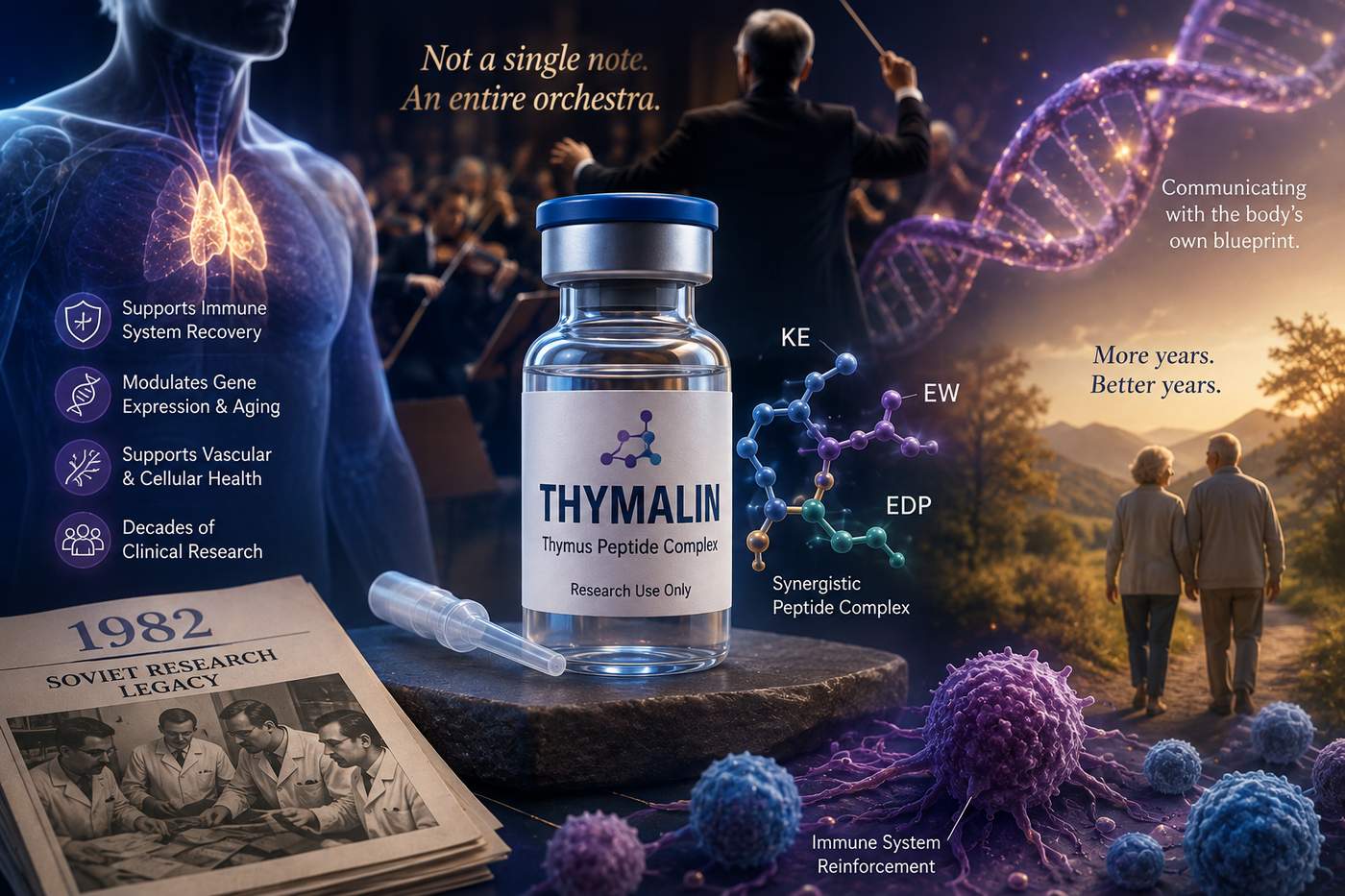
You know, some things sit in the room next door for forty years, and you never even suspect they exist. Thymalin is exactly that kind of character.
What is it, anyway?
Picture this: Soviet scientists in 1982 decided that the immune system isn't just a shield that rusts over time, but a full orchestra where every instrument matters. They took the thymus — that gland behind your breastbone that works at full throttle when you're a kid, then unfortunately retires — and squeezed out something like "concentrated wisdom of immunity."
Thymalin isn't one peptide, like most trendy modern substances. It's an entire quartet: short peptides KE, EW, EDP, and a bunch of supporting players that work together like a good old jazz band. Each one plays their own part, but together they create music your body still remembers from its youth.
Why can't scientists let this topic go even now?
First, immunity.
After chemotherapy, surgery, radiation — when the immune system lies in ruins — Thymalin was studied as "reinforcement." Not a miracle potion, but exactly reinforcement: so macrophages wake up, T-cells remember what they were trained for, and the body starts protecting itself again. Especially in elderly people, where the immune system sometimes behaves like a grandpa who forgot why he left the house.
Second, aging.
Professor Khavinson — a man who dedicated his entire life to this — believes that short peptides can talk to DNA. Not metaphorically, but literally: they approach histones (those "librarians" of our genetic information) and say, "Hey, maybe we don't need to rush this whole aging thing so much?"
Sounds like science fiction? Maybe. But a six-year observation showed: in the group of elderly people who received Thymalin, mortality was significantly lower. And when combining Thymalin with Epithalamin, the effect was even more pronounced. This isn't "eternal youth" — it's just more time in good shape.
Third, blood vessels.
One component, the EW peptide, turned out capable of influencing the ACE2 enzyme. For those not in the loop: that's the same enzyme everyone talked about during COVID. And a 2021 study showed that in severe elderly patients, Thymalin helped lymphocytes recover faster and quiet down the inflammatory "noise."
So what makes it better than trendy synthetic peptides?
Imagine the difference between an orchestra and a single violin. Synthetic peptides are the violin: clean, precise, playing one note. Thymalin is the orchestra — it isn't aimed at one pathway, it creates an atmosphere where the body starts remembering what it feels like to be young and healthy.
Forty years of documentation isn't just a number. It's thousands of patients, hundreds of publications, generations of researchers who saw how this works in real life, not just in test tubes.
But let's not have illusions
Thymalin isn't a dietary supplement, not a vitamin, and not something you can buy at the pharmacy next to paracetamol. It's a research peptide. It isn't approved as a drug for free sale. All these "miracle" stories are scientific data that need further study, especially outside the post-Soviet space where people know about it, while in the West they're only starting to whisper about it.
My take (if I may say so)
What impresses me in all this isn't so much the chemistry as the story. Imagine: 1982, the Soviet Union, and a group of scientists creates something that forty years later will be more relevant than many modern "anti-aging novelties." Because they weren't looking at symptoms — they were looking at the mechanism itself, at how the body regulates itself, and how to help it remember that.
Thymalin isn't about eternal life. It's about living your last decades not as a fight against your body, but as cooperation with it. And in that, I think, lies the real value.

