Top 100 Startup Failure Statistics (2026): Why Most Startups Fail and What Every Founder Must Know Before It’s Too Late
By Robert Moment | Product Market Fit Consultant & SaaS Advisor
Startup success stories dominate headlines. We celebrate billion-dollar valuations, unicorn companies, and founders who reshape entire industries.
But behind every celebrated success story lies a difficult truth that every entrepreneur must understand before launching or scaling:
Most startups fail. And the number one reason is a problem most founders never see coming.
Understanding why startups fail is one of the highest-leverage insights any founder can develop. The patterns are not random. They repeat. And they are preventable if you know what to look for.
This guide compiles the most important startup failure statistics for 2026, the top evidence based reasons startups collapse, and introduces a critical strategic concept shaping the survival of SaaS, AI, and technology startups today:
Product Market Fit Is Expiring.
Whether you are a pre-revenue founder testing your first hypothesis or a scaling SaaS company managing churn, the data and frameworks in this article will sharpen how you build, position, and protect your company.
Startup Failure Rate: The Big Picture (2026)
Before examining specific failure causes, founders must understand the baseline reality of startup survival.
These statistics establish the stakes:
-
Approximately 90% of all startups fail globally.
-
About 20% of new startups fail within their first year of operation.
-
Nearly 50% of startups fail before reaching their fifth year.
-
Around 65% of startups fail by year eight.
-
Approximately 70% of startups fail within ten years of founding.
-
Only 1 in 10 startups builds a sustainable, profitable business.
-
Less than 1% of startups reach unicorn status ($1 billion+ valuation).
-
Venture-backed startups have moderately higher survival rates than bootstrapped companies but still fail at staggering rates.
-
Many startups fail not because the technology was wrong, but because the strategy was wrong.
-
Product-market fit is consistently identified as the single most critical survival factor across all startup research.
What these statistics collectively reveal is a critical insight for 2026 founders:
Startup survival is not primarily a technical problem. It is a strategic and market alignment problem.
The question is not whether you can build the product. The question is whether the market urgently needs what you built and whether it will still need it in 18 months.
The Top Reasons Startups Fail: Evidence-Based Analysis
Across decades of startup research from CB Insights, Startup Genome, Crunchbase, and Statista, several failure patterns repeat with striking consistency.
The following list represents the most documented causes of startup failure, ranked by frequency across major research studies.
Primary Failure Causes
-
No product-market fit the most cited reason across all research.
-
Running out of cash before reaching sustainable revenue.
-
Weak or absent go-to-market strategy.
-
Building for non-existent or insufficient market demand.
-
Severe competitive pressure from better-resourced players.
-
Pricing strategy errors too high, too low, or misaligned with perceived value.
-
Poor product positioning that fails to communicate differentiation.
-
Founder conflict or leadership dysfunction.
-
Hiring the wrong team for the stage of the company.
-
Lack of meaningful differentiation from existing alternatives
Secondary Failure Causes
-
Failure to validate core assumptions before committing resources.
-
Ignoring direct customer feedback in product decisions.
-
Over-engineering features customers did not request or need.
-
Leadership decisions based on assumptions rather than evidence.
-
Weak distribution strategy with no scalable customer acquisition channel.
-
Product roadmap misaligned with actual customer outcomes.
-
Premature scaling before product-market fit is confirmed.
-
Poor market timing entering too early or too late.
-
Weak customer retention strategy and rising churn rates.
-
Strategic diffusion pursuing too many markets simultaneously.
Emerging Failure Causes in the AI Era (2024–2026)
Research from recent startup cohorts identifies several new patterns unique to the current technology environment:
-
AI feature replication competitors rebuild core differentiators using AI tools within weeks.
-
Product commoditization unique features become industry standard faster than ever.
-
Positioning confusion founders cannot clearly articulate how their product differs from AI-native alternatives.
-
Synthetic traction early adoption driven by novelty rather than genuine need.
-
False product-market fit signals from early adopters who do not represent the
mainstream market. -
Overreliance on one acquisition channel with no defensible distribution.
-
Underinvestment in customer success at the exact moment retention becomes critical.
-
Speed-to-market pressure causing quality and differentiation trade-offs.
-
Failure to build proprietary data assets while competitors do.
Ignoring behavioral shifts in how buyers research and evaluate SaaS tools.
The consistent pattern across all research from early startup studies through 2026 data is this:
The absence of genuine, validated, and continuously maintained product-market fit is the root cause behind the majority of startup failures.
A New Strategic Reality: Product Market Fit Is Expiring
For most of startup history, founders were taught a linear model: find product-market fit, then scale. Find it once. Protect it. Build on it.
That model is no longer reliable.
The forces reshaping the technology landscape in 2024 and 2025 have introduced a new strategic reality that every SaaS and technology founder must internalize before it becomes a crisis:
Product Market Fit is no longer a permanent achievement. It is a temporary state and it is expiring faster than at any point in startup history.
This concept, captured in Robert Moment’s book Product Market Fit Is Expiring, represents one of the most important strategic shifts founders must understand in 2026 and beyond.
Why Product Market Fit Is Expiring Faster Than Ever
Five interlocking forces are accelerating the pace at which product-market fit weakens, even for successful companies.
- AI-Driven Product Development
Artificial intelligence development tools have collapsed the time required to build functional software.
A feature that once required six months of engineering can be prototyped in weeks.
This means competitive replication is now a near-constant threat rather than a distant risk.
If your differentiation lives in a specific feature, that differentiation has a shorter
shelf life than it did two years ago.
-
Feature Commoditization at Scale
The SaaS industry is experiencing rapid feature commoditization.
Capabilities that once defined category leaders analytics dashboards, workflow automation, API integrations, AI-generated content have become baseline expectations rather than differentiators. What earns a premium today may be table stakes in 18 months -
Dramatically Lower Customer Switching Costs
Cloud infrastructure, open APIs, and data portability standards have made switching vendors easier than ever for buyers.
Customers who once stayed because migration was painful now leave because switching is frictionless.
Loyalty based on lock-in is weakening.
Loyalty based on outcomes is what retains customers in 2026. -
Accelerating Competitive Replication
Well-funded competitors and AI-native startups can now study successful products, identify the core value drivers, and launch competing solutions in compressed timescales.
The competitive moat that took years to build can be breached in months. -
Rapidly Evolving Customer Expectations
Buyer expectations in SaaS shift faster than most product roadmaps can respond to.
What delighted a customer in year one may feel inadequate by year two.
Fit must be re-earned continuously
the Hidden Danger: False Product Market Fit
One of the most dangerous positions a startup can occupy is believing it has achieved product-market fit when it has only achieved temporary traction.
False product-market fit creates the illusion of safety while the foundation quietly erodes.
Founders who have achieved false fit often experience a period of strong early growth followed by a plateau that traditional tactics cannot break through
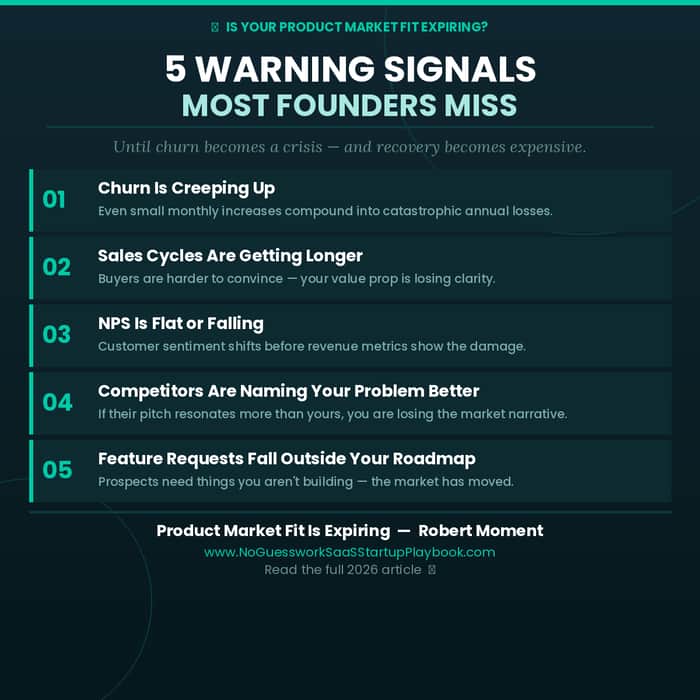
Warning Signals That Product Market Fit Is Weakening
The following signals indicate that product-market fit may already be expiring, even if headline revenue metrics appear stable:
Monthly churn rate is rising quarter-over-quarter despite product improvements. Net Revenue Retention (NRR) is declining expansion revenue is slowing even as new
logos grow.
Sales cycle length is increasing deals that used to close in 30 days now take 60 or 90.
Customer acquisition cost (CAC) is rising without a corresponding increase in lifetime value (LTV)
Net Promoter Score (NPS) is flat or declining despite feature releases. Prospects are using competitor language to describe problems your product solves.
Customer success teams are spending more time on issue resolution than expansion conversations.
Engaged users are a shrinking percentage of total accounts.
Feature requests from prospects consistently fall outside your current product direction.
Your best salespeople are having harder conversations than they were 12 months ago.
Any three or more of these signals appearing simultaneously is a strategic warning not a tactical challenge.
The founders who act on these signals early recover quickly.
The founders who explain them away with tactical stories face a much harder path back to alignment.
How Founders Protect and Rebuild Product Market Fit
The SaaS founders who consistently maintain product-market fit do not do so by being lucky.
They do so because they have built systematic processes for continuously measuring, testing, and responding to market signals.
The following strategies are drawn from Robert Moment’s frameworks in How to Find Product Market Fit for SaaS Startups and Product Market Fit Is Expiring.
Strategy 1: Continuous Customer Validation
Product-market fit is not validated once. I
t is validated on a rolling basis.
The strongest founders run structured customer discovery conversations every quarter not just when something feels wrong, but as a permanent operating discipline.
Strategy 2: Outcome-Focused Product Strategy
Winning SaaS companies obsess over the outcomes customers achieve, not the features they request. Features are inputs.
Outcomes are what customers renew for, expand for, and advocate for.
Strategy 3: Build Defensible Competitive Advantages
In a world where features are replicable, defensible advantages must be built deliberately.
The most durable advantages in 2026 SaaS include:
Proprietary data assets that improve the product with use
Deep ecosystem integrations that create switching costs based on value, not friction Brand trust and category authority in a specific niche
Community and network effects that compound with scale
Domain expertise embedded in the product experience
Strategy 4: Monitor Leading Indicators, Not Lagging Metrics
Revenue is a lagging indicator.
By the time revenue declines, product-market fit has usually been weakening for six to twelve months. The metrics that predict fit erosion early include engagement depth, session frequency, feature adoption rates, expansion behavior, and the ratio of support tickets to activated features.
Strategy 5: Build a Product Market Fit Operating System
The most sophisticated founders institutionalize product-market fit monitoring as an operating process not a periodic exercise.
This includes quarterly customer listening programs, monthly churn pattern analysis, competitive intelligence review, and a positioning test cadence that validates messaging assumptions against live market responses.
The Startup Survival Mindset for 2026
Startup success in 2026 is not about avoiding risk.
It is about identifying strategic risks earlier than your competitors and building organizations that can respond faster than the market shifts.
The founders who consistently build resilient companies share a common discipline: they never stop asking the hard questions that most founders stop asking after early traction.
The questions adaptive founders ask continuously:
Are our customers’ needs shifting in ways our current product does not yet address? Are competitors reframing problems in our space that we have not yet responded to? Is our differentiation still meaningful to buyers today, or has the market moved past it?
Do our best customers describe the value we deliver the same way they did 12 months ago?
What would a new competitor with no legacy product commitments build to beat us today?
Are we growin
g because of genuine fit, or because of market tailwinds that may not persist?
Startups that ask these questions consistently and build the organizational capability to respond to the answers are the companies that outlast their competition and build durable category positions.
SaaS-Specific Startup Failure Statistics
Founders building SaaS companies face the startup challenges described above alongside a set of SaaS-specific dynamics that compound failure risk.
-
The average SaaS company churns 5–7% of its annual revenue base each year best in-class companies churn below 3%.
-
A SaaS startup with negative Net Revenue Retention will not survive long-term regardless of new customer acquisition rate.
-
Approximately 92% of SaaS startups do not reach $1M in Annual Recurring Revenue.
-
The average time from SaaS founding to $1M ARR is approximately 2–3 years for successful companies.
-
SaaS companies that grow at 20% annually have a 92% chance of reaching $1B in valuation, according to McKinsey research on software companies.
-
The leading cause of SaaS failure is building a product customers want but do not urgently need.
-
Onboarding experience is the single highest-leverage retention intervention available to early-stage SaaS companies.
-
SaaS companies with strong Net Promoter Scores grow at twice the rate of companies with average NPS.
-
The cost of acquiring a new SaaS customer is typically 5–7 times the cost of retaining an existing one.
-
Product-led growth companies have 2x the valuation multiples of sales-led companies
at comparable ARR, according to OpenView Partners research.
Additional Startup Statistics by Category
Funding and Capital
-
Over 75% of venture-backed startups fail to return capital to investors.
-
The median time from founding to Series A is approximately 2.5 years for successful startups.
-
Startups that raise too much capital in early rounds face increased pressure to grow into unrealistic valuations.
-
Bootstrapped startups that survive their first three years have comparable long-term survival rates to venture-backed peers.
-
The average seed-stage startup raises $1–3 million before reaching meaningful product-market fit validation.
Team and Leadership
-
Founding team conflict is cited in approximately 23% of startup failures according to CB Insights research.
-
Single-founder startups raise less capital and have lower survival rates than two- or three-person founding teams on average.
-
Companies with experienced domain-specific founders outperform first-time founders by a significant margin in long-term survival studies.
-
Hiring decisions made in the first 20 employees disproportionately shape company culture and strategic direction for years.
-
Leadership inability to adapt strategy based on market feedback is a primary reason otherwise well-funded companies fail.
Market and Timing
-
The Startup Genome Report identifies premature scaling as the primary cause of failure in approximately 74% of high-growth startups that collapse.
-
Startups entering markets too early spend 2–5 times more on customer education than those entering established demand categories.
-
Companies that achieve product-market fit validation before Series A have dramatically higher Series B conversion rates.
-
Markets experiencing regulation changes, workflow disruption, or technology transitions represent the highest-opportunity windows for new startups.
-
Startups that niche down to a specific customer segment before expanding to broader markets achieve fit faster and retain it longer.
Frequently Asked Questions: Startup Failure and Product Market Fit
Why do most startups fail?
Most startups fail because of a combination of three root causes: the absence of genuine product-market fit, running out of capital before achieving sustainable revenue growth, and strategic mistakes in go-to-market execution.
Research consistently shows that the lack of product-market fit is the most common single cause of startup failure across all industries and stages
What percentage of startups fail?
Approximately 90% of startups fail globally, according to multiple studies including CB Insights, Startup Genome, and academic research on entrepreneurship.
About 20% fail within the first year, 50% within five years, and 70% within ten years.
What is product-market fit?
Product-market fit is the condition in which a product genuinely satisfies strong, urgent market demand in a way that is meaningfully better than available alternatives.
It is characterized by strong retention, organic word-of-mouth growth,
increasing customer engagement, and a market that pulls the product forward rather than requiring the company to push it.
Why is product-market fit the most important factor in startup survival?
Without product-market fit, every other investment in a startup marketing, hiring, sales, product development is deployed against a problem that either does not exist in sufficient scale or is not solved well enough to sustain customer loyalty. A company with genuine fit and mediocre marketing will outperform a company with strong marketing and weak fit every time.
What is the biggest strategic mistake startup founders make?
The most common and costly strategic mistake is building a product without first validating that a specific, identifiable group of customers experiences an urgent, recurring problem that they are actively seeking a solution to and willing to pay for.
Many founders confuse interest with demand, and early adoption with sustainable market fit.
How do startups find product-market fit?
Finding product-market fit requires a disciplined process of customer discovery, hypothesis testing, and iterative product development anchored to customer outcomes rather than feature delivery.
The most reliable method is to conduct structured discovery interviews with ideal prospects, identify the most painful and poorly-served problem in their workflow, build the minimum product necessary to solve that specific problem, and measure retention and engagement as primary success metrics before any growth investment.
What does it mean that product market fit is expiring?
The concept, introduced in Robert Moment’s book Product Market Fit Is Expiring, describes the accelerating pace at which the alignment between a product and its market weakens over time
The combination of AI-accelerated competitive replication, feature commoditization, lower customer switching costs, and evolving buyer expectations now means that fit must be actively re-validated and re-earned on a continuous basis.
How quickly can product-market fit expire?
In the current technology environment, meaningful fit erosion can occur within 12 to 18 months of achieving initial fit in fast-moving SaaS categories.
In categories experiencing AI disruption, this window can compress to six to nine months.
What is the Sean Ellis test?
The Sean Ellis test asks customers how they would feel if they could no longer use the product
. Research found that companies where 40% or more of customers answered “very disappointed” had achieved genuine product-market fit. Companies below 40% had not. It measures emotional dependency on the product the most honest proxy for fit that exists.
What is Net Revenue Retention and why does it matter?
Net Revenue Retention measures the percentage of recurring revenue retained from existing customers over a period, including expansion revenue from upsells, minus revenue lost to churn and downgrades. An NRR above 100% means the company grows revenue from existing customers even without acquiring new ones the defining characteristic of the most durable SaaS businesses.
Sources and Research References
Startup statistics and insights referenced in this article are based on research from: CB Insights Startup Failure Report and Venture Capital Database
Startup Genome Global Startup Ecosystem Report (2024–2026)
Crunchbase Startup Funding and Failure Data
Statista Entrepreneurship and Business Survival Statistics
U.S. Bureau of Labor Statistics Business Employment Dynamics
OpenView Partners SaaS Benchmarks Report
Andreessen Horowitz (a16z) Software and SaaS Market Research
McKinsey & Company Software Company Growth Research
Sean Ellis Product-Market Fit Survey Methodology
About the Author
Robert Moment is a Product Market Fit Consultant and SaaS Advisor who works with technology founders to validate, defend, and rebuild product-market fit in rapidly evolving markets.
His work focuses on helping SaaS and AI startup founders eliminate guesswork from their growth strategy and build companies that achieve durable market alignment.
He is the author of:
Product Market Fit Is Expiring the definitive guide to understanding and responding to the accelerating decay of product-market fit in the AI era
How to Find Product Market Fit for SaaS Startups a practical framework for validating product-market fit at every stage of the SaaS journey
SaaS Growth Playbook a strategic resource for scaling SaaS revenue with defensible differentiation .
For frameworks, resources, and the complete SaaS startup strategy library, visit: www.NoGuessworkSaaSStartupPlaybook.com

8 year to run a non-profitable startup? :O I don't even know how would someone roll something for 8 years without validation. In the current landscape of saas, in 8 years most of the ideas will be dead or disrupted twice over by then. What do you think about validating with ads instead? I’ve seen people spend $100 on a landing page + search ads to get a 'yes/no' in a weekend rather than guessing for years. Is that still a reliable signal in 2026, or is the 'waitlist' dead?"