Top 12 Microservices Frameworks Every Developer Should Know
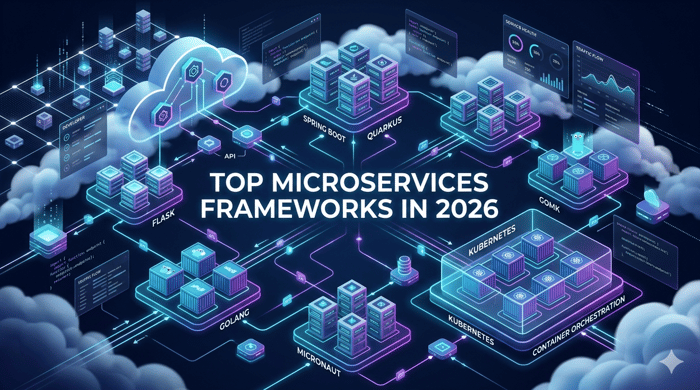
Popular Microservices Frameworks
Introduction
When you know what kind of business app you want to make, one of the first things you do is outline its design. Nowadays, business owners prefer microservice approach. Monolithic single applications are divided into smaller ones using microservice frameworks. To create microservices, one can utilize any number of languages and frameworks. The development of different deployment models is their main focus.
In this article, you will find a list of popular microservices frameworks to help you choose the best one for your application.
The innovative ability of microservices frameworks to construct highly extensible applications has earned them widespread renown and appreciation. To build, deploy, and maintain applications based on microservices successfully, developers can make use of the tools and libraries provided by these frameworks. Application durability and strength are enhanced by developers utilizing microservices frameworks, which offer advanced functions like service discovery, load balancing, and fault tolerance. Microservices frameworks provide a strong basis for developing cutting-edge, adaptable, and dependable software solutions by effortlessly handling complicated distributed systems.
1. Spring Boot
When it comes to creating microservices in Java, Spring Boot is by far the most popular and up-to-date framework. Get in touch with Spring Boot developers if you're looking for coders who can build powerful, flexible, and self-contained software utilizing Spring Cloud and Spring Boot. Its 59.2k GitHub ratings and rising popularity are a direct result of the lack of serious competition in the market.
As part of this microservices architecture, developers have Spring Initializr ready to quickly launch apps before bundling them in JAR files. The ability to facilitate rapid development gives the built-in server approach an edge when considering the time required to launch contemporary apps. Spring Boot isn't the best framework option when dealing with several applications.
2. Flask
Flask is a popular Python web framework for creating microservices and SMB-sized web apps due to its lightweight nature and flexibility. Since it offers just the most important building blocks for a web app without enforcing a strict structure or incorporating superfluous dependencies, it is frequently called a microframework. Developers are granted full autonomy over the design and scalability of their apps using this basic approach.
The fact that Flask is both simple and easy to use is one of its main features. Quick prototyping and iterative development are made easy with its ability to enable developers to set up basic applications with just a few lines of code. Flask is incredibly extensible, even if it is simple. Database integration, authentication, form validation, and API development libraries are just a few of the many available extensions.
Since Flask enables developers to build very small autonomous services that can be launched and managed separately, it is ideal for a microservices architecture. When compared to frameworks with more features, its lightweight design guarantees greater efficiency and less resource use. The REST APIs, containerization platforms, and cloud environments are just a few examples of the latest tools and technologies that Flask works well with.
If you're a developer who values control, simplicity, and scalability in your microservice framework, Flask is a great pick.
3. Golang
Thanks to Google's support and services, the Go programming language has become more popular among software professionals who focus on microservices. With GoMicro, building microservices in the Go programming language becomes a piece of cake.
By integrating GoKit and GoMicro, two Golang frameworks tailored to building microservices, it becomes a breeze to set up a distributed architecture for any program. This pluggable PRC library supplies the essential building blocks required to create microservice applications. Although it is not a framework per se, developers frequently take advantage of its basic abstractions to quickly handle the difficulties of a distributed architecture.
4. Eclipse Vert.X
You should choose Eclipse Vert.X if you want to build custom apps using an event-driven microservices architecture. The framework's compatibility with the Java Virtual Machine makes it an excellent pick for highly complex, service-oriented applications. Ceylon, Java, JavaScript, Groovy, Kotlin, and Java are just a few of the languages that this multilingual framework supports.
The Eclipse Foundation's Vert.X is different from ordinary stacks and frameworks built on blocking I/O since it can process several requests concurrently while being resource efficient. It is possible to complete tasks in a limited environment, particularly in containers. Vert.X is more of a highly flexible toolbox than a framework because of its integrated functions and variety in ease of use. For its microservice architecture, Vert.X is most famous.
5. Quarkus
Quarkus, developed by Red Hat, is a native Java framework for Kubernetes that aligns with OpenJDK HotSpot and GraalVM. A reactive and imperative programming paradigm is provided by the framework to solve the issues with microservice design.
Developers have always had lightning-fast startup speeds as their top priority with the native Kubernetes container-first framework Quarkus. Microservices running on containers and Kubernetes can be automatically scaled thanks to their fast startup time. Microservices, on the other hand, can increase container density with little memory utilization because they launch numerous containers individually.
6. Micronaut
Software engineers are concentrating on Micronaut, a top polyglot framework for developing microservice apps and making them modular. It was the authors' objective to provide a full-stack environment that already had all the capabilities needed for a microservices architecture, rather than just adding the toolkits. Software engineers can build modular applications using the JVM-based full-stack framework.
One of the great things about Micronaut is that its memory usage and startup time are not affected by the size of the codebase. The end effect is a smaller memory footprint, faster startup, and higher throughput.
7. Oracle Helidon
Oracle Helidon is an all-inclusive set of lightweight Java microservices frameworks that allow programmers to construct modular, powerful, and quick applications with an extensive set of tools and features. Its two strong frameworks, Helidon SE for cloud-native microservices and Helidon MP for Java EE applications, are part of its adaptable architecture.
Reactive programming, support for service mesh topologies, and a smooth interface with common container orchestration platforms are just a few of the sophisticated capabilities offered by Helidon SE, which is designed for cloud-native environments. With its integrated health checks, monitoring, and fault tolerance features, it simplifies the deployment and management of microservices for developers.
But if you're a Java EE developer seeking to make the most of your current knowledge and resources, Helidon MP is a great option. To ease the deployment of Java EE applications in contemporary cloud and microservices architectures, it offers a runtime that is functional and compact. Helidon MP makes it easy for developers to construct enterprise applications that are both scalable and robust by providing extensive support for Java EE requirements.
Oracle Helidon is the perfect platform for your next-gen apps if you're looking for adaptability, top-notch performance, or seamless integration. It is an attractive option for developing contemporary and scalable Java applications due to its lightweight design and comprehensive feature set.
8. Lightbend Lagom
You may build microservice apps in Scala or Java with the help of Lagom, an open-source framework. The groundbreaking technologies that form the basis of Lagom are Akka and Play, which have been in use for some of the expected applications. You can start the Lagom architecture, build the project, and deploy your supporting modules and microservices all in one go. The design is reloaded instantly whenever it finds changes to the source code.
9. Dropwizard
Developers may construct RESTful web services effectively with Dropwizard, a framework that integrates multiple renowned libraries. The simplicity and efficacy of it stand out. This stable and mature framework is a happy medium between Micronaut and Spring Boot. You can keep an eye on your systems and run diagnostics with the help of pre-built operational tools and application metrics.
10. AxonIQ
If you're looking for a way to make your Java programs more adaptable without breaking the bank, Axon has you covered. In order to provide software system support that is ready for business use, specifically for software development processes within corporations, Axon is comprised of a software system and a specialized architecture. You may find models and architecture in Axon Framework and in Axon Server, respectively.
11. GoMicro
Go Micro provides the essential components needed to create Go microservices through a modular RPC-based framework. In order to construct scalable systems, Go Micro meets all requirements. As a result, the microservice architectural pattern becomes a set of resources that underpin the whole system. Through the use of familiar, clear representations, micro aids programmers in navigating the challenges of parallel computing.
12. Ballerina
Create your own microservices with the help of the open-source, cloud-native programming language Ballerina. It simplifies the development of concurrent, distributed, and event-driven applications with its one-of-a-kind syntax and optimized runtime. Ballerina, created by WSO2, is a great language for creating microservices since it takes advantage of Java's benefits while removing its complexity.
Without the need for any other components in the infrastructure, the Ballerina runtime handles service discovery, load balancing, and fault tolerance. With its pre-built connectors and libraries, it also makes it easier to integrate with other services or APIs. Its popularity among developers for creating dynamic programs using a microservices architecture is due to its characteristics.
With its many features that simplify development, Ballerina revolutionizes how developers think about microservices.
Future Trends In Microservices Frameworks
When it comes to creating cutting-edge distributed systems, emerging technologies and trends in microservices are always popping up to meet the problems and seize the opportunities. Some important trends that will affect microservices frameworks in the future include these.
1. Increased Observability
To facilitate debugging in distributed systems, frameworks are increasingly integrating technologies like OpenTelemetry to offer built-in tools for tracking, recording, and monitoring. Experts anticipate that in the not-too-distant future, a great number of frameworks will either come equipped with observability or be able to seamlessly include current observability technologies.
2. Greater Security
Secure service communication is rapidly adopting zero-trust paradigms and features such as mutual transport layer security (mTLS). New compliance-focused solutions are being included in frameworks to tackle requirements such as GDPR and CCPA. Soon, developers won't have to do much to make security a part of frameworks; these new frameworks will already include best practices for these technologies and standards.
3. Cloud-native Integration
To better manage traffic, improve scalability, and integrate with serverless platforms and Kubernetes, frameworks are developing integrations like Istio. Numerous specialized frameworks that operate natively within the realm of containers and orchestration platforms will likely emerge as their popularity grows.
There will be further development and evolution of these trends inside microservice frameworks. You may see several of the aforementioned trends in action right now. There have been tremendous advancements in addressing many of the aforementioned challenges in the ecosystem when compared to a few years ago.
Summing Up
When it comes to creating cutting-edge, adaptable, and dynamic apps, microservices architecture is now king. Organizations can accelerate development, make systems more resilient, and enable continuous deployment by dividing big systems into smaller, independent services. The independence of each service in terms of development, deployment, and scaling makes microservices ideal for applications that are constantly evolving and experiencing rapid growth.
The effectiveness of this design relies heavily on picking the correct microservices framework. The technological stack, performance requirements, and team skills determine which framework offers the best combination of features. Frameworks can be categorized according to their emphasis on ease of use, functionality, or enterprise-level features.
Ultimately, every situation calls for a unique approach. Project needs and long-term objectives will determine the optimal option. Organizations may create efficient systems that are ready for the future by using the correct tools and following best practices to properly utilize microservices.
