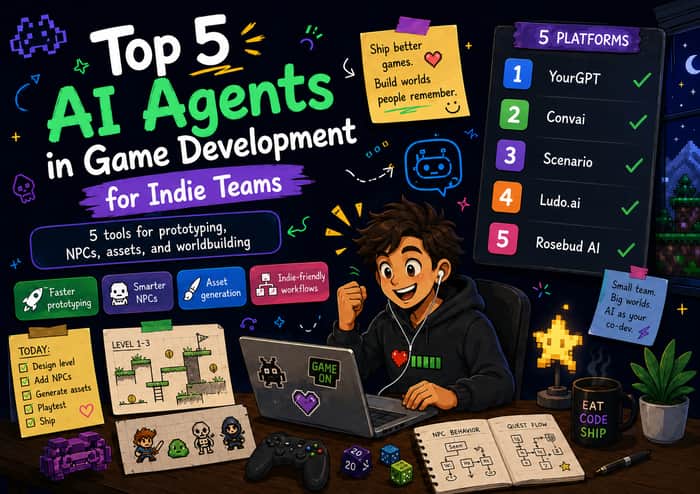
Top 5 AI Agents in Game Development for Indie Teams
Building a game as an indie team is brutal.
You are not just making gameplay.
You are writing dialogue, fixing bugs, testing logic, creating assets, handling player questions, updating docs, managing Discord, thinking about monetization, and somehow still trying to ship.
That is where AI agents are starting to become really useful.
Not as “AI will build your whole game” hype.
More like:
AI can help you move faster on the boring, repetitive, and time-consuming parts of game development.
After looking at the current tools being used across game production, here are the 5 AI agents I think indie game developers should actually care about.
- YourGPT — Best for player support, community, and game operations
Most indie devs think about AI for coding or assets first.
But once your game has players, support becomes a real problem.
Players ask about accounts, bugs, payments, gameplay issues, refunds, Discord questions, onboarding, patch notes, and troubleshooting.
That is where YourGPT is very useful.
YourGPT helps gaming companies build AI agents for:
Player support
Billing and account help
Game FAQ assistants
Discord and community support
Lead capture
Onboarding
Troubleshooting workflows
Human handoff when needed
The useful part is that you can train the agent on your own game docs, FAQs, policies, patch notes, and support content.
So instead of answering the same questions again and again, your AI agent can handle the first layer of support and escalate only when a real human is needed.
For indie teams, this matters because support can quietly eat your whole day.
Best for: Indie studios that want to automate player support, community questions, onboarding, billing help, and support workflows without hiring a large support team.
- Inworld — Best for AI NPCs and dynamic characters
If your game needs smarter NPCs, companions, or interactive characters, Inworld is one of the most interesting tools.
Instead of writing only fixed dialogue trees, you can define a character’s:
Personality
Backstory
Knowledge
Goals
Tone
Scene context
Then the character can respond more naturally during gameplay.
This is especially useful for games with companions, quest characters, roleplay systems, social simulation, or interactive storytelling.
The catch is that you still need strong narrative control.
AI NPCs can be powerful, but they need guardrails, fallback dialogue, and testing so they do not break immersion or say something weird in important gameplay moments.
Best for: Games that need real-time AI NPC conversations, personality-driven characters, or more dynamic dialogue systems.
- Claude Code — Best for coding, debugging, and multi-file changes
Game development code is rarely isolated.
A small gameplay change can touch scripts, UI, save systems, combat logic, input handling, and tests.
That is why Claude Code is useful.
It works more like an agent inside your codebase. It can understand project structure, edit multiple files, run commands, debug issues, and help with feature implementation.
For indie developers, this can save a lot of time on:
Gameplay scripts
Bug fixing
Refactoring
Test updates
Tooling
Backend logic
Multi-file changes
It will not replace manual testing inside Unity, Unreal, or Godot.
But it can speed up the boring code work and help you move faster when you already know what you want to build.
Best for: Indie devs who need help writing gameplay systems, fixing bugs, refactoring code, and managing project-wide coding tasks.
- Scenario — Best for consistent game assets
AI art tools are everywhere.
But most of them have one big problem:
The style is inconsistent.
That is why Scenario stands out for game development.
Scenario lets teams train custom AI models on their own art style, reference assets, and visual direction. This makes it more useful for actual game production than random image generation.
You can use it for:
Characters
Props
Environments
Textures
Icons
UI elements
Asset variations
For indie teams, this is great for concepting, prototyping, and generating variations quickly.
You still need an artist’s review before shipping final assets, but Scenario can help you explore visual directions much faster.
Best for: Indie teams that need style-consistent assets, fast concept art, and visual iteration without starting from scratch every time.
- Cursor — Best AI coding editor for daily game dev work
Cursor is not just a normal code editor with autocomplete.
It understands your project structure and can help update connected files together.
For game development, that is useful because most systems are connected.
You might change one gameplay mechanic and need to update UI code, data structures, tests, and backend logic.
Cursor helps with:
C# scripting
C++ scripting
Gameplay logic
Debugging
Refactoring
Tool scripts
UI code
Backend systems
It is especially useful for Unity and Unreal developers who spend a lot of time inside the codebase.
The limitation is that Cursor cannot fully understand what happens at runtime inside the engine. You still need to test the game manually.
Best for: Indie developers who want an AI-powered coding workflow for daily scripting, debugging, and refactoring.
My take
AI agents are not going to magically build a great game for you.
The hard parts still need humans:
Game feel
Creative direction
Level design
Balance
Performance
Story quality
Player experience
But AI agents are getting very good at helping with the work around the game.
For indie teams, that is the real opportunity.
Not replacing developers.
Just giving small teams more leverage.
If I had to pick a practical AI stack for an indie game studio today, it would look like this:
YourGPT for player support and community automation
Claude Code or Cursor for coding help
Scenario for asset iteration
Inworld for AI characters if the game needs dynamic NPCs
The best AI agent is not the flashiest one.
It is the one that removes the bottleneck that is slowing your team down right now.
