Top 7 Regtech Use Cases in the Financial Sector
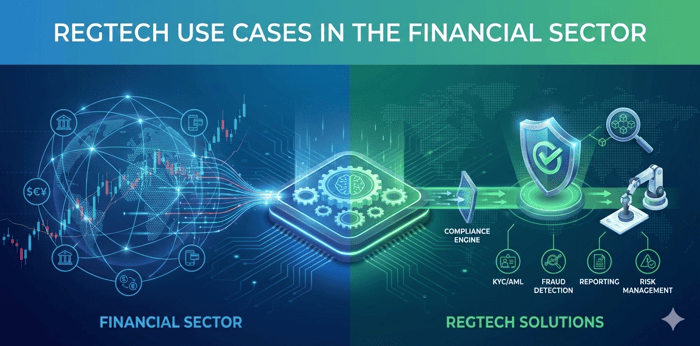
Businesses may find it difficult to understand the regulatory compliance system, particularly in the financial industry. The acronym "RegTech" stands for "regulatory technology," and it's revolutionizing this field. Compliance processes are made easier and more cost-effective with the help of RegTech, which uses cutting-edge technologies like cloud computing, big data, and machine learning.
Creative approaches to managing compliance are more necessary than ever before due to the growing complexity of rules. Businesses can find these solutions through RegTech, which offers technologies that help reduce risks and stay up-to-date with changing regulatory regulations.
Learn the ins and outs of RegTech and why it matters in this comprehensive post. We will go over its main features, functions, and how it is used in different industries. Notable RegTech cases will also be covered, along with developments in the sector.
What is RegTech?
The term "RegTech" describes the use of technological means to standardize and improve business regulatory procedures, with a focus on the banking and insurance industries. Various applications are part of it, all with the goal of making regulatory compliance easier and cheaper for companies.
The primary goal of regulatory technology is to simplify and expedite compliance processes while decreasing related costs and effort. It offers more efficient and accurate tools for reporting, tracking, and adherence to regulations than the old ways. Not only does this help companies remain compliant, but it also lets them adjust to new rules with ease.
The Importance and Advantages of RegTech
The ever-increasing amount and complexity of regulations have led to RegTech quickly becoming an essential tool for companies.
Companies dealing with strict regulatory settings, in particular, must have this new technology. It guarantees comprehensive and efficient compliance processes by automating repetitive tasks and offering real-time data analysis, hence minimizing the chance of human error. Additionally, it works well with other systems, so companies may stay compliant without having to change their whole architecture.
Simply said, RegTech revolutionizes compliance management, elevating it from a mere necessity to a strategic asset. Companies can keep ahead of regulatory developments, handle regulatory risks early on, and keep their competitive edge with this tech-driven approach.
A deeper look at the main advantages of RegTech points out:
Cost Efficiency: Reducing costs is one of the main advantages of RegTech. The personnel costs and the fines for noncompliance can add up quickly, but automating compliance procedures can help firms save a ton of money.
Real-Time Monitoring and Reporting: With the help of RegTech , suspicious activity can be detected and reported instantly because transactions and activities are monitored in real-time. Problems like fraud and money laundering can be averted with this constant monitoring.
Easy Decision-Making: Regulatory technology solutions provide an in-depth understanding of compliance data through the use of advanced analytics and big data capabilities. Optimizing compliance methods, seeing trends, and making educated judgments are all made easier with this data.
Scalability: Scalability is a key feature of RegTech solutions, which allow them to expand alongside businesses. Without a total system redesign, RegTech can grow to fulfill an expanding company's ever-increasing compliance obligations.
Intelligence on Regulations: Features that keep firms apprised of regulatory trends and changes are common on RegTech platforms. Businesses can anticipate changes and maintain compliance with little to no downtime thanks to this data.
Moreover, RegTech's value and advantages come from the fact that it can simplify and expedite compliance processes, turning them from a frustrating ordeal into something more manageable. Businesses can acquire a competitive edge through enhanced business effectiveness, cost reduction, and risk management by implementing RegTech, which also guarantees regulatory compliance.
Key Functions of RegTech
In order to properly manage regulatory compliance, RegTech incorporates a wide variety of necessary operations. Compliance with regulations, mitigation of risk, and maintenance of operational integrity are all aided by these functions.
Listed below are the primary functions of RegTech:
1. Regulatory Monitoring
Regulatory monitoring is keeping tabs on company operations to make sure they're following all the rules. In order to detect anomalies or non-compliant activity, regulatory technology solutions employ advanced algorithms that analyze data in real-time. Businesses can benefit from this proactive strategy because it helps them identify possible difficulties early on, giving them time to fix them before they become major problems.
2. Reporting
To make sure that companies are factual and deliver their reports on time, RegTech proactively generates and sends reports to regulators. These solutions bring together data from many sources, make reporting easier, and lessen the chances of mistakes. Time and resources are saved and report dependability and correctness are improved by RegTech's automation of this operation.
3. Compliance
It is the responsibility of this department to make sure that the company follows all the rules and regulations. From keeping tabs on regulatory changes to executing the required modifications to corporate processes, RegTech solutions offer tools for successfully handling compliance needs. Businesses may keep their compliance up-to-date, lessen the likelihood of non-compliance, and avoid fines with these solutions.
4. Managing Risks
The goal of regulatory technology solutions is to find security flaws and dangers in a company's operations by analyzing massive amounts of data. The use of machine learning and predictive analytics allows them to foresee possible compliance violations and suggest solutions. Successful risk mitigation and regulatory compliance are both aided by this proactive risk management strategy.
5. Privacy and Security of Data
Additionally, RegTech technologies aid in the administration and protection of private data. These solutions safeguard the company and its customers from data breaches and misuse by ensuring compliance with legal standards.
Applications of RegTech
Given their adaptability, RegTech solutions can be used in a wide range of industries, each of which faces its own set of regulatory obstacles. Although RegTech developments mostly help the financial sector, other sectors also use them to make operations more efficient, comply with regulations, and decrease risks.
Some of the most important uses of RegTech in various industries are as follows:
1. Banking and Finance
Compliance with several regulations, such as Anti-Money Laundering (AML), Know Your Customer (KYC), SEC guidelines, and FINRA requirements, is managed by RegTech in the financial services sector.
RegTech products automate compliance report generation, real-time transaction monitoring, and the detection of questionable behaviors for financial institutions. This improves the efficacy and precision of compliance procedures while simultaneously guaranteeing conformity with regulatory requirements.
2. Medical Field
Regulations concerning research studies, patient data confidentiality, and billing methods are particularly onerous for the healthcare sector. Healthcare providers and organizations can benefit from RegTech technologies when it comes to staying in compliance with regulations like HIPAA. Secure handling of patient data, management of consent forms, and automation of reporting processes are all made possible by these systems. Health care firms can improve data security, simplify processes, and avoid fines for noncompliance by using RegTech.
3. Telecommunications
Data privacy, consumer agreement, and fraud prevention strategies are some of the heavily regulated areas in which telecommunications businesses operate.
By automating communications monitoring, guaranteeing consumer data protection, and streamlining regulatory reporting, RegTech solutions aid telecom companies in managing compliance. The General Data Protection Regulation (GDPR) and similar legislation at the national and regional levels can be more easily met by telecommunications companies in this way.
4. Energy Industry
Utility and oil and gas businesses, among others in the energy industry, are bound to adhere to safety standards, report as required, and comply with environmental legislation. Businesses can benefit from RegTech solutions in several ways, including the automation of emissions reporting and other regulatory data, the monitoring of environmental effects, and the management of safety compliance.
5. Insurance
Data security, fraud prevention, and financial reporting are three areas where insurance firms encounter regulatory hurdles. Through the automation of client verification processes, the monitoring of operations for fraudulent activity, and the management of regulatory reporting, RegTech products assist insurers in complying with rules. International standards, including Europe's Solvency II, might be easier to adhere to with the help of these technologies.
What is the Process of RegTech?
Analyzing the fundamental operations and techniques of regulatory technology platforms is essential to comprehending their operation. A few examples of the most common RegTech use cases are as follows:
1. Onboarding Customers
Many regulated businesses, like the banking sector in particular, rely heavily on customer onboarding. This procedure is made better by RegTech systems, which automate AML and KYC checks. A RegTech tool may, for instance, scan a user's facial features of the face against a government-issued ID in order to confirm the user's identification. To further verify that consumer information is not marked for questionable activity, machine learning algorithms can compare it to databases and worldwide watchlists.
2. Continuous Monitoring and Identification
In order to identify any anomalies or questionable conduct, RegTech solutions constantly keep an eye on all conversations, transactions, and other activity.
Companies can employ real-time monitoring to examine financial data and flag unusual activity that could indicate money laundering or fraud, for instance, using algorithms and machine learning models. Their system is designed to constantly monitor for any suspicious patterns or behaviors, notifying compliance professionals of any potential dangers in real-time.
3. Reporting
Regulatory report collection, compilation, and filing can be automated via compliance systems. In order to submit correct reports to regulatory agencies, these tools collect data from several sources, analyse it in accordance with regulatory requirements, and then generate them.
4. Data Administration
Maintaining compliance with regulations requires efficient data handling. Strong data management capacities, including data collection, storage, and retrieval, are provided by regulatory technology systems.
Data security and compliance with data protection requirements are guaranteed by these instruments. For the sake of reporting and compliance checks, they also make it easy to access the necessary data.
5. Integration with Existing Systems
Integrating RegTech solutions with a company's current systems and procedures is a top priority. The incorporation of compliance procedures into the larger operational framework of the business is guaranteed by this integration. Integration with CRM systems, financial management software, and other business applications is possible using RegTech technologies. The effectiveness of compliance procedures is improved by this compatibility.
Challenges Faced by the RegTech Sector
If the regulatory technology sector is to continue to develop and include cutting-edge technology, it will need to meet a number of new difficulties if it is to maintain healthy growth and provide efficient compliance solutions. To overcome these obstacles, a well-planned strategy is needed to strike a balance between innovation, regulatory requirements, and operational constraints.
Premature Adoption of Technologies
The hasty acceptance of new technology is a major problem in the RegTech sector. Blockchain and artificial intelligence have tremendous promise, but they pose risks if not properly tested and understood before implementation, which can cause delays and compliance issues. Introducing new technology into compliance frameworks requires a thorough evaluation of its readiness and application.
Understanding Outcomes in Regulation
Comprehending and foreseeing the implications of changes to regulations is another obstacle. It is challenging for RegTech solutions to provide a universal solution because regulations might differ greatly among jurisdictions and industries. In order to stay in compliance, businesses need to build systems that can easily adjust to different regulatory contexts and even predict what regulations will be popular in the future.
Role of Data Architecture
Strong data architecture is crucial to the success of RegTech solutions. It is critical for compliance to have conveniently available, consistent, and correct data. The problem is that many businesses have poor data quality and disjointed data systems. If you want to get the most out of RegTech, you need to put money into a data architecture that can scale and integrate.
Balancing Innovation and Compliance
Striking a balance between being innovative and compliant is no easy feat. Due to the quick pace of technological change, there is always a chance of non-compliance, even if RegTech strives to bring creative solutions to simplify compliance.
Companies need to be careful that their new ideas won't get in the way of government regulations. Keeping up with technology developments and regulatory changes necessitates constant vigilance and the revision of compliance procedures.
Emerging Trends in RegTech
Innovative RegTech solutions are always adapting to tackle new regulatory difficulties and seize new possibilities as the regulatory landscape changes.
A number of new developments are influencing the direction RegTech will take in the future, with the goal of improving compliance processes and adding value for companies through the use of innovative technology.
1. Natural Language Processing
In order to better understand and analyze regulatory documents, RegTech systems are incorporating Natural Language Processing (NLP) more and more. With the help of natural language processing (NLP) technology, RegTech systems can automatically read, understand, and summarize lengthy regulatory documents. With this feature, compliance teams may easily adapt their plans in response to new regulations by keeping themselves apprised of all the newest developments in the field.
Automated updates to a company's compliance needs and notifications to appropriate departments of any required adjustments can be triggered by natural language processing (NLP) scanning and interpreting newly published laws by government organizations.
2. Blockchain
The use of blockchain technology has the ability to greatly improve regulatory compliance in terms of both security and transparency. Blockchain technology guarantees the integrity and veracity of all records and transactions by creating a distributed and unchangeable database. This technology proves advantageous in domains such as transaction surveillance and audit documentation, where the integrity and traceability of data are of paramount importance.
Blockchain technology is utilized by businesses such as Chainalysis to track bitcoin transactions. This helps identify and avoid criminal activity and ensures compliance with financial regulations.
3. Cybersecurity
Incorporating modern cybersecurity measures into RegTech solutions is becoming more and more vital as cyber threats grow more complex. In order to safeguard sensitive information and guarantee conformity with data protection laws, RegTech solutions are increasingly integrating cybersecurity elements. Among these safeguards are encryption, encrypted data storage, and the ability to detect threats in real-time.
To swiftly identify and neutralize any breach attempts, RegTech solutions can provide real-time monitoring and warning systems that track and react to any cyber threats.
4. Data Standardization
A key development in RegTech is data standardization, which aims to simplify data gathering, processing, and reporting. The reliability and precision of data across all platforms and systems depend on standardized data formats and protocols.
Multinational corporations are particularly affected by this trend because of the wide variety of regulations that they are required to follow in different countries. By establishing and adhering to standardized data protocols, financial companies may facilitate the global integration of their systems and guarantee that all data pertaining to compliance is consistent and readily available for audits and reporting.
5. AI-driven compliance solutions
The use of AI and ML to automate and improve regulatory compliance is quickly becoming the focus of attention in AI-driven compliance solutions. In order for enterprises to remain one step ahead of ever-changing compliance standards, these systems are able to analyze massive amounts of data, spot irregularities, and provide real-time insights.
Future trends in RegTech
Fintechs should seriously explore incorporating RegTech solutions into their operations for a number of important reasons:
Investing in Advanced Technologies: Government agencies have to put their money into cutting-edge equipment that can process rules that are both machine-readable and operational. A lot of staff training and new technology will be required to make this happen.
Prioritizing the Administration and Quality of Data: Maintaining exceptional, structured data is of utmost importance due to the increasing prominence of AI and analytics. If financial institutions want RegTech solutions to work as intended, they need to concentrate on data management.
Keeping Abreast of Any Changes to Regulations: Keeping up with the latest developments and trends in global regulation is crucial. This requires familiarity with both the current rules and regulations
and the ability to foresee and adapt to any changes that may be forthcoming.
Teamwork and Collaboration: The easiest way to stay abreast of RegTech trends and best practices is to network with vendors in the field and take part in industry forums. Gaining access to specialist knowledge and solutions is another benefit of such connections.
Conclusion
Financial institutions that want to improve compliance and decrease risk must be updated about trends in RegTech as it evolves. The key to remaining ahead of the competition is to stay current, whether it's through investigating RegTech-as-a-Service or using AI-driven solutions.
New developments in RegTech are propelling the sector ahead. Businesses now have better, safer, and more efficient ways to handle regulatory compliance thanks to these innovations, which also improve the capabilities of RegTech solutions. The future of RegTech and the ease with which businesses can traverse the complicated regulatory landscape will be greatly influenced by these technologies as they continue to evolve.
Organizations can better manage complicated rules and make educated compliance decisions when they have a firm grasp of emerging technology.
