Top 8 Global SaaS Providers Scaling the Digital Ecosystem in 2026

The software-as-a-service landscape has reached an inflection point. In 2026, the competitive advantage in SaaS no longer stems from feature proliferation or aggressive customer acquisition — it emerges from architectural sophistication. Behind every successful SaaS platform lies a critical infrastructure layer: specialized development firms that architect multi-tenant systems, embed autonomous AI capabilities, and build the foundational technologies enabling rapid scaling.
These companies operate in the shadows of consumer-facing brands, yet their influence shapes the entire digital economy. They are the architects who transform ambitious product visions into production-ready platforms capable of serving thousands of enterprises simultaneously. As SaaS companies face mounting pressure to integrate intelligent automation, optimize cloud infrastructure costs, and accelerate time-to-market, the role of specialized development partners has evolved from optional vendor to strategic necessity.
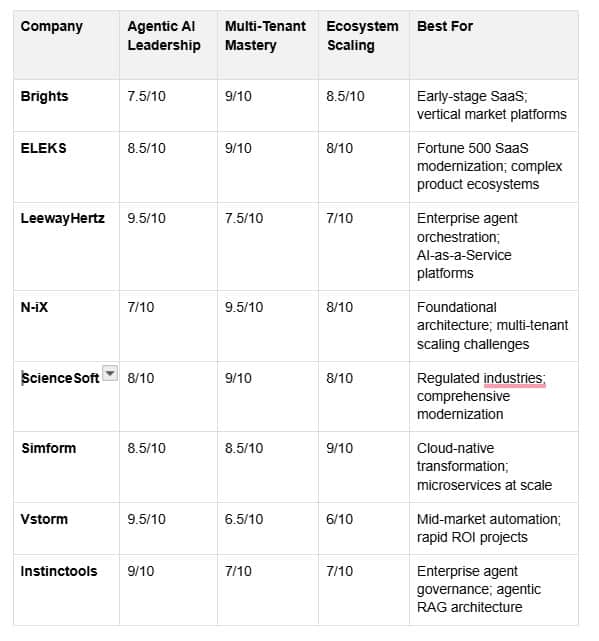
This analysis identifies eight firms distinguished by their mastery of three critical dimensions: agentic AI orchestration, multi-tenant architecture excellence, and ecosystem-enabling capabilities. These organizations don't merely build software — they construct the technical foundation upon which the next generation of SaaS innovation rests.
The 2026 SaaS Development Landscape: Three Defining Trends
The SaaS enablement sector in 2026 is shaped by transformative shifts that separate market leaders from followers.
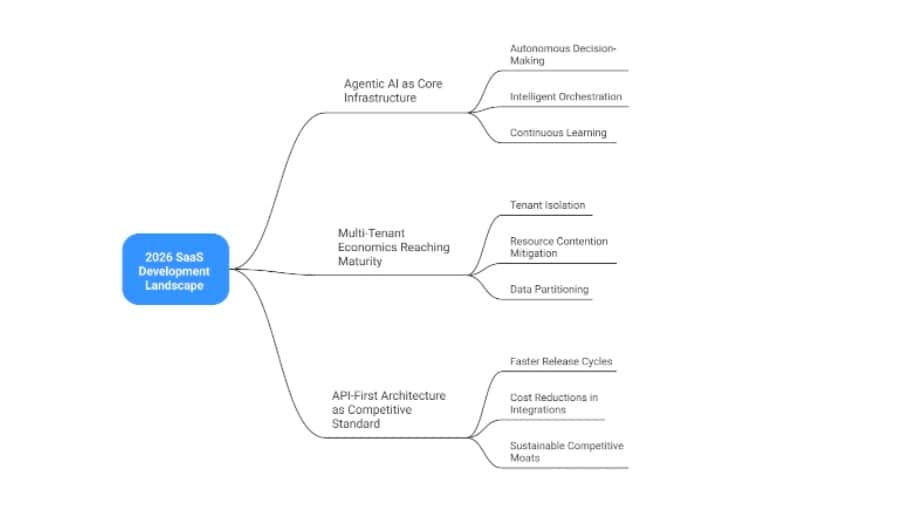
Agentic AI as Core Infrastructure: Enterprise adoption of AI agents has moved decisively from experimental pilots to production-grade deployment. Research indicates that 81% of organizations plan to expand AI agent implementations into complex, multi-step workflows this year. Modern SaaS platforms must embed autonomous decision-making, intelligent orchestration, and continuous learning mechanisms not as feature add-ons but as foundational architectural components, directly influencing long-term SaaS development cost through architecture, infrastructure, and operational complexity. The most sophisticated development firms now design platforms where AI agents handle customer service escalations, automate compliance workflows, and optimize resource allocation without human intervention.
Multi-Tenant Economics Reaching Maturity: Well-implemented multi-tenant architecture delivers infrastructure cost reductions of 30-50% compared to single-tenant deployments while enabling instant scalability and rapid customer onboarding. However, achieving these benefits requires solving complex technical challenges: tenant isolation, resource contention mitigation, and data partitioning across thousands of simultaneous users. The architectural gap between viable multi-tenant platforms and catastrophic failures is measured in specialized expertise — expertise that few organizations possess internally.
API-First Architecture as Competitive Standard: The API economy will reach $25.7 billion globally by 2027, with companies employing strategic API-first design achieving 57% faster release cycles and 37% cost reductions in integrations. Leading SaaS development firms embed API-first thinking from inception, enabling platforms to evolve from standalone tools into comprehensive ecosystems that drive network effects and create sustainable competitive moats.
Top 8 SaaS Development Firms Powering the 2026 Digital Ecosystem
1. Brights: Vertical SaaS Architecture & Rapid Market Entry
Brights leads this selection through specialized competency in accelerating time-to-market while maintaining institutional-grade architectural quality. Through its SaaS product development services, the firm leverages over a decade of focused SaaS experience to deliver production-ready MVPs in 3–4 months — a timeline that enables founders and enterprises to capture market opportunities before competitive windows close.
Their distinctive strength lies in vertical SaaS specialization: building industry-specific platforms for fintech, healthcare, logistics, real estate, and education that deliver 3-5x more value than generic horizontal tools. Brights employs API-first platform design, cloud-native architecture, and investor-ready documentation frameworks that allow non-technical founders to launch sophisticated platforms without requiring in-house engineering infrastructure.
The firm's team composition — 82% middle and senior-level SaaS specialists — ensures that projects benefit from accumulated architectural wisdom rather than junior experimentation. Their transparent pricing models and dedicated resource allocation democratize access to institutional-grade SaaS engineering, positioning Brights as the enabler for ambitious founders seeking to build category-defining platforms in specialized markets.
2. ELEKS: Enterprise SaaS Engineering with Integrated AI
ELEKS operates as one of Eastern Europe's largest software engineering firms, deploying 2,000+ specialists across Fortune 500 enterprises. Their core competency combines deep multi-tenant architecture expertise with end-to-end agentic AI integration — embedding autonomous workflows as foundational orchestration systems rather than superficial feature layers.
The firm's proprietary delivery framework balances architectural rigor with agile methodology, ensuring clients receive production-ready, scalable infrastructure capable of handling explosive growth and sophisticated AI-driven automations. ELEKS excels in vertical markets where SaaS complexity peaks: media, e-government, e-learning, healthcare, and fintech. By transferring architectural knowledge and AI implementation patterns to clients, ELEKS enables both startups and enterprises to compete on product innovation rather than engineering capacity constraints.
3. LeewayHertz: Enterprise-Grade AI Agent Orchestration
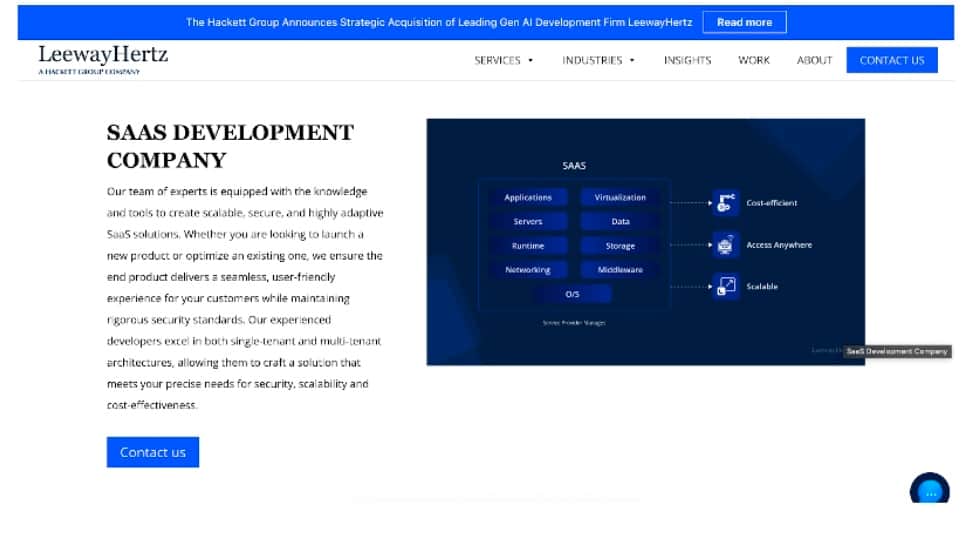
LeewayHertz has positioned itself as a pure-play agentic AI specialist with enterprise-grade orchestration capabilities. Using premier frameworks including AutoGen Studio, Vertex AI Agent Builder, and crewAI, they build task-focused autonomous agents handling complex workflows across customer service, HR automation, supply chain management, and compliance monitoring.
Their distinctive offering — no-code/low-code PaaS solutions — enables enterprises to deploy and manage AI agents without deep technical expertise, dramatically reducing implementation timelines. LeewayHertz operates as the orchestration backbone for SaaS platforms embedding intelligent agent capabilities without in-house AI engineering teams. Their continuous learning and optimization frameworks ensure agents improve over time, addressing the critical requirement where agent reliability directly impacts customer retention in enterprise contexts.
4. N-iX: Multi-Tenant Architecture Mastery
N-iX brings singular mastery of multi-tenant architecture through a global talent pool exceeding 2,400 specialists. Their expertise addresses the most challenging architectural problem in modern SaaS: achieving cost efficiency and scalability while maintaining data isolation, security, and customization flexibility across thousands of tenants.
The firm solves the notorious "noisy neighbor" problem through sophisticated resource isolation and dynamic auto-scaling mechanisms, ensuring one tenant's heavy usage doesn't degrade another's performance. N-iX's architectural guidance translates directly to operational cost reductions of 30-50% versus single-tenant deployments. By managing the complexity of tenant isolation, data partitioning, and scaling orchestration, N-iX enables SaaS product teams to focus on feature differentiation rather than infrastructure challenges.
5. ScienceSoft: Comprehensive SaaS with AI/ML Integration
ScienceSoft brings 36 years of delivery track record with over 3,600 completed projects spanning regulated industries. Their distinctive competency integrates disruptive technologies — AI, machine learning, blockchain, AR/VR — into cloud-native SaaS architectures while maintaining rigorous compliance frameworks including HIPAA and PCI-DSS.
The firm demonstrates mastery of the full SaaS lifecycle from architectural conception through deployment, scaling, and continuous optimization on AWS, Azure, and Google Cloud platforms. Their portfolio spans predictive analytics, automated customer engagement, recommendation engines, and intelligent workflow automation. By providing integrated cloud, architectural, and AI engineering services, ScienceSoft reduces the need for clients to coordinate multiple specialized vendors, accelerating time-to-market for sophisticated SaaS solutions in regulated markets.
6. Simform: Cloud-Native Transformation Excellence
Simform operates as an Azure Solutions Partner with 400+ certified engineers including 75+ Azure specialists and 250+ Microsoft developers. Their portfolio demonstrates end-to-end cloud competency from infrastructure-as-code and containerization through MACH development and Platform-as-a-Service implementations, with case studies revealing 50% reductions in development time and 30% cost reductions in infrastructure.
The firm designs modular, composable architectures allowing SaaS platforms to scale elastically, reduce operational overhead, and integrate advanced features without architectural redesigns. Their serverless computing and containerization expertise enables SaaS companies to build platforms scaling from dozens to millions of users while maintaining cost efficiency — positioning Simform as the architect of next-generation SaaS stacks.
7. Vstorm: Rapid-ROI Agentic AI Implementation
Vstorm positions itself as a specialized agentic AI boutique focused on delivering measurable ROI within 30-90 days of deployment. Their approach emphasizes practical autonomy over theoretical sophistication, building AI agents that integrate seamlessly with existing enterprise infrastructure through APIs and standard protocols without requiring complete overhauls.
The firm enables mid-market SaaS companies to embed agentic capabilities without enterprise-scale budgets or complexity. By transforming high-impact use cases — customer service automation, supply chain optimization, financial analysis, marketing personalization — into autonomous workflows generating 40-60% efficiency gains, Vstorm helps SaaS companies differentiate on automation rather than competing on feature parity.
8. Instinctools: Enterprise AI Agent Governance
Instinctools brings 25+ years of AI and software engineering experience with specialized expertise in Agentic Retrieval-Augmented Generation (RAG) architecture. This critical advancement layers autonomous agents atop retrieval frameworks to enable reasoning, planning, and adaptive decision-making rather than simple search-and-summarize patterns.
The firm's emphasis on enterprise governance, data quality, and system reliability addresses the persistent challenge of integrating AI agents into existing corporate infrastructure without disrupting operations. By solving technical complexities including token usage optimization, context-window management, and hallucination prevention, Instinctools reduces implementation risk for SaaS companies embedding enterprise-grade agents into production environments.
Comparative Framework: How These 8 Companies Scale the Digital Ecosystem
Conclusion: The Infrastructure Behind Innovation
The future of SaaS belongs not to companies that build products, but to firms that build the infrastructure through which others build products. These eight organizations represent the evolution of SaaS enablement — specialized partners providing the foundational architecture, autonomous intelligence layers, and scaling expertise upon which the next generation of innovation rests.
Their competitive advantage lies in integrating multiple complex domains — cloud architecture, AI orchestration, security compliance, and rapid deployment — into cohesive platforms that allow ambitious companies to scale with institutional-grade engineering despite resource constraints. As the digital ecosystem grows increasingly sophisticated, these architectural partners will determine which SaaS platforms succeed and which struggle beneath the weight of technical complexity they cannot master alone.

