Top 8 Healthtech Development Companies for 2026 Projects
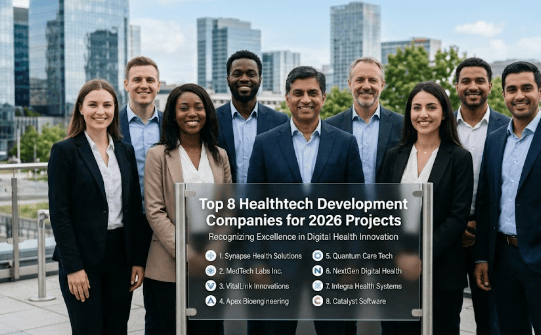
8 Best Healthtech Development Companies to Consider in 2026
Two development companies can quote the same build at very different prices: $80,000 from one, $300,000 from another. Usually, neither is wrong. They have scoped different work, and the proposal may not make that clear.
The eight healthtech development companies below are evaluated on three criteria: a confirmed founding year, a named healthcare client or measurable case, and a visible Clutch rating. Where published, rates and minimums are included. The spread is wide: $25 to $149 an hour, $10,000 to $50,000 minimums, and project costs from $4,000 to over $4 million.
Healthcare depth and delivery location vary as well. Some firms work exclusively in healthcare, while others are generalists that take on health projects. Some buyers may also be limited by payer or Medicaid rules on where engineering work can happen. Two questions matter most: how long the build takes, and what pushes the price. Timelines come first. Pricing follows the table.
How long does a healthcare build take
Timelines from healthtech development companies depend on the gates a product must pass through. Four stages account for most of the calendar. Two sit outside the vendor’s control, which is why a development estimate and a launch date are not the same thing.
Discovery and scoping: two to six weeks
Most firms sell discovery separately. A useful discovery phase should produce system architecture, a data model, a list of connected systems and authentication methods, a migration assessment, and a priced scope. If it only produces a slide deck, the build estimate is still a guess. Ask what happens if discovery changes the answer. Some firms credit the fee against the build. Some requote from scratch. Some hold the original number.
First usable release: three to nine months
A focused product with settled requirements sits at the low end. The timeline grows with external integrations, legacy data volume and quality, and the amount of compliance work completed before launch.
This is the stage buyers usually compare vendors on, but for EHR-integrated products, it may be only about half the calendar.
EHR integration and vendor review: weeks to months outside your control
Deploying within Epic or Oracle Health means passing vendor and health-system reviews on their schedules.
Epic is federated, so each health system runs its own instance with its own governance. Credentials, security review, and activation happen site by site. Epic has also moved third-party integrations into tiered Showroom listings, with Connection Hub covering most data integrations. The older App Orchard program is retired. If a health system still refers to App Orchard, its internal documentation may be stale, which can cost weeks.
HL7 v2 work adds another queue. An interface analyst at the health system typically configures, tests, and approves the feed. That queue is not under your development vendor's control.
Compliance documentation: parallel work until certification
Risk analysis, access logging, audit documentation, and security controls can be built alongside features. Certification, attestation, or regulatory submission runs on its own clock.
Two scope items reliably move the date. Device classification is the larger one, because software that forms part of a medical device can bring IEC 62304, ISO 13485, and a submission cycle into scope. Data migration is the quieter one, because the volume and quality of legacy records often become clear only mid-project.
Ask each company for a dated plan that shows which gates are on the critical path and who owns each one.
8 best healthtech development companies to consider in 2026
The gates above are the same for every vendor. What differs is whether a firm has already cleared them with a client you can verify.
Every company below has three things: a confirmed founding year, a named healthcare client or published case with a measurable result, and a live Clutch profile with a visible rating.
Quality was not one of the checks, so the order is not a ranking.
| Company            | Founded | Named healthcare client or case                                 | Clutch score        |
| ------------------ | ------: | --------------------------------------------------------------- | ------------------- |
| Baytech Consulting |    2007 | MedData point-of-care app; American Allied Health platform      | 5.0 from 10 reviews |
| Arkenea            |    2011 | ORLINK surgical workflow app; NPHub clinical placement platform | 4.9 from 14 reviews |
| Tateeda            |    2013 | Aya Healthcare; La Maestra Community Health Centers; VentriLink | 4.9 from 10 reviews |
| Empeek             |    2015 | GetHealr, integrating Upvio with Elation EHR                    | 5.0 from 20 reviews |
| Overcode           |    2018 | Intelon Optics; Synapse Medical; Embryonics AI IVF platform     | 5.0 from 20 reviews |
| Atmosphere Apps    |    2001 | ZimVie Dental; medical device registration portal               | 4.9 from 18 reviews |
| Mindbowser Global  |    2013 | ProofPilot clinical trials platform; Doximity                   | 4.9 from 6 reviews  |
| Orangesoft         |    2011 | FDA- and HIPAA-compliant post-stroke monitoring platform        | 4.9 from 42 reviews |
1. Baytech Consulting
Founded 2007 · Irvine, California · in-house US staff · 10–49 people · $100–$149/hr · $25,000 minimum
Baytech Consulting is a healthtech development company that staffs engagements with in-house US employees and no offshore contractors, and it fixes scope, budget, and date before work starts. The firm has been based in Irvine since 2007, and medical work accounts for 20% of its client focus.
Its certification and learning platform for American Allied Health, a national credentialing organization for allied health professionals, was launched after 7 months, with the MVP delivered under a $600,000 budget. The client reports that average monthly revenue has increased by more than 20% since launch and that the team has retained the client for DevOps-managed services thereafter.
A second engagement turned Medicare and Medicaid eligibility screening into an iPad application used at the point of care, rolled out in Texas.
Published project costs range from $15,000 to over $4 million, with a $25,000 minimum, so the same firm handles a scoped pilot and a multi-year program.
2. Arkenea
Healthcare only since 2011 · US analysis and project management, India engineering · 10–49 people · $50–$99/hr · $50,000 minimum
Arkenea has worked exclusively in healthcare since 2011. It states a delivery team of more than 100 engineers in India, with client-facing management in the US. Its named client work is specific. ORLINK, a surgical workflow platform, covers a web and iOS build with an EHR-interoperable API at $150,000 to $180,000. NPHub credits a clinical placement platform at $125,000, and Feelya credits a redesign of an online therapy video service. It also reports cutting patient check-in time by 30% on a multi-specialty clinic EHR.
Its own case studies describe clients by type and cite NDA coverage, so ask for references directly. Published project costs run from $10,000 to $180,000.
3. Tateeda
Founded 2013 · San Diego · 50–249 people · $50–$99/hr · $25,000 minimum
Tateeda's healthcare work runs from a community clinic app to a cardiac monitoring device. La Maestra Community Health Centers, a San Diego nonprofit, operates five primary care clinics, ten dental suites, and four school-based centers. It received an iOS and Android patient app with a web admin panel. Patients locate nearby clinics, view appointments and test results, and message staff securely. The MVP shipped in one month, and the firm reports a 40% increase in patient engagement.
For VentriLink in California, it built the clinician-facing app for a wearable heart-monitoring device that streams signals over cellular networks, then returned for a desktop application. Its Visiontree engagement has been running since May 2018 and covers electronic data capture forms for patient-reported outcomes. Aya Healthcare's CTO describes the team as an embedded engineering and QA extension, and the firm has appeared on the Inc. 5000 list in 2022, 2023, 2024, and 2025.
4. Empeek
Founded 2015 · remote-first across 11 countries · $25–$49/hr · $10,000 minimum
Empeek builds cloud platforms, IoT and wearable integrations, and EHR connectivity for healthcare clients. Its published case names GetHealr, a company serving medical practices, and covers integrating the Upvio platform with Elation EHR. A HIPAA-compliant mental health system was built to replace paper and spreadsheets for assertive community treatment teams.
Other published cases cover a remote patient monitoring portal and a portal for lab and drug testing data. Published project costs run from $4,000 to $300,000. The low end of that range suits pilots better than platform builds, so confirm the cost of a comparable build.
5. Overcode
Founded 2018 · Kyiv, Ukraine · 50–249 people · $50–$99/hr · $10,000 minimum
Intelon Optics, a medical device company, credits Overcode with a web app that manages oocytes, embryos, and patients, including dashboards, billing, and notifications. Synapse Medical, a healthcare payment integrity firm, credits a nursing app with OCR scanning and a shared calendar. Embryonics credits the HIPAA-compliant frontend of an AI IVF product and a later egg-freezing calculator.
Overcode's published website packages have stated delivery windows of five, seven, and ten weeks at $7,500, $10,000, and $13,500, respectively.
6. Atmosphere Apps
Founded 2001 · Gainesville, Florida and Rzeszów, Poland · 10–49 people · $100–$149/hr · $25,000 minimum
Atmosphere Apps builds the commercial and operational software around medical devices. For ZimVie Dental, a Nasdaq-listed dental implant manufacturer, the company implemented Vital Sign-In to replace handwritten sheets used to track physician attendance at training events. That record matters for sunshine law reporting, and the client has extended the tool to all rep-led events. A companion app gives Highridge Medical's spine sales representatives access to product resources in the field.
Its longest healthcare relationships are with the American Geriatrics Society since 2003 and with the medical publisher F.A. Davis for close to a decade. The firm states it has more than 25 years of operation and has delivered 400 apps. Work here covers commercial and operational systems, so it fits manufacturers digitizing sales, training, and event operations.
7. Mindbowser Global
Founded 2013 · Pune, India · 50–249 people · $25–$49/hr · minimum project size undisclosed
Mindbowser focuses entirely on custom healthcare software, including telehealth, remote patient monitoring, HL7 and FHIR integration, and healthcare AI. ProofPilot, a venture-backed remote clinical trials company, described its engagement in an analyst-interviewed review. Published cases on Doximity, a clinical research platform, the firm reports managing more than 5 million study tasks across 21 countries.
The firm uses prebuilt healthcare accelerators and integration components, which it credits with shortening the time to a working build. That suits a defined scope on a fixed date and makes the license terms worth reading.
8. Orangesoft
Founded 2011 · Warsaw, Poland · 50–249 people · $50–$99/hr · $25,000 minimum
Orangesoft holds ISO 13485, ISO 27001, and ISO 9001, which includes the medical device quality standard on its list of certifications. Its published healthcare work includes an FDA- and HIPAA-compliant post-stroke platform that pairs a doctor-facing web application with a patient mobile app. The app streams vital signs from connected monitoring devices and supports secure messaging, including video and audio calls. The firm states the program runs inside a US hospital network. Other published cases cover Android and iOS apps for a virtual hospital platform with AI medical imaging and e-prescription, plus a heart-rate algorithm that measures pulse from camera video.
Mobile development accounts for 40% of services, and IoT for 20%. Discovery packages start at $4,850, and the firm publishes a healthcare budget range of $70,000 to $350,000.
What changes the quote
Four scope items explain most of the gap between the two quotes for the same product. The hourly rate is rarely the main reason.
How many systems do you connect to, and in which direction
Each connection is its own build-and-test effort, with credentials, a test environment, error handling, and reconciliation logic.
The pattern matters more than the count. An HL7 v2 ADT feed for admissions and discharges is not the same work as ORM orders or ORU results. A billing platform often means X12 EDI, with 837 claims going out and 835 remittances coming back. That is a different skill set again.
Read-only FHIR access is usually the least expensive integration option. Bidirectional write-back to a chart is among the most expensive. One EHR read is one project. Four systems plus a billing platform is another.
Ask: list every interface by message type and direction, and price each one separately.
Which compliance artifacts are included
A HIPAA security risk analysis, penetration testing, and SOC 2 or HITRUST support are often quoted separately from development.
The part many buyers miss is that your development vendor cannot produce the final artifact for SOC 2 or HITRUST. A SOC 2 attestation must be issued by a licensed CPA firm. A HITRUST assessment must be validated by a HITRUST Authorized External Assessor and reviewed by HITRUST for certification.
The vendor sells readiness and remediation. A second firm sells the report. That means two invoices, and the second one is often the surprise.
SOC 2 Type II also has an observation period. It runs at least 3 months and often 3 to 12. Tooling does not shorten that clock.
Ask: which artifacts are included, which require a separate firm, and what the vendor assumes about your existing controls.
Migration volume and data condition
Record count matters less than buyers expect. The real cost drivers are the number of source systems that hold the records, the level of data structure, and whether historical records must remain searchable in the new system or can be archived for retrieval.
Paper and spreadsheets are the expensive cases. Turning them into usable data takes manual abstraction, not just engineering, and is often priced per record. Validation and reconciliation are another line item that is often left out of fixed bids.
Empeek’s mental health case and Baytech’s eligibility screening application both replaced paper and spreadsheet processes.
Ask: who owns data cleansing, and what happens if record quality is worse than the discovery sample?
Device classification
If the software is part of a medical device, IEC 62304 and ISO 13485 apply, along with ISO 14971 risk management.
The documentation load depends more on the software safety class than the FDA device class. Class A means no injury is possible. Class B means a non-serious injury is possible. Class C means death or serious injury is possible. Class C carries the heaviest documentation load by far.
Premarket submissions now also require cybersecurity evidence, including a software bill of materials and a threat model. A wellness product and a Class C device are not comparable products, and no vendor can close that gap with a discount.
Ask: which safety class is the vendor quoting against, and does the quality management system already exist or need to be built for your project?
Conclusion
No single firm here fits every project. A dental implant manufacturer digitizing event compliance needs something different from a fertility clinic building embryo management. Both differ from a specialty practice that wants an EMR shaped around its own charting. The 8 healthtech development companies above are grouped by what each has delivered. So, the next step is to narrow it down to the two or three whose documented work most closely resembles yours.
Two things are worth doing before you sign. Ask for the names of the people who would be assigned, and check whether the individuals credited in the case you liked are still there. Then get the post-launch arrangement priced alongside the build, since support terms determine the total long after the launch date becomes irrelevant.
