Top AI Calling Tools Businesses Are Using to Scale Faster in 2026
Outreach calls, inbounds, and follow ups. Businesses are made or broken by how well they communicate with their customers.
But what happens when your customer base grows to the point where your team can’t keep up with the outreach and inbound call demands?
Should you settle for whatever your team can handle?
Now you don’t have to. Leading businesses have turned to conversational AI agents to support their expanding sales and support calling needs.
But there are a lot of options on the market and each with their own unique features.
In this blog, we point you in the right direction. We share a comprehensive list of the best AI calling platforms helping businesses scale in 2026 and beyond.
We’ll also highlight which tool is best for unique operational scenarios.
How Do AI Calling Tools Help Businesses Scale?
Working harder is only a part of the business growth equation. Here’s why more teams are consulting AI experts to deploy automation that humans can’t keep up with.
Reduced Bottlenecks That Hinder Growth
Scaling a business becomes extra challenging when growth depends entirely on human availability. After all, that availability is finite, not to mention human productivity levels rise and fall.
AI calling tools solve this problem. They place calls, answer them, and follow up on hundreds of calls simultaneously without slowing down, missing steps, or taking breaks.
This means that your outreach, qualification, and scheduling can keep running even after your team clocks out for the day or goes home for the weekend.
Speed Becomes Your Competitive Weapon
As a rule of thumb, the business that responds first has a much higher chance of landing the customer. Unfortunately, humans can only handle one call per time, which means long queues or even worse, unanswered calls.
AI calling agents change the narrative.
They engage leads and customers instantly while interest is still high, improving conversion and retention rates. While competitors are putting customers on hold, your AI agents are holding conversations and moving opportunities forward.
Follow-Ups Become Impossible to Miss
In many cases, revenue leakage happens after the first touch. Why? No one follows up and the lead or customer gets lost in the noise.
AI calling tools solve this with persistent, intelligent, and personalized follow-ups across every account in your CRM. With AI agents, every contact gets re-engaged automatically until a clear outcome is reached—qualified, booked, or disqualified.
You Get Shorter Sales Cycles
Long cycles kill momentum, whether it’s in sales or hiring. But with manual-only workflows, it is almost impossible to eliminate the delays that increase sales cycles.
So how does AI calling change this?
Conversational AI accelerates early-stage conversations by automatically qualifying intent, answering common questions on the spot, and routing hot opportunities to human teams instantly. All at scale.
The result? Back-and-forths that slow teams down are reduced, and decisions get accelerated.
The Best 5 AI Calling Tools to Know in 2026
Here are the top five voice AI calling platforms delivering results for businesses trying to scale today:
1. Pete & Gabi
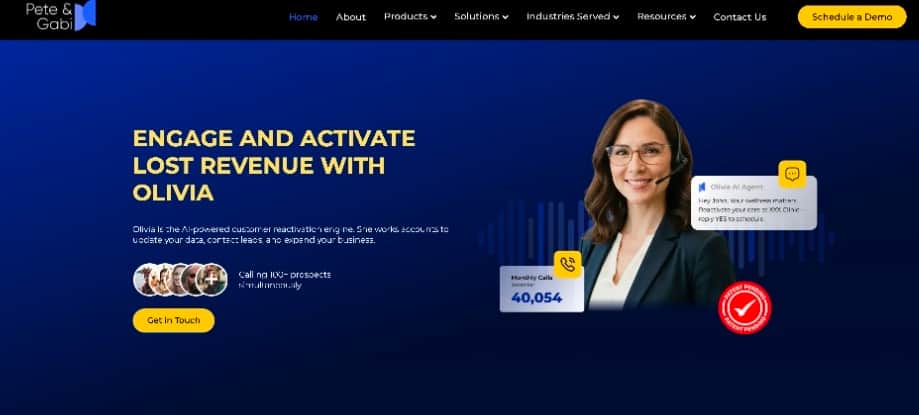
Pete & Gabi sits at the forefront of AI-powered voice calling for business growth.
Built as a plug-and-play conversational AI system for enterprise businesses, this platform does more than just dial numbers or field incoming calls. It fills pipelines and scales workflows without expanding overhead or overworking your team.
Pete & Gabi engages customers in natural, human-like conversations, follows up on autopilot, and qualifies meaningful opportunities before routing them to your team.
In addition to that, it integrates seamlessly with popular CRMs, ensuring that every interaction is logged, tracked, and measured.
If your business needs 24/7 phone coverage across time zones, automatic engagement with CRM contacts, and real-time sync with existing workflows, Pete & Gabi is an excellent AI calling platform to consider.
Key Features
Live conversational AI for outbound and inbound calls
Persistent follow-ups & reactivation logic
Deep CRM & ATS integrations
Multilingual capabilities
Personalized engagement at scale
24/7 global availability
Lightning quick deployment
Best For
Sales, customer success, and revenue teams that need always-on calling and measurable ROI without adding headcount.
2. Bland AI
Another top AI calling provider to consider is Bland AI.
This platform offers businesses a developer-friendly platform for building custom AI phone agents for inbound and outbound calling workflows.
Since Bland AI is an API-first architecture, it gives technical teams more control over conversation logic, call routing, and integration points. This makes it perfect for businesses that want uniquely tailored voice automation.
It does also mean you're expected to provide this technical expertise to deploy effectively.
Non-technical teams may struggle with setting up Bland AI, but for highly specific workflows, it offers great flexibility.
Key Features
API-first platform for custom AI phone agent development
Webhook integrations for connecting to internal systems
Voice customization and tone control
Great developer documentation
Pay-per-minute pricing model
Best For
Technical teams with development resources who need highly customized AI calling solutions.
3. Aloware
In the number three spot is Aloware.
This platform boasts a robust AI calling and contact center platform that’s designed to support multi-channel sales and support automation.
Aloware offers businesses voice agents that manage both inbound and outbound calls, qualify leads, book appointments, and escalate conversations to humans when needed.
Whether your team wants to automatically engage leads after form fills, follow up on older prospect, or provide customer support through voice interactions, Aloware’s conversational AI offers a versatile solution.
This platform also supports deep native CRM integration that enables businesses to trigger various calling campaigns without manual work.
Key Features
AI voice agents for 24/7 inbound/outbound calling
Bidirectional CRM syncing
Automated follow-ups & call logging
Appointment booking and call routing
Best For
Sales and support teams that need CRM-centric calling automation with minimal setup.
4. Synthflow AI
Synthflow AI is another top platform to consider for AI-powered calling in 2026.
Designed as a no-code AI voice automation platform, Synthflow allows businesses to build custom voice agents without engineering overload.
Using a simple, visual interface, teams can design outbound communication flows, callback campaigns, appointment reminders, and basic qualification conversations.
Synthflow AI also supports scalable call volumes in multiple languages, which makes it incredibly useful for high-frequency outreach across global markets.
But where this platform really shines is its simplicity and flexibility.
Teams can deploy voice agents quickly and easily without scripting every scenario manually.
If there’s a drawback here, it’s in Synthflow’s conversation capability, which can trail more advanced adaptive voice AI models.
Key Features
Drag-and-drop voice flow builder
Multilingual capabilities
Automated outbound campaign support
White-label and customizable flows
CRM integration support
Best For
Businesses and agencies that need rapid voice automation deployment.
5. Retell AI
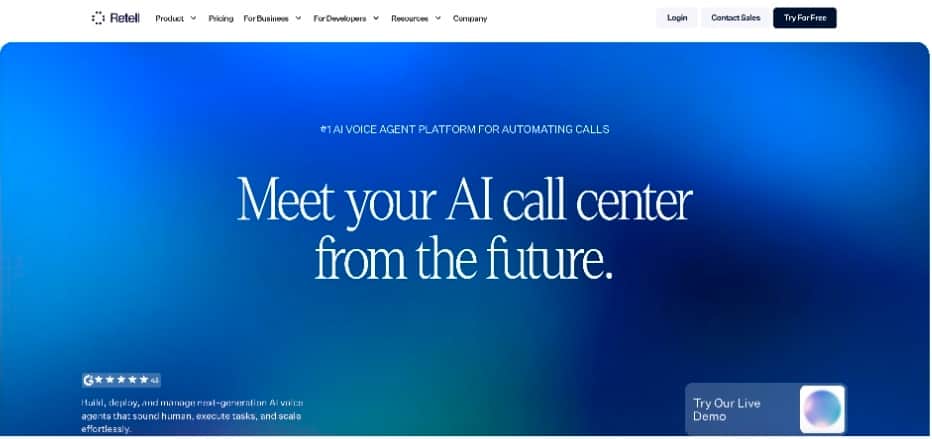
In our final spot, we have Retell AI.
This platform positions itself as a premium enterprise voice AI agent platform that focuses on providing natural, context-aware conversations to drive business outcomes.
Retell AI offers AI-powered voice technology that emphasizes high-quality speech and dialogue continuity, allowing it to carry out more nuanced interactions across complex topics.
In other words, if your calling workflows require deeper engagement rather than scripted flows, Retell AI ticks that box. As is common with these kinds of platforms, setup and deployment do require more comprehensive technical support.
Overall, Retell’s AI call agents provide a strong value proposition for enterprise scenarios where customer experience and voice quality matter.
Key Features
Enterprise-grade voice quality
Context-maintaining conversation engine
Secure, customizable implementation
Support for complex dialogue flows
Best For
Mid-size to enterprise teams that prioritize high-quality voice engagement over simple automation.
Final Thoughts
Knowing that there’s a gap in your business that conversational AI calling agents can help you fill is the first step.
The next one is choosing the right AI calling tool for your workflows.
The platforms we discussed can each solve a different scaling problem: from outreach capacity and lead qualification to revenue recovery and customer engagement. The right choice depends on where your own bottlenecks live today.
Ultimately, scaling isn’t only about adding headcount or working longer hours. It’s about working smartly, and AI calling tools make that possible.
FAQs
What is an AI calling tool, exactly?
An AI calling tool uses voice agents to make, receive, and manage phone calls automatically. These agents handle outreach, qualification, follow-ups, and scheduling using natural, adaptive conversations that don’t require human reps on every call.
Can AI calling tools actually sound human?
It depends on the provider. Modern AI calling platforms use advanced speech models, intent detection, and contextual memory to hold natural conversations which can absolutely sound human. These top voice AI tools don't rely on rigid scripts but are able to adapt in real time based on how a person responds.
What business functions benefit most from AI calling tools?
Sales outreach, customer reactivation, recruitment, appointment setting, and customer support see the fastest ROI. But any workflow involving high call volume, repetitive conversations, or time-sensitive follow-ups is a strong fit.
How long does it take to deploy an AI voice platform?
Leading platforms can be deployed in days with many teams seeing ROI within the first few weeks. However, some other AI calling platforms may take as long as a few weeks to several months.


Useful roundup. One distinction I would surface for anyone scaling on these: tools built for a single business vs tools built for an agency running many clients.
If you are one business automating your own calls, almost any of these works and you optimize for price and voice quality. If you are an agency, the decision criteria flip entirely: client isolation, white-label portal, and per-client billing become the whole game, and most of the "top tools" lists ignore those because they are reviewing from a single-business lens.
The trap to avoid is picking a tool that is great at one client and miserable at ten. Retrofitting multi-tenant billing later is painful. If there is any chance you scale to multiple clients, weight the boring infrastructure features heavier than the voice demo. The demo is always good. The billing reconciliation at client 12 is what you actually live with.
we use buildwithhermes I know it's new but all the others like Vapi, Retell, Sybthflow are all going for enterpise focus. Hermes is for agencies like mine.
Good roundup of the voice tier. Worth noting for anyone evaluating: missed-call recovery often doesn't need a voice agent at all. An under-60-second SMS textback recaptures ~30-60% of unanswered home-services calls (HVAC/plumbing/roofing data) at a fraction of the per-lead cost of voice — and a lot of home-service customers actually prefer to text back than answer an unknown caller. The n8n recipe is straightforward: webhook → AI urgency classifier (JSON-schema constrained) → SMS in 60s → CRM upsert → Slack alert → daily recovered-revenue digest. Voice agents shine on warm-lead qualification and outbound; SMS wins inbound rescue on cost and conversion. Both/and, not either/or.