Top Healthcare Technology Trends Creating Opportunities for Startups in 2026
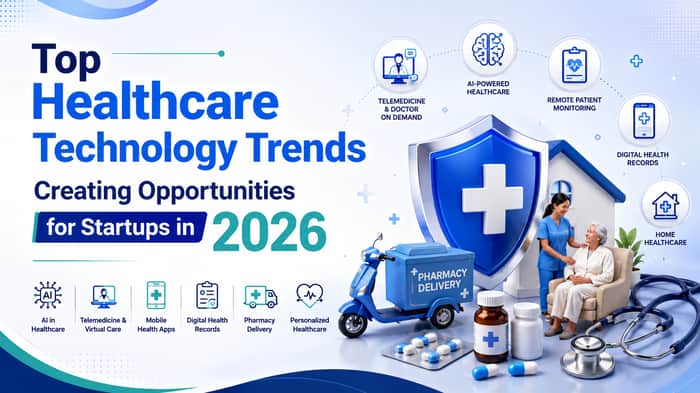
Healthcare is moving rapidly toward a more connected, convenient, and technology-driven model. Patients increasingly expect healthcare services to be as accessible as other digital services, while providers are looking for better ways to manage appointments, consultations, records, payments, and communication.
For startups, this shift creates opportunities to build products that solve specific healthcare problems rather than simply adding technology for the sake of it. From AI-powered healthcare apps and telemedicine platforms to doctor on demand apps and digital pharmacy services, several areas are gaining attention in 2026.
Here are some of the key healthcare technology trends creating opportunities for startups.
1. AI-Powered Healthcare Apps
Artificial intelligence is becoming an important part of digital healthcare. Modern healthcare apps can use AI to support users with symptom information, appointment recommendations, personalized health insights, reminders, and other services.
For startups, the opportunity is not necessarily to replace healthcare professionals with AI. Instead, AI can be used to improve the experience around healthcare services.
For example, an AI-powered healthcare app could help users identify the appropriate type of service based on their needs, recommend available healthcare professionals, provide medication reminders, or assist with basic health-related information.
Startups that combine AI with practical healthcare workflows can create useful products while maintaining a strong focus on user experience and responsible technology.
2. Doctor On Demand Apps
The demand for convenient access to doctors has helped telemedicine become an important part of digital healthcare.
A doctor on demand app can connect patients with healthcare professionals through video consultations, voice calls, or chat. Depending on the platform, users may also be able to schedule appointments, receive prescriptions, make payments, and access consultation history.
This model can be particularly useful for non-emergency consultations where patients may prefer speaking with a doctor remotely instead of visiting a clinic.
For startups, doctor on demand platforms can provide opportunities to serve specific medical categories, geographic markets, or patient groups rather than competing directly with large general-purpose healthcare platforms.
3. All-in-One Healthcare Apps
Healthcare services are often fragmented across different providers and applications. Users may need one platform for doctor appointments, another for medicine delivery, and another for laboratory services.
This is creating interest in all-in-one healthcare apps that bring multiple services together.
A healthcare app can potentially combine:
- Doctor consultations
- Appointment booking
- Medicine delivery
- Laboratory test booking
- Ambulance services
- Home healthcare
- Pharmacy services
- Health reminders
- Digital health records
- Veterinary services
For startups, the challenge is creating a simple experience despite the number of services available. A well-designed platform can give users a single place to discover and access different healthcare services.
4. Digital Medical Care Apps
A medical care app can help patients manage different aspects of their healthcare journey from their smartphones.
Instead of focusing only on appointments, these platforms can support ongoing communication and care management. Features may include medication reminders, health records, follow-up notifications, care plans, and communication with healthcare professionals.
This creates opportunities for startups to develop specialized applications around chronic care, elderly care, women's health, mental wellness, rehabilitation, and other healthcare categories.
The strongest products will focus on solving a specific user problem rather than trying to include every possible feature from the beginning.
5. Remote Patient Monitoring
Remote patient monitoring is another area where technology can improve healthcare delivery.
Connected devices and wearable technology can collect information such as heart rate, blood pressure, blood glucose, activity levels, and other health measurements. Depending on the use case, this information can be shared with healthcare professionals for monitoring and follow-up.
For startups, this opens opportunities to build software that connects patients, wearable devices, healthcare providers, and data platforms.
The value comes from making health information easier to monitor and helping professionals identify changes that may require attention.
6. Telemedicine and Virtual Healthcare
Telemedicine continues to expand the way patients interact with healthcare providers.
A healthcare app can allow users to find doctors, check availability, schedule appointments, and conduct consultations remotely. Virtual healthcare can be especially useful for follow-ups and situations where an in-person visit is not necessary.
Startups can also develop specialized telemedicine platforms for areas such as dermatology, nutrition, mental wellness, pediatrics, or general consultations.
Rather than building a generic platform, entrepreneurs can identify underserved healthcare categories and create focused solutions around them.
7. Personalized Healthcare Experiences
Consumers increasingly expect digital products to provide personalized experiences, and healthcare is no exception.
Healthcare platforms can use user preferences, appointment history, health information, and other permitted data to provide more relevant experiences.
For example, an app might provide personalized reminders, relevant healthcare services, follow-up notifications, or content based on a user's needs.
However, personalization in healthcare requires careful handling of sensitive information. Startups need to prioritize privacy, security, transparency, and applicable regulations when designing these experiences.
8. Digital Pharmacies and Medicine Delivery
Online pharmacy services are another growing part of the digital healthcare ecosystem.
Healthcare apps can allow users to search for medicines, upload prescriptions where applicable, place orders, track deliveries, and manage recurring medication needs.
For startups, opportunities exist in connecting pharmacies with customers, improving delivery logistics, or creating specialized solutions for recurring medication management.
Combining pharmacy delivery with doctor consultations and other healthcare features can also create a more connected user experience.
9. Healthcare Marketplaces
Healthcare marketplaces can connect multiple sides of the healthcare ecosystem through one platform.
A marketplace model could connect patients with doctors, clinics, laboratories, pharmacies, home-care professionals, or other healthcare providers.
This approach gives startups an opportunity to build a network rather than operating every healthcare service themselves.
The key challenge is establishing trust. Provider verification, transparent information, secure communication, reliable service, and strong customer support can become important differentiators.
10. Healthcare Apps With Home Services
Healthcare is also moving beyond hospitals and clinics.
Home healthcare platforms can connect users with nurses, caregivers, physiotherapists, diagnostic professionals, and other service providers who can deliver services at home.
This can be particularly useful for elderly users, people recovering from procedures, patients requiring regular care, and users who have difficulty traveling to healthcare facilities.
A healthcare app that combines professional discovery, scheduling, payments, tracking, and communication can make these services easier to organize.
11. Healthcare Data and Digital Health Records
Digital health records can help users and healthcare professionals access relevant information more conveniently.
Healthcare applications can provide secure access to medical histories, prescriptions, test reports, appointments, and other permitted information.
For startups, the opportunity lies in making health information easier to organize and share while maintaining strong security and privacy practices.
Interoperability will also become increasingly important as patients use multiple healthcare providers and digital services.
12. Healthcare Automation
Automation can help healthcare businesses reduce repetitive administrative work.
Appointment confirmations, reminders, notifications, billing workflows, customer communication, and basic support processes can be automated through software.
For startups, healthcare automation can become a valuable B2B opportunity. Instead of building a consumer-facing healthcare app, entrepreneurs can create software that helps clinics, hospitals, pharmacies, and healthcare professionals operate more efficiently.
What These Trends Mean for Healthcare Startups
The healthcare technology market offers opportunities across both consumer and business applications. However, startups should avoid building an app simply because a technology trend is popular.
The strongest healthcare products generally begin with a clear problem.
For example, a startup could focus on:
- Making doctor consultations more accessible
- Simplifying medicine delivery
- Helping patients manage recurring healthcare needs
- Connecting users with home-care professionals
- Improving appointment management for clinics
- Using AI to improve healthcare discovery
- Supporting remote patient monitoring
- Connecting multiple healthcare services through one platform
A focused product can then expand as the business gains users and understands their needs.
Final Thoughts
Healthcare technology in 2026 is moving toward greater convenience, personalization, connectivity, and automation. AI-powered healthcare apps, doctor on demand apps, medical care apps, telemedicine platforms, digital pharmacies, remote monitoring solutions, and all-in-one healthcare apps are creating new possibilities for entrepreneurs.
For startups, the biggest opportunity may not be building the most feature-rich healthcare platform. It may be identifying a specific healthcare problem and solving it better, more conveniently, and more responsibly than existing alternatives.
As healthcare becomes increasingly digital, entrepreneurs who combine useful technology with strong user experiences, security, privacy, and genuine healthcare needs will be better positioned to build products that deliver long-term value.
