Traffic is easy to track. Revenue is easy to track. What customers actually use and pay for isn’t
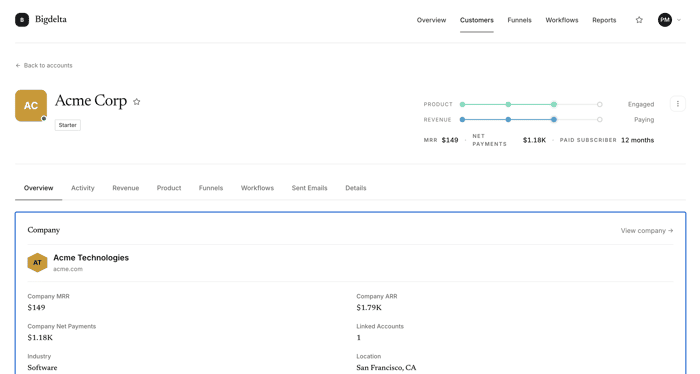
Hello IH 👋
Every time I launched some project, I ended up with the same setup:
- Google Analytics for traffic
- Stripe for payments
- SQL queries trying to connect what each customer is using and on what plan they are.
I could see visitors.
I could see revenue.
But I couldn't easily answer the question that actually mattered:
Which customers are using the product, paying me, and growing revenue?
For an early-stage SaaS with 10-50 customers, every customer matters. Yet I was making decisions without a clear view of who was getting value, who was about to churn, and who was ready to upgrade.
I tried product analytics tools, but they felt backwards for what I needed. Before getting answers, I had to define events, build dashboards, and create funnels. And even then, revenue usually lived somewhere else.
So we built Bigdelta.
You add a snippet to your site, connect Stripe, and Bigdelta automatically combines customer activity with subscription revenue.
Every customer shows up with:
- What they're using
- Their subscription status
- Their MRR contribution
- Limits they are hitting
you can also set up Slack/Discord alerts when important things happen:
- New paying customers
- Customers approaching usage limits
- Subscription cancellations and churn risks
The idea is simple:
Most analytics tools show you events.
Most billing tools show you revenue.
Bigdelta shows you customers.
It's built for early-stage SaaS founders who don't need a data team—they just need to understand what's driving growth.
I'd love feedback from founders here:
- What's the first metric you check every morning?
- How do you currently figure out which customers are driving revenue?
- Is "connect Stripe + add a snippet" simple enough, or is there another integration you'd expect on day one?
It's live at bigdelta.com.
Would love your thoughts, criticism, and ideas. 🙏

This resonates — analytics lie by being complete. The gap I keep seeing is founders tracking everything except "who actually had the problem badly enough to change behavior this week."
How are you deciding which usage signals mean "this person would pay" vs "nice demo"? Still manual or do you have a rule of thumb?
It starts as a data aggregation problem, but quickly becomes a decision-making problem. Having more dashboards doesn't necessarily mean you understand your customers any better.
What I found interesting is that the post starts with a visibility problem and ends with a customer-understanding problem.
Those might be the same thing.
But they can also lead to very different products depending on where the actual gap is.
I can definitely relate to having traffic data in one place, revenue in another, and still feeling like I'm missing the important part.