Trust over Hype: Why handing over the keys to autonomous testing is a high-stakes gamble
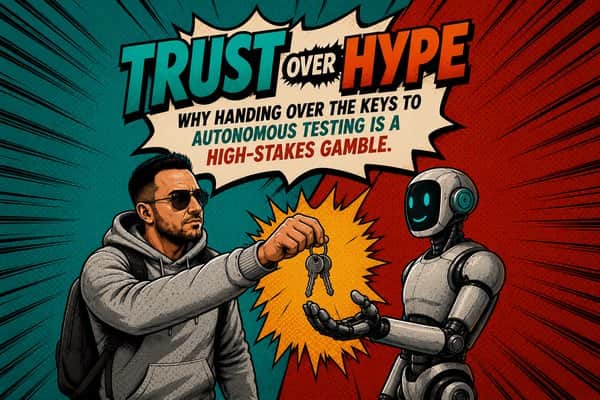
The AI hype train in software testing is moving fast… I’m on it too. I love AI. I use it every single day.
But there’s a massive problem brewing in our industry right now: People are handing over the wheel to AI without checking the rearview mirror.
It’s easy to see why. AI is incredible at the boring, mechanical stuff. Need 50 standard, repetitive test cases generated in five seconds so you don't have to manually type them? Perfect. AI excels at the common stuff.
The danger starts when you give it bigger, more critical chunks of your workflow and assume it's got everything handled. That’s exactly where the whole system drifts away.
The Mirage of the "Low-Hanging Fruit"
From my years of experience in QA and now navigating the AI era I’ve noticed a definitive boundary where AI fails:
- What AI is good at: Grabbing the low-hanging fruit. Standard paths, common edge cases, and boilerplate testing logic.
- Where AI falls off a cliff: Complex exploratory testing, strange edge cases, unexpected system behaviors, and handling live outages.
AI can simulate a user path, but it doesn't possess human consciousness or intuition. It doesn’t get a "bad feeling" about a weird race condition. If an LLM encounters a truly bizarre, non-deterministic system state, it will often hallucinate a passing result just to fulfill its prompt.
If you are building a simple landing page, maybe you can afford a blind spot. But if you are working in high-stakes environments like defense, cybersecurity, or banking applications blindly trusting AI isn't just lazy it's dangerous.
Human consciousness, skepticism, and oversight are actually becoming more important, not less. We need to stop using AI as a replacement for thinking, and start using it as an accelerator for our own expertise.
Why I Built QA Evolve
I want to change the current narrative and open people’s eyes to the reality: AI is an awesome co-pilot, but you are still the captain.
I created qaevolve.com to serve as a practical, hype-free corner of the internet dedicated to real-world QA testing in the AI era. My goal isn't to sell a course or push a flashy tool; it’s to share raw, hard-earned experiences from real projects so other engineers don't have to learn these lessons the hard way.
Moving forward, I am building this out as a living resource hub for the community. In fact, I’m already working on my first practical project and video right now to share with you all very soon. You won't find generic AI prompts here. Instead, I’ll be regularly dropping:
- Deep-Dive Articles: Breaking down the exact friction points between human intuition and machine automation.
- Useful Code Snippets: Practical scripts to help you build objective validation layers and testing oracles.
- Small Project Videos: Short, over-the-shoulder videos showing exactly how I test non-deterministic systems, handle model drift, and catch the edge cases AI misses.
I love this technology, but I’ve learned how to use it without letting it break the product. I want to share it openly so we can collectively elevate the standard of modern quality assurance.
A Small Favor: I Would Like to Ask for 6 More Beta Testers
I’ve been quietly building a mobile application, to bring this philosophy to life and help people step up their QA life.
Let's be completely transparent: It is not a "game-changer" app, and it doesn't want to be. It’s simply a clean, practical tool built for those starting out in QA, people curious about the field, or mid-level testers who want to patch up gaps in their foundational knowledge.
Right now, the app is cooking in the Google Play Console for closed testing. To move forward, I would like to ask for a handful of real human eyes to verify it before the public release.
I already have 6 incredible testers on board, and I would like to ask for just 6 more to hit my target.
If you have a few minutes and want to support a fellow indie builder, it would honestly mean the world to me if you joined the group. You can sign up right here:
👉 Google Play Beta Testing Signup Form
I am incredibly grateful for anyone willing to take a look, and I would love to get your completely honest feedback. Whether it's about the UI, the content flow, or a bug you managed to catch through solid human exploratory testing I want to hear it all.
Thank you so much to anyone who joins the ride.
Where do you think the line between AI generation and human verification should be drawn in your current stack? I’m genuinely curious to hear how you handle this balance - let’s talk in the comments!

The QA parallel I keep coming back to: in MSP land, we learned the hard way that 'AI/automation can monitor this' is true 95% of the time. The 5% is what kills clients. Same logic applies to autonomous testing. One missed regression in a payment flow erases six months of efficiency gains. The honest framing is not 'should I use AI testing' but 'what is the blast radius if it lies to me?' Curious what your trust threshold looks like in practice, do you re-verify high-stakes paths weekly, daily, never?
My opinion is AI an acceleration layer, not a trust layer. Most systems look 95% fine until the missing 5% hits something expensive or irreversible. The danger isn’t loud failure; it’s confident failure. In practice, my trust threshold dictates daily whenever is possible or continuous re-verification for high-stakes paths (like auth, payments, and data migrations) because their blast radius is catastrophic. Take a checkout test: AI might see a 200 OK and pass it, missing a load-time retry bug that double-charges users. Technically green, operationally catastrophic. Appreciate your perspective!🤝
The "detects words, not hesitation" framing is exactly the gap I keep running into in voice AI too. You can transcribe and categorise a call. You can't replicate the rep who pauses half a second when the prospect's tone shifts and adjusts in real time. The mechanical/intuition split is the only honest way to describe where the line actually sits.
The "bad feeling about a weird race condition" framing is exactly right, and it's the thing AI evangelists skip over in every demo.
I build with voice AI and the same problem shows up on the distribution side: AI can replicate a pattern but it can't read the subtext in how a prospect responds. It detects words, not hesitation. A human rep who's been on 200 calls knows the difference between "that sounds interesting" that means yes and the same phrase that means the meeting is already over.
The line you've drawn -- let AI handle the mechanical, keep humans on the intuition-critical path -- is the only framework that actually holds up in production. Everything else is a slide deck waiting for an incident.
Based on my point of view AI replicates observable patterns, but production reality relies on implicit, contextual signals. In sales, it's not the sentence that matters it's the hesitation, timing, and tone. Experienced humans compress years of context into instincts that are hard to formalize. It’s the same in QA. An AI sees a green test; an experienced engineer notices a timeout recovered too cleanly and smells a hidden race condition. AI handles mechanics; humans handle judgment. It’s the only model that survives. Thanks for the great example! 😊
The line I use is: AI can propose coverage, but it should not be the final witness. For risky workflows, I want a human-readable proof trail: what assumption was tested, what evidence passed, what was skipped, and what still needs judgment. That keeps AI useful without quietly turning uncertainty into a green check.
This is the healthiest operational model I’ve seen. The danger is when AI confidence replaces visibility, compressing uncertainty into a simple green checkmark. A human-readable proof trail is vital because it preserves reasoning and ambiguity instead of hiding them. For example, AI might mark a deploy "safe" because API responses matched, completely missing a degraded fallback failure during a partial outage. AI can propose coverage, but cannot be the final witness is a powerful framing. Thanks for the comment! 👋
This is one of the few AI/QA takes that actually feels grounded in real engineering instead of hype. The point about AI handling the happy path while humans handle the weird production reality is spot on
Exactly! Demos live in controlled environments, but production fails in messy, stateful ways. The happy path is commoditized; the real value is spotting when a test "technically passed" but feels unsafe. For example, AI might validate that a retry flow succeeds, missing that those retries mask a deeper concurrency or data problem under load. That gap between works in theory and survives production reality is where human judgment matters most. Thanks for the perspective!
agree on the boundary. 3 specific places this lands:
eval DESIGN is judgment, not test generation. agents generate 100 test cases enthusiastically. cant tell me which 5 matter most. on an e-commerce support agent last quarter, my agent suggested measuring accuracy via semantic similarity to a "golden answer" set. wrong in 2 ways: the golden answers are themselves judgment calls, AND the actual metric was "did the customer ask a follow-up that suggests confusion."
production-reality estimation is the other place. agent says "query should be fast" based on indexed columns. with cold cache + network jitter + concurrent load, its 800ms slow.
hallucinating-passing-test is real. last month: agent generated a test for a race condition. passed every run. real condition reproduced 1 in ~50 runs. agent ran the test 3 times, saw 3 passes, called it done.
the "bad feeling about a race condition" you describe is unteachable from training data. its pattern recognition over years of incidents 🤷
Thanks for the valuable insights and for bringing these great points to the table! 🙌
I love how you highlight the current limitations of AI with such concrete, real-world examples. The e-commerce bot breakdown perfectly demonstrates that understanding true context and actual user intent like customer confusion remains a uniquely human privilege. And your point about race conditions and that "bad gut feeling" is the perfect conclusion that kind of intuition and battle-tested pattern recognition simply cannot be trained through synthetic data. 🤔
The interesting shift is that AI is making basic implementation cheaper, which means the real competitive advantage moves toward judgment, verification, and understanding weird edge-case behavior.
The “AI as co-pilot, human as captain” framing feels especially true for anything non-deterministic. Most failures don’t happen on the happy path — they happen in the strange states nobody explicitly prompted for.
I also think this applies outside QA. Even in analytics products, the dangerous part is not generating signals — it’s trusting the wrong interpretation of those signals.
Exactly. The "happy path" is a commodity now. The real engineering happens in those strange, unprompted states where non-deterministic AI loses its mind
Love your point about analytics, too hallucinated data interpretations can tank a business just as fast as a bad deployment. Trusting the machine blindly is the real gamble here.
Thanks for taking the time to share your thoughts, really appreciate the insight! 🙌
This is a strong angle because you are not selling “AI testing hype.” You are pushing the opposite: human verification, skepticism, and QA judgment in systems where AI can quietly miss the dangerous edge cases.
That positioning is much sharper than a generic QA resource hub.
The one thing I’d pressure-test early is the name. QA Evolve explains the topic, but it also feels like a content/resource brand rather than something that could become a serious QA product, testing layer, or trust system for AI-era software teams.
If the direction expands into practical tools, validation layers, model-drift checks, or high-stakes QA workflows, a harder technical name like Vroth .com would carry that better. It feels more like infrastructure for testing serious systems, not just a QA education hub.
I’d think about this before the app, videos, and resource hub all lock around QA Evolve, because the topic is serious enough that the brand should feel like a product company, not a blog.
Thank you, I really appreciate this feedback 😊
You made a very good point about the positioning and especially the brand perception long term. QA Evolve started more community/content focused, but I agree that if this grows into serious tooling, the branding matters a lot.
Really grateful you took the time to think this through and share it honestly 🙌
Appreciate that, Zoltán.
This is exactly the kind of decision where a small positioning audit may be useful before the brand gets more fixed.
QA Evolve can work if the direction stays community, education, and content. But if you are seriously considering tools around AI-era QA, validation workflows, model-output checks, regression risk, or edge-case testing, then the name/domain/category frame should probably be pressure-tested before more videos, app assets, and public memory build around it.
I’m doing a few focused naming/positioning audits at $99 while refining the format.
It would cover the current name risk, whether QA Evolve can carry a product company, what category the brand currently signals, where the domain/name may limit you later, and what stronger naming direction would fit if this becomes serious QA infrastructure.
Not a long consulting thing, just a sharp written breakdown you can use before deciding whether QA Evolve stays the umbrella or needs a stronger product layer.
If useful, message me privately and I can put together a clear outside read.
Thanks, Zoltán. That makes sense.
If QA Evolve stays mainly community, videos, and education, the current name is clear enough.
Where I think the decision becomes important is if you start building tools around AI-era QA: validation workflows, model-output checks, regression testing, risky edge-case detection, or anything teams may rely on before shipping.
At that point, the brand has to feel less like a resource hub and more like a serious testing layer.
That is why Vroth.com came to mind. It has the harder technical feel for QA infrastructure, security-minded testing, and high-stakes software validation without tying you to “QA content” as the whole identity.
I would not overthink it if this stays educational. But if the product side is real, I’d pressure-test the name before the app, videos, and public assets make QA Evolve harder to move away from. If Vroth feels like a serious candidate for that direction, happy to discuss privately.
Hey, It's great to see this post here, I was planning to learn more about QA for my next project. I will definitely check out the app, your website has great content, so I expect to learn from the best. :)
Thank you, I hope you will find it usefule and let me know if you miss something, or wanna hear any kind of topic that I didn't touched yet :)
I’d separate “autonomous testing” from “repeatable manual scenarios” as early as possible. For Kinetic Override, the useful beta task is very concrete: grant the Android permission, record one tap/swipe loop, replay it twice, then report where timing or trust broke. That gives cleaner feedback than a generic “try the app”.
Exactly. The proof trail is what turns AI from a black box into a tool you can challenge.
For risky paths, I'd want the output to say: here is what passed, here is what was assumed, here is what was not tested, and here is where human judgment is still needed. That last category is usually where the expensive failures hide.