2
4 Comments

Try the Market Verdict demo before using your own idea

I built Market Verdict to help people evaluate business ideas before spending months building the wrong thing.
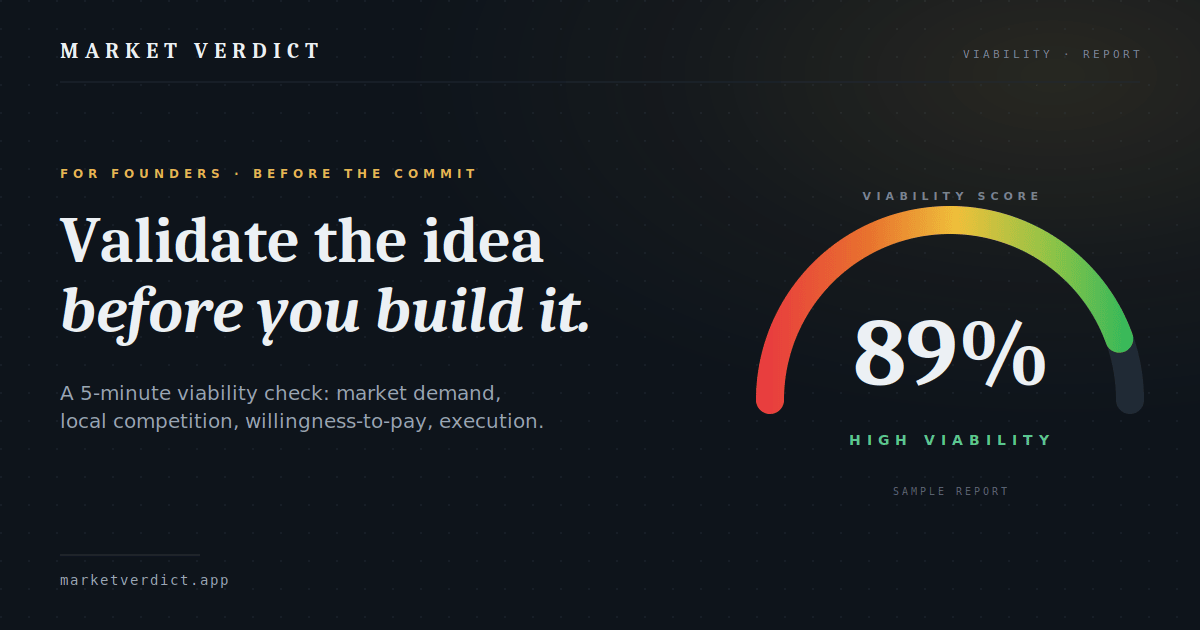
![Market Verdict demo report](https://marketverdict.app/assets/og-image.png)

The
easiest way to understand it is to try the demo first.

The demo gives you a feel for the type of report Market Verdict generates: viability score, market signals, risks, break-even estimate, suggested pivots, and a practical execution plan.

After that, you can try it with your own business idea.

New users get 3 free analyses with their own input after logging in. There is no traditional account creation required — just use the email magic-link login.

The goal is simple: help founders, indie hackers, freelancers, and small business owners answer:

**“Is this business idea worth pursuing?”**

Try the demo first, then run your own idea through it:

posted toAvatar for product Market Verdict
Market Verdict
  1. 1
    Agreed, and that's the failure mode I worry about most. A number that looks precise invites more confidence than the underlying evidence supports. The way I try to handle it: the score isn't the deliverable. The output is a breakdown of which specific assumptions are load-bearing and where the evidence is thin, plus a plan for what to test next. A high score should mean "this is worth spending three weeks testing," not "build it." I also publish the methodology so people can see what's actually being weighed instead of treating it as an oracle. Whether that framing survives contact with users is a different question — people do tend to read the number and skip the reasoning. If you've seen a presentation format that pushes readers toward the caveats rather than past them, I'd take the suggestion.
  2. 1
    That's a fair distinction — pre-launch validation and post-launch complaints are measuring two different things. Market Verdict is deliberately a pre-build tool: it scores an idea against market, competition, and demand signals before anyone writes code. Complaint data is a much stronger signal, but by the time you have it you've already spent the money. Where I think the two connect is calibration. If you can see which post-launch failure modes cluster with which pre-launch signals, that's a feedback loop for the scoring itself rather than a new input to it. Not on my roadmap right now, but I'd be interested to hear what patterns you're seeing in ComplaintIQ — what shows up in complaints that a founder plausibly could have caught earlier?
  3. 1

    Interesting approach. While building ComplaintIQ, I've noticed that many founders validate ideas before building, but customer complaints after launch often reveal a completely different set of problems. Curious if you've considered incorporating real customer feedback signals into the viability score in the future?

  4. 1

    One thing I'd be careful with:

    The interesting question may not be whether an idea scores well.

    It may be what decision deserves confidence because of that score.

    Those sound similar, but they can lead to very different outcomes.

    I'd be especially careful where strong-looking signals create false confidence rather than real validation.