Trying to build a community that does not become another dead Slack
I’m working on a side project with my partner and wanted to share it here before we open it up.
Most of my week is spent 1:1 with founders. Coaching, strategy, decisions, the stuff that usually does not show up in public updates.
One thing I keep noticing is that more people are building with fewer people around them. AI makes that easier, which is amazing, but it also makes it easier to sit alone with every decision.
I don’t think another Slack or Discord group fixes that. Most of those spaces start with good intentions and then become places people visit only when they want to post a launch, ask for something, or disappear again.
We are trying to build something that feels more like an actual room.
It is called Open Room:
https://joinopenroom.com/
Curated, application based, with a short interview call before joining as a vetting process. Two weekly calls, one more around the human side of building and one around business, product, growth, and decisions.
It is for founders, solopreneurs, owner operators, consultants, agency owners, and people running their own thing who want to give and receive in a real way.
We are still early and being careful about the first people in, because they will shape the culture more than anything we write on the website. But so far, we have had some interesting applicants, and we are interviewing.
Would love honest feedback from IH.
What would make a community like this actually worth joining for you? And what would make it an immediate no?
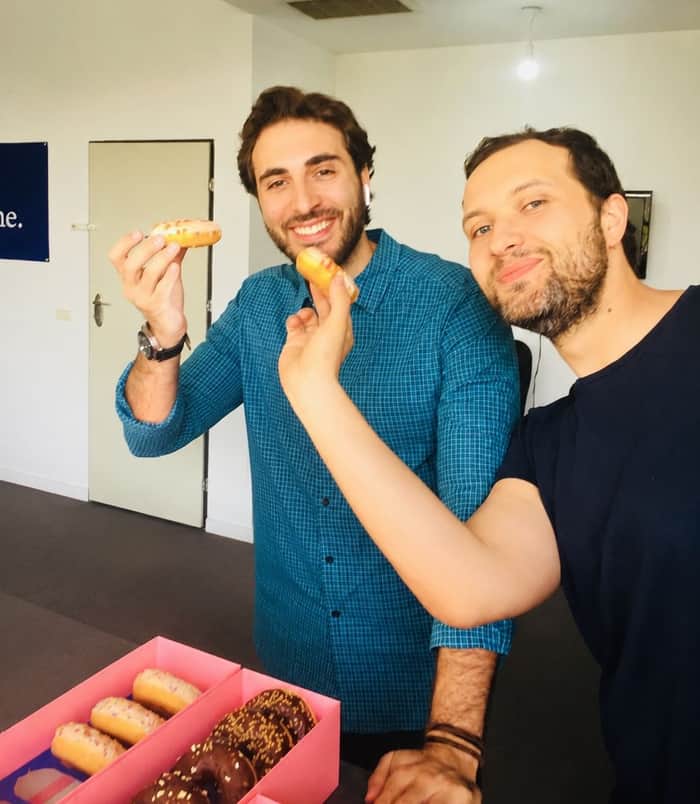
P.S.: The photo is of my partner and me from a long time ago in the office. It felt fitting because this is the kind of simple, human energy we want more of.

t
the real problem is not launch, it is repeated reasons to come back. if the first week does not create that loop, slack dies fast.
This is why we build for more human connection and a curated community, so you can hear from real humans who are looking to connect with you, not just sell to you.
Not bad.
The vetting part is everything. Most communities die because the first 100 members were let in to grow the number quickly, then the interesting people leave because the quality dropped and it became a broadcast channel.
"A room" rather than "a community" is the right framing. Rooms are live. Communities archive. The distinction matters because it sets different expectations about how people should show up.
One thing worth making explicit in your interviews: what does success look like for this person after 3 months in? People who have a specific answer are almost always better community members than people who say "just looking to connect." That question also helps you filter faster than any application form.
What does the interview usually look like — how long, and what question do you ask that tells you most about whether someone fits?
@AmandaBrown thanks this is really useful.
I like the 3 month question. I’ve been asking more around “what are you carrying right now that you do not want to keep carrying alone?” and “what kind of room would actually make you show up?”
The calls are usually 20 to 30 minutes. I’m mostly listening for whether the person is actually open, specific about what they are building or dealing with, and has some instinct to give to others, not only take. It is largely about the energy and the reason to join.
And yes, I agree with you on “room.” That word matters to me. I want people to feel like they are entering something live, not joining another archive.
Answering your two questions, since they're the right ones. What makes it worth joining: the feeling that my absence would be noticed by specific people, not a logo. What makes it an immediate no: a member directory in the hundreds and a calendar I'll never realistically attend. Someone below is right that application plus interview plus weekly calls is the standard playbook, so the mechanics won't be your edge. The edge is obligation and size. I run a community for veterans breaking into tech, and the only thing that has ever kept it from going dead is a recurring ritual plus a group small enough that people actually recognize each other. The "actual room" feeling breaks the second it becomes a crowd, so I'd protect smallness like it's the product. Two weekly calls already caps your scale, lean into that as the feature. The real question isn't how to differentiate from Hampton or Reforge, it's how many people fit in one room before you have to split it, and whether you'll have the discipline to split rather than swell.
@GregoryScottHenson thanks this is very sharp
“Protect smallness like it’s the product” is probably the line I’m taking from this.
I agree with you. The room only works if people start recognizing each other and feel some natural responsibility to show up. Otherwise it slowly becomes another directory and calendar.
One thing we already changed because of the early calls is splitting the first members into 3 smaller groups: starting out, running solo, and scaling up. Same general feeling of building mostly on your own, but very different conversations.
I think that will help us keep the rooms small and relevant, rather than letting one group grow too large.
And yes, the weekly calls are probably not just a feature. They are the core ritual.
The "dead Slack/Discord" pain is real, but your solution uses the exact mechanics that produced those dead Slacks. Application + interview + 2 weekly calls is the standard playbook for curated founder communities — Hampton, Pavilion, Reforge, Founders Network, On Deck all use this shape. Category is crowded.
Vetting solves entry, not engagement. People pass interviews, attend 2 calls, disappear. Same dynamics that kill Slack kill paid-call groups too.
Real wedge isn't "more curated." It's the specific filter producing a specific cohort with shared context. Hampton wins by "$1M+ ARR founders." Pavilion wins by "senior B2B operators." "Founders + solopreneurs + agency owners + consultants" is too broad — those groups have different problems and won't relate to each other's contexts.
Asset buried in your post: you're a coach, not "another community founder." Lead with that. The community is a natural extension of a real coaching practice.
@Hire_Hivemind this is fair and honestly helpful.
I agree that “application + interview + calls” is not a wedge by itself. A lot of people use that structure, and it can still become dead.
The part I’m taking seriously is the specific filter. We already realized that one broad group is too loose, so we’re starting with separate rooms by stage: starting out, running solo, and scaling up. Different weight, different conversations.
And I think you’re right about the coaching part. This is not coming from “let’s start a community.” It’s coming from years of sitting with founders every week and seeing what they keep carrying alone.
I probably need to say that more clearly.
The stage-based rooms (starting out / running solo / scaling up) is the right correction. Stage is a much stronger filter than role because it produces shared context. A solo founder at $0 and one at $500K have almost nothing to talk about, but two people both stuck at "should I hire my first person" will trade real value instantly. Stage creates the relatability role never could.
One thing to pressure-test: stage is dynamic, role is static. People graduate out of "starting out" into "scaling up," which is good for them but means your rooms have constant churn at the edges. Worth deciding early whether someone moves rooms as they grow (keeps each room coherent, breaks the relationships they built) or stays (keeps relationships, dilutes the room's shared context over time). Most stage-based communities don't plan for this and the rooms slowly blur.
On the coaching angle, don't just say it more clearly, make it structural. The reason your community won't die is that there's a coach in the room who keeps it alive, which is exactly the thing volunteer-moderated Slacks lack. You showing up as the coach is the engagement engine. That's not a bio detail, it's the product: "a room with someone whose job is to keep it valuable," not "a room we hope stays valuable."
The immediate-no for me: if it feels like a paid audience for your coaching funnel rather than a room where you happen to be one of the people. That line is thin and worth guarding, because the moment members feel like leads, the room dies faster than any Slack.
What's the pricing model, and does it change by stage? That quietly determines who actually shows up.
This is a really good point.
The room movement is something I need to think through more. My gut is that people can move as they grow, but not too often or too automatically, because the trust inside the room matters too.
And yes, I agree with the coaching risk. I really don’t want this to feel like a paid audience for my coaching. I’m fully booked there, 20+ clients and a waitlist, so this is not a funnel for me.
It’s more of a side project that grew out of seeing the same need again and again.
Where my coaching background probably helps is in holding the room, asking better questions, and keeping conversations useful.
Pricing is the same across groups for now. I want the main filter to be fit, intention, and whether someone will add to the room.
Appreciate you pushing on this. It’s useful.
This is really refreshing to see, Itay. I completely agree that most Slack and Discord communities start with good intentions but quickly lose the human energy that makes them feel alive. The emphasis on curated members and live calls makes Open Room feel intentional rather than transactional.
For me, a community becomes truly worth joining when:
An immediate no would be if it felt like just another networking or marketing channel with low accountability or ghost activity.
Excited to see how this evolves—I love the focus on real human connection in building something.
@LucasAlvarez thanks I appreciate that.
The reciprocity part is the big one for me. I don’t think this works if people join only to get access, leads, feedback, or attention.
The people I’m most excited about are the ones who have something real they are building, but also seem like they would be good in the room for someone else.
That is why we are being slow with the first group. The culture will come much more from the first people than from anything we write on the site.