Turning a neglected, 17-year-old side project into a $26k/mo
business
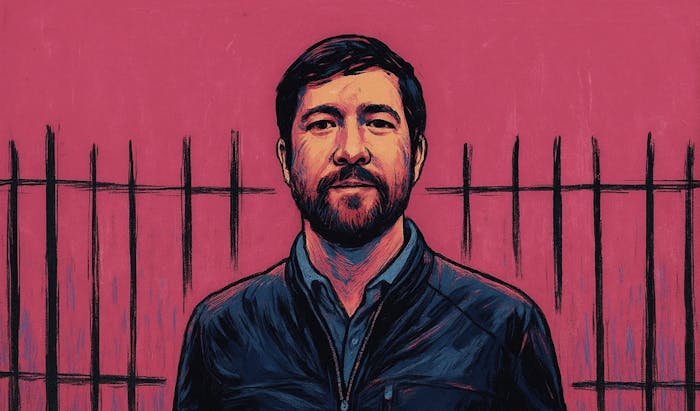
Buster Benson had big ambitions that had nothing to do with turning his back-burner project, 750 Words, into the 920k-user, $26k/mo product that it is today.
It was a side hustle, and an oft-neglected one at that. But after 17 years of slow growth, he quit his job and doubled down with the intention of growing it to $50k/mo within a year.
Here's Buster on the winding path that led here. 👇
The path of a curious monkey
I’ve spent 25+ years weaving through tech, writing, startups, burnout, and art, and am now focused full-time on growing 750 Words — my 17-year-old membership-supported private journaling platform used by thousands every day.
My work life started in 1998 after graduating with a bachelor’s degree in creative writing from the University of Washington. I was living just down the street from a hyped-up startup named Amazon.com and wondered to myself if I should leave my delightful job as a security guard at the Seattle Art Museum to jump into the frothy waters of the internet bubble to be a customer support rep on the night shift. That was certainly a turning point I could neither have predicted nor planned for, and maybe a bit like how college graduates today must feel.
My resume from that point forward resembles the path of a drunken, curious monkey, zig-zagging between big writing ambitions (a self-published novel in 2002, a viral article about cognitive biases in 2016, and a book about productive disagreements in 2019), running a real-world art and events space (McLeod Residence in 2006-2009), building small products and companies (43 Things, Health Month, Locavore, 750 Words), as well as participating in some exciting big companies (Amazon, Twitter, Slack, Patreon, and Medium), and making periodic swift emergency detours for burnout (2006, 2016, 2024), having children (2010, 2016), and global crises (2000, 2008, 2020) along the way.
I can trace a loose arc connecting these zigging and zagging dots with the theme of my interest in crafting words, technologies, and communities that try to make our lives feel more authentic and human.
Building $26k/mo community
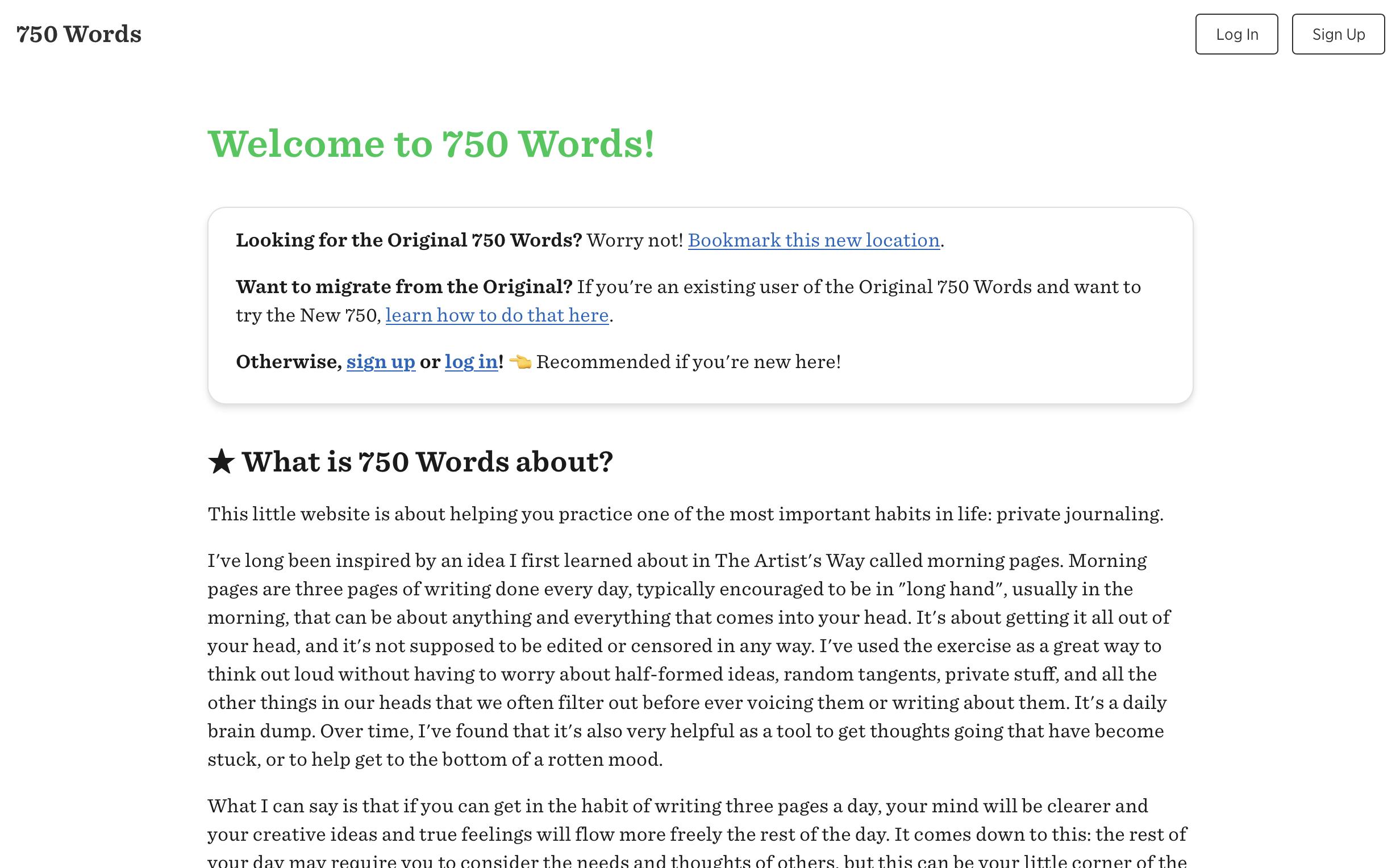
750 Words is an online private journal that I launched in 2009. It creates space for you to brain-dump your thoughts and get some clarity in a world where we have almost no private space to think and reflect anymore. It encourages you to pour three pages of raw thoughts every day, and turns them into analytics, streaks, badges, and now things like AI prompts and reporting tools that reflect your own thoughts to you in often revealing and helpful ways.
It’s a humble lifestyle business, but it has managed to keep growing over the last 17 years because I think it taps into the deep need in our lives for a little time and space that we can call our own.
As of today, about 920,000 have signed up and over 13 billion words have been written. Over 5,000 people have written 100 days in a row or more, which inducts them into our prestigious Hall of Phoenixes, where they are invited to share a bit more about themselves. Even people who enjoy the deeply solitary act of private journaling enjoy a little community.
There are 470 people who have streaks over 1,000 days in a row, 197 with streaks over 2,000 days in a row, and 68 with streaks over 3,000 days in a row.
The site started as a free site, became a donations-supported site in 2010 when the server costs became significant, then shifted to a membership site in 2014, and continues today with 2 tiers of membership — $5/month for standard or $10/month to be fancy and get some additional features and support. The 200,000+ people who joined before becoming a membership site in 2014 were all granted a Lifetime free account, and we have happily honored that.
As of this moment, we have about 5,800 paying members and make about $26K/month in revenue. Revenue had been pretty flat from about 2019 to 2024 at around $20K, so this is the first time I've really tried to grow the site's revenue in its entire history.
My current goal is to grow it to $50K/month in the next year.
Getting started
As I said, I launched 750 Words in 2009... but didn’t “become a business” until 2016. It was a sole proprietorship until then.
It was built during a phase of my life when I was building a lot of things. Registering domains every week. Building little websites and apps for all kinds of whims. Starting companies and raising money. The ideas I was excited about all circled around behavior change and habit building in various ways. Most of these ideas and websites died of neglect — either I lost interest, or the idea couldn’t be realized in the way i imagined, or nobody else liked it.
Truthfully, 750 was no different from the rest in terms of being neglected by me. I had a newborn in 2010 and had closed down my previous startup, Habit Labs, to take a full-time job at Twitter, relocating to the Bay Area, and for many years, barely gave 750 enough attention to keep the servers up. Once, the domain even expired for a full day before realizing what had happened.
It lived in maintenance and support mode from about 2011-2020. However, to my surprise, 750 wasn’t like the rest in terms of being neglected by its users. Unlike all the other things I had built up to that point, this one continued to grow every month for years — even after moving from free to donation-supported to membership-based. And it generated enough income to pay for the servers and to also provide a nice part-time salary to my partner and wife-at-the-time, Kellianne, who answered all the support tickets and apologized for all the bugs I never had time to fix.
That forced me to take the project’s value seriously even when I couldn’t dedicate time to it. 750 turned into a business when we realized that there was enough interest in things to keep working on it — and because living in the Bay Area was expensive and this was beginning to contribute a meaningful amount to our costs of living.
I never would have guessed that a private journaling website would be the stickiest and most loved product I’ve ever built, but I’m grateful that it is! It’s a product that I not only love using myself, but that I also love building. I re-wrote the whole app in 2020 during the pandemic, and finally found a way to work on it full-time as of last October. The timing feels right to give this my full attention, but the timing is built on 16 years of luck, the patience of our users, and duct tape.
Building the product
I built the first version of the site using Ruby on Rails and jQuery on a shared server in about a week. I hired a designer to help me craft some of the badges. I added features here and there for the first couple of months when I could, but eventually, my attention shifted.
The biggest effort during those years was responding as promptly as possible to all the people who had lost passwords or that had broken a streak for either personal or bug-related reasons. Because it's about writing every day, and the day ends at midnight, there was often a big surge of people writing at the end of the day that would cause the site to crash and then streaks to be broken. The site has a strange architecture because most of the database queries are writing to tables instead of reading. In 2009, we were one of the only places doing the auto-save thing, and I wrote it all in jQuery in a way that probably wasn't optimized very well.
In 2020, I re-wrote the whole site and split it into a Rails API backend and a Vue frontend. Up until that time, I was working mostly as a product manager at various places and hadn’t been writing much code at all, and so was delighted to see how much these frameworks had improved over the previous 10 years.
In the last couple of months, I’ve re-written the entire frontend (upgrading Vue 2 to Vue 3), with the help of Claude Code. The leap in improvement enabled with AI is even more striking and fascinating to participate in, and the code of the site has never been in a better spot.
Metrics and models
My business model is to offer a monthly and yearly subscription for $5 that clearly delivers more value than it costs. About a year ago, I added a $10/month tier that includes new AI-prompt features (to offset the added cost of using LLMs). I've recently updated my user funnel and analyzed everything from visitors visiting the site to creating an account to starting a membership trial to paying for the first time, and then retention month to month from there.
Here are some raw numbers to give a picture:
About 30-40k people visit the site every month (most new visitors are from search, but AI is also starting to be a significant referrer).
On a slow month, we'll get 1,500 signups, and on a great month, we'll get 3,500 signups, so let's say 2,500 on average, or 7% of visitors sign up organically. It's around 9% from ads.
I currently give everyone a 30-day free trial before trying to convert people to members, and this is the weakest part of my funnel. Only about 1.5% of people who sign up end up becoming a member in that first 30 days... mostly because there's no reason to do that during a free trial. The hope is that if people use the product and like it, they'll be more likely to become members when the trial is over, but in reality, a lot of people will give up and never come back if they don't see the value of the site immediately. Journaling is something that takes real energy investment to see the value come out, and I've never really tried to figure out how to get people there faster or more efficiently — because all signs say that once you do see that value, you become a member and stick around.
While only 1.3% of people become a member in the first 30 days, about 6% of people become a member in the first 90 days, which I feel is pretty healthy, and that number continues to climb a bit more slowly over the next couple of years, up to about 10%.
Then there's retention, which is probably the strongest part of the funnel, further validating that once people see the value, they stick around. Subscriber churn rate is about 2.5% per month, and retention for the first year is about 80% (and goes up for subsequent years). According to Stripe, this puts us in the 75th percentile of small businesses. I think keeping these numbers high is what I'm most proud of, and I attribute it to keeping prices low enough that it feels like a no-brainer to keep paying, even if you're not using the site every day. I like to think that if people use the site a few times a month even, that the $5/month is easy enough to justify.
Getting the retention rate healthy is definitely the first requirement to growth. And that has been healthy for pretty much the lifetime of the site. Now, increasing visitors and signups could help, but I think there's probably an even bigger opportunity in thinking more about how to activate more of the remaining 90% of signups that never become members. I'll be working on a mix of both acquisition and activation this next year.
Product-led growth and reddit ads
I consider growth to be one of my best strengths and one of my greatest weaknesses. For whatever reason, I am not a natural marketer, and for the most part, this project has succeeded due to the fact that it didn't really require marketing to grow. Otherwise, there's no way it would have survived that 10+ year dry spell in attention.
As a product thinker, I do think a lot about how products grow, and I respect the ruthlessness that a marketing perspective and a growth perspective bring to the table in terms of making sure a product actually addresses a valuable niche in the real world. I love studying funnels and cohorts and calculating the cost to acquire a customer and lifetime value, and the very tangible, data-driven, game-like delight of identifying campaigns that demonstrably bring in more value than they cost to run.
But I dislike having to compete for attention with marketing and ads because the more you understand how they work, the more you realize that there are ways to maximize that funnel that feel slimy. These take you away from the reason you're building a product, because you start realizing that being misleading in small (and large) ways does actually work.
So, not "having" to market has been an incredibly fortunate and privileged permission slip that has allowed me to avoid what I see are inevitable consequences of doing the most effective — but not entirely honest or authentic — marketing.
With all that said, I am currently in a phase of trying to increase the growth rate of 750 Words through paid marketing, SEO, optimizing for inclusion in AI responses (what a strange new world we live in), incentivizing referrals from existing happy users, etc.
At the moment, the strategy that seems to be having the most success is Reddit ads. That works for me because I appreciate that Reddit's a place where bullshit is less effective. It's still early days, but signs are promising.
Staying indie
My guiding light for 750 Words has always been to build the product through the lens of love, delight, simplicity, clarity, etc. Pure intrinsic motivations that I feel are at the core of this practice of private stream-of-consciousness journaling.
It helps, of course, that this wasn't ever turned into a project that HAD to grow — which is what happened to several of my other projects that turned into businesses, raised money, hired people, etc. There's no greater enemy of intrinsic motivations than the panic of having to convince a venture capitalist that you can 10X users and revenue in the next year NO PROBLEM... and then actually having to do it because you took their money.
Remaining independent is not a guarantee of success, but in my book, it's a necessary-but-not-sufficient kind of thing. Else, sooner or later, the enshittification fairy will come sit on you and force you to cry uncle and pay tribute to some other higher authority than yourself.
Only one type of success is worth all the work
This may not be the most conventional advice you'll get out there, but it's still what I believe to be the most important thing to get right from the VERY BEGINNING — because it is almost impossible to get back once it's gone.
Get your values straight and build something that, if it does become successful, you will be proud of contributing to the world.
And work with people in a way that builds respect and sharpens your integrity, rather than dulls it. Life is long and the people you work with in your early days will be your best resources and relationships and support network down the line.
Yes, it does seem a little quaint and maybe even backward to value these things when there is so much that can be done more quickly now without them. However, I've seen so many people get everything they ever wanted success-wise but with nobody to share it with other than other mercenaries. The inner delight and pride of having built something that feels like a true and authentic contribution to the world, with peers that understand you and celebrate with you when you succeed, is the only success that feels worth the cost of all the work.
What's next?
In October, I wrote up a strategy to double 750 Words' revenue within the next 12 months — from $26k to $50k/month. I'm excited to see how that goes.
I had a similar goal last year, but only grew the site about 25%, from $21K to $25K. A big chunk of that time went to a full site refactor and migration from the previous site (much needed after a couple of years of neglect), and it was more about onboarding my skills and the site itself to this new world of AI-assisted development.
We're in a great spot now to build on that foundation. The world is changing a lot, and I had to decide between going back to a big startup that would be eating the goat of AI for the next couple of years, trying to reconfigure and reinvent itself in order to survive, or to do what I could to learn and build something that could support me and my kids in the Bay Area for the foreseeable future. I chose the latter and am having a blast.
The strategy I have currently has the following primary pillars (not necessarily in priority order):
Increase SEO and "Answer Engine Optimization" to get more traffic from LLMs. It's an interesting new landscape and something that is exciting to learn more about.
Paid marketing. Reddit is already performing pretty well, so fine-tuning that to be always on, then expanding to other ad platforms.
Launching more courses like the One Month Challenge, Creating Space, and Silly Robot that provide writing prompts (sometimes using AI and past writing to create smart prompts) that address specific life situations, circumstances, and use cases.
Continue keeping existing users happy enough to stick around. Here's a recent post where people had 5 coins to toss into a wishing well, which led to a list of enhancements like more badges, better export, better search, and more writing prompt courses as features that they most wanted to see built.
Follow along
I share a lot about my thinking of running 750 Words on this blog/forum. Outside of this project, most of my social time is now spent in a number of private Discord communities, which is a little bit sad since I miss out on the serendipity of connections that would be more likely to happen in a public social network.
The time I do spend in public spaces is generally LinkedIn, Threads, and Bluesky. I sometimes write things on Medium and Substack, and archive them on busterbenson.com. Also feel free to email me at buster at benson dot fm. I'm not the best at replying quickly, but I do try to be available to people who want to talk about things, ask questions, or share ideas.

Leave a Comment
What an inspiring story! The AI marketing software I'm currently using, called Amplift, is also playing an important role in my entrepreneurial journey, and I hope I can achieve the same success as him.
Really inspiring story. The part that resonated with me most is how steady, quiet growth over many years can turn into something meaningful. I’m building a small vocabulary-learning app (Kiwi Notes), and your experience is a great reminder that solving a real need and being patient can matter more than fast growth or hype. Thanks for sharing such an honest and grounded journey.
Absolutely love the journey and philosophy behind 750 Words. It’s inspiring to see a product built with such patience, care, and focus on intrinsic value rather than growth for growth’s sake. The metrics and retention stats speak volumes about the product’s stickiness and the real value it provides. I especially appreciate the focus on integrity, intrinsic motivation, and building something you’re proud of — that mindset is rare in today’s growth-at-all-costs world. Excited to see how the next phase unfolds, especially with AI-assisted development and expanding courses. 750 Words feels like a model for sustainable, meaningful indie projects.
it defines actually the vision and the hidden part is the power of compounding over time !!
Reviving a 17-year-old side project into $26k/month demonstrates persistence, vision, and smart business strategy.
Crazy how 17 years of quiet compounding turned into $26k/mo. Real product-market fit right there.
Really loved reading this. The honesty about slow growth, rewrites, burnout, and the long path is rare and super refreshing.
One thing I’m curious about: when you decided to finally double down, what gave you the confidence that this was the project worth committing to versus all the others you had built? That moment of clarity is always fascinating to me.
I think it came from how it seemed to have a life of its own even without much of my attention. If it could do this well with almost no attention, then it seemed possible that giving it attention be worthwhile. Like that old metaphor about trying to fill a leaky bucket. This particular bucket seemed pretty hole-proof, so it would be worthwhile to invest in trying to fill it. Also, it was work that I really enjoyed, and I also feel a lot of goodwill for the users of the site and love working on projects for people that I like.
'80% annual retention on a $5 product.'
That single stat is the ultimate validation of your philosophy. We often obsess over acquisition and 'going viral,' but you proved that building a habit-forming utility beats hype every time.
The fact that it grew even during the 'years of neglect' is the purest definition of Product-Market Fit. It proves that if you solve a deep human need (private mental space), the product markets itself.
Incredible case study on playing the long game. Thanks for sharing the roadmap, Buster.
Yeah, I've worked at many places that would kill for retention like that. Of course, there is the argument that that kind of retention might exist with the die-hards that find the product the hard way (the must've been looking for it to find it, since I did very little marketing), and that it might not stick if I bring a lot more people to it. But it's at least a good place to start to know that at the core there's something valuable there.
This is the kind of sustainable, meaningful business more makers should aspire to build. The fact that you honored lifetime free accounts for 200K+ early users shows real integrity. Growing slowly for 17 years and now doubling down full-time - that takes patience and courage. Congrats!
Thank you! I definitely recommend it to others as a path to take. At the same time I know there's luck involved. I stumbled on this one after trying 20 other ideas, and wouldn't have been able to guess that this was the one that would survive when I was starting it.
What really stands out here is how the product quietly earned its place. Seventeen years of on-and-off attention, yet people kept showing up because the core value never faded. You don’t get retention like that from clever growth tactics — you get it from solving a real emotional need.
the thing that sticks with me most is how 750 words basically survived years of “maintenance mode” just because people kept coming back on their own. that feels like the strongest product signal you can ever get.
Wild story. I love when something built off pure curiosity outlives the hype cycle and still turns into real money. Seventeen years of drift, resets, burnout, life shifts, and it still grew because the value was real. That’s the part folks miss. When you build something that actually hits a human need, it compounds quietly until it can’t be ignored anymore. Respect to Buster for doubling back and scaling it with intention. This is how you build legacy-level products.
This article is like a gem for me. As I am also working on a journal platform and willing to scale it further. As of now I even don't have a separate domain but I am very much committed to scale it to the next level. Thanks for sharing this whole story.
There's definitely a lot of room in the world for more journaling platforms! Let me know if you have any questions that I might help with. And best of luck!
Today has been an incredible day. I’ve read two articles that resonated with me deeply - and then I stumbled upon yours.
My mom actually recommended the 750 words practice to me, and in a way, you’ve inspired me to start my own experiment and project in the field of journaling and critical thinking.
Thank you for bringing your project back to life - and good luck!
The world truly needs more people who can and want to think.
The bit about enshittification really hit home. It's so easy to get swept up in growth-at-all-costs thinking, especially when you see others doing it. But Buster's point about intrinsic motivation being "necessary-but-not-sufficient" feels like wisdom earned the hard way.
17 years of keeping something alive through jobs, burnout, kids, and global crises - that's not a business case study, that's a lifestyle philosophy. The fact that 68 people have 3,000+ day streaks says everything about what happens when you build for genuine value rather than metrics.
Thanks for sharing this one, James.
Yeah, it's so very tempting to give up on our intrinsic motivations before any kind of success is found, but then it's so difficult to reconnect to them afterwards.
That’a Amazing!
750 Words might be the most defensible private journaling product in existence, and not for the reasons you'd usually cite for moats. It's not the features. It's the data gravity: 920K users have years of private journal entries living there. For daily journalers who've built a streak and a history, migration to any competitor has an enormous psychological cost that goes well beyond switching friction. You don't leave the place where your past self lives.
That's why 17 years of neglect didn't kill it. Users who write daily — the core use case — have a habit loop that's hardwired: open 750 Words, write 750 words, close. The product doesn't need to be updated for that to keep working. This is a fundamentally different retention dynamic than most SaaS products.
The career arc described here is genuinely interesting: Amazon (1998 customer support) → product work at Twitter, Slack, Patreon, Medium → building 43 Things, Health Month, Locavore → writing projects (the cognitive biases article, the book) → 750 Words. These aren't random zig-zags — they're a person building their understanding of how technology, writing, and community interact, and 750 Words is the synthesis: a daily writing tool that creates a private community of one.
The "drunken curious monkey" self-description undersells the through-line. Creative writing degree → customer support → product → 750 Words is a straight line if you squint at it right: the product is about helping people write every day, and everything in between was research.
Congrats on finally going full-time on this — the $50K/mo target seems very reachable from 920K users.
This is a cool concept, and with today's AI tools you can propose valuable insights to the user over time. Privacy seems not guaranteed though, as text needs to be parsed and analyzed it seems. Creative idea !
Congrats, that's awesome. I just built a platform for creators to have a place to sell digital products that is half the price of Gumroad, I would love feedback, get cocoonly is the domain. Thank you
incredible!
बहुत बढ़िया जानकारी है! इसके बारे में मैंने DNP India पर भी खबर देखी थी, और अच्छा लगा कि यहां भी इसी विषय पर उपयोगी जानकारी दी गई है।
Amazing, I hope you'll achieve your goal to turn it into 50K$ a month.
iPhone apps were the thing in 2009. 17 years later, a lot has changed. Perhaps now the time is better than ever for this.
Great concept for both the self help curious and those who want to expand their writing commitment. Hell of a thing to bring an idea back from the brink of death and not give up on it. The most exciting part of the journey is starting it and that feeling vanishes quickly in the tech realm, especially when you feel like everyone else is going to beat you to the finish line. Cheers to the follow through and success.
Love reading this
Thanks for this story, good read and very inspiring!
The ability to turn a 17-year-old side project into a $26k/mo business shows the power of consistency, solving real problems, and refining value over time. It is possible to transform hidden potential into success through smart improvements.
Wll done!
As a reliable partner, Wizard Hilton Cyber Tech employs a team of seasoned cybersecurity and digital forensics experts who use state-of-the-art tools and techniques to thoroughly investigate each case, leaving no stone unturned in the pursuit of recovering lost or stolen Bitcoin holdings. The company serves both individuals and businesses that have fallen victim to the unpredictable and frequently dangerous world of cryptocurrency. Their streamlined, multi-stage recovery process is designed to navigate the complexities of blockchain technology, identifying points of vulnerability and exploiting any available avenues to successfully retrieve the rightful assets of their clients. Wizard Hilton Cyber Tech understands the immense emotional and financial toll that Bitcoin-related losses can take, which is why they approach each engagement with the utmost compassion, discretion, and dedication, providing personalized support and guidance every step of the way. With an impressive track record of recovering millions in Bitcoin, this cybersecurity powerhouse has earned the unwavering trust of a global client base seeking to regain control over their digital wealth. Whether you've fallen prey to a sophisticated hacking scheme, a fraudulent investment opportunity, or simply made an innocent mistake in your cryptocurrency transactions, Wizard Hilton Cyber Tech stands ready to leverage its unparalleled expertise to restore what is rightfully yours, giving you the peace of mind and financial security you deserve. Contact these experts via: Email : wizardhiltoncybertech ( @ ) gmail (. ) com
WhatsApp number +18737715701
Thank you for all you do.
This is a great approach. I’m working on something similar and your architecture gave me a couple of ideas — thanks for sharing!
This hit differently, what stood out to me wasn’t the $26k/mo or the 17-year journey, it was how honest you were about the zig-zag path, the neglect, the burnout cycles, the forgotten domain, and still the product kept growing because people genuinely needed it.
As someone building in public and constantly fighting the pressure to move fast, reading this felt grounding. Not every product grows because of aggressive marketing, sometimes it’s the quiet, consistent usefulness that wins.
Your line about intrinsic motivation being the only thing that survives the long run really stayed with me. Most indie founders talk about hacks, you talked about values, and that’s rare.
The insight about activation being the real lever was especially valuable, a lot of us underestimate how slow habits form and how important it is to help people feel the value early.
Honestly, this story reminded me that it’s okay to build slowly, thoughtfully, and with love, and that staying indie is a strategy, not a compromise. Thanks for writing something that actually made me pause and recalibrate.
It was very well written and gave me some inspiration. Thank you.
A neglected 17-year-old side project can become a $26k/month business with consistent effort, a refined product, market understanding, and strategic marketing.
YOU CAN RECOVER YOUR STOLEN FUNDS WITH THE HELP OF // THE HACK ANGELS RECOVERY EXPERT
The most reputable and trustworthy recovery experts available today. THE HACK ANGELS RECOVERY EXPERT. They can help you retrieve your stolen crypto funds. They have technical expertise resources to track down and recover lost crypto. I had lost £973,000 to fraud and at first I thought it was gone for good. I went online to search for recovery, I saw numerous testimonies regarding THE HACK ANGELS RECOVERY EXPERT and how they had assisted other people in getting their money back. I didn't hesitate to contact them, in just a few days the experts returned all my money. They said that they did an investigation and returned my money immediately. They can never ask you for any upfront payment. They can help you track your funds. They are cyber security experts doing great jobs out there. Be wise and do your research to avoid being scammed again. For anyone in a similar situation seeking to recover funds lost to online scams, contact THE HACK ANGELS RECOVERY EXPERT through
WhatsApp +1520200-2320
Great success story, persistence is key.
I’m impressed that after 17 years of building, you still didn’t quit. Every successful person started from zero, and it took time before their business became something real. Jeff Bezos built Amazon for 7 years without making a single cent. So yes, persistence guarantees success
Transforming a 17-year-old neglected side project into a $26K/month business highlights the value of patience, iteration, and market fit. Revisiting old ideas with fresh strategies, optimizing features, and targeting the right audience can turn dormant projects into profitable ventures. Consistent marketing, improvements, and leveraging existing resources make long-forgotten projects lucrative.
17 years of quiet, steady love for one simple idea and it’s now at $26k/mo with insane retention — this is the ultimate proof that real value compounds. So refreshing to see someone win by just caring deeply instead of chasing hype. Huge respect
Prove that steady consistency and genuine value beat hype any day, sometimes slow and quiet growth outlasts flash in the pan.
Awesome
the retention numbers are what get me here. 2.5% monthly churn at a $5 price point is actually insane — most apps would kill for that. but it also makes sense because journaling is the kind of thing where if you stick with it for 3+ months, you're not really leaving.
Curious though: when you say you're focusing on "activating the remaining 90%" who never become members — does that feel like it actually moves the needle for retention? because it seems like your existing 1.3% early conversion + time already does the filtering naturally. just wondering if you're chasing activation or if the real opportunity is just cheaper traffic to the funnel.
It won't move the needle for retention, but it could move the needle for total active members. Since, a small relative change in absolute conversion (like going from 1.3% to 2% first month conversion) could turn into almost doubling new members in a month, and if they retain as well as the others that would work to change the trajectory of growth. The parallel on acquisition would be to find a way to get 50,000 more people to show up to the front door every month through marketing, etc.
That’a Amazing!
Great good
solid idea with huge effort and challenge
This is a solid idea. What’s been your biggest challenge getting traction so far?
Private journaling isn't for everyone. Especially in a world where we're almost exclusively creating words for a public audience, and attention spans are shorter than ever. Getting people to that first aha moment, if they haven't experienced it already, is definitely a challenge. But I tell myself that if I only found the people who already valued the practice of private journaling, then I'd still have plenty of people to keep this business growing for a long while. I don't need a billion users.
those projects that are not shiny and bring in the most traction.. man those are the sweet unexpected ones.. great place to be in
wishing you an all-round success and hoping to read another piece from you when you reach 50k/mo
your information is very informative ! you reach us at license requirements. corpzo DOT COM . click on it.
Thank you! And I'm looking forward to writing that one as well.
Impressive! A 17-year-old neglected side project now generates $26k monthly — truly inspiring.
A 17-year-old side project transformed into $26k monthly success.
Proof that not every win comes from speed. Sometimes consistency and patience compound into something huge. Love this and congrats!
“Impressive turnaround! Transforming a 17-year-old neglected side project into $26k/month demonstrates vision and persistence.”
“Impressive turnaround! Transforming a 17-year-old neglected side project into $26k/month demonstrates vision and persistence.”
Inspiring story! Reviving an old side project can generate impressive revenue with dedication and strategy.
What I like about this story is how steady attention over many years turned a simple idea into a real business. No big launch, no growth hacks, just a product people kept coming back to. The retention numbers make it clear why it works. Inspiring to see a long-term side project become sustainable.
This is such an insightful article on Reiki! I’ve personally experienced the calming, restorative effects of Reiki Healing, and your explanation of the technique and energy flow echoes my own journey. For anyone curious to explore it further, I found a detailed resource . Looking forward to more posts like this — thanks for sharing!
This comment was deleted 6 months ago